
Keeping your Articles of Association bank-ready requires maintaining an up-to-date share capital structure, ensuring clear director voting rights, and filing all statutory amendments with Companies House immediately to satisfy strict UK corporate compliance and anti-money laundering risk assessments.
Why Do UK Banks Inspect Your Articles of Association?
UK corporate banks inspect your Articles of Association because commercial lenders must verify authorized share classes, confirm voting thresholds, and validate legal ownership structures before approving business bank accounts or issuing credit facilities.
Commercial lenders evaluate corporate governance documents to mitigate financial crime risks. When banks review business applications, compliance officers examine internal governance rules to prevent unauthorized fund transfers. Financial institutions mandate updated constitutional documents to comply with strict regulatory frameworks.
Clear structural definitions protect corporate entities from ownership disputes. Banks reject applications containing ambiguous shareholder authorities or outdated share classifications. Maintaining pristine governance records accelerates commercial account approval timelines significantly.
What Are the Core Elements of a Bank-Ready Constitution?
A bank-ready corporate constitution must contain explicit provisions for share transfers, precise director quorum rules, and clear limitations on borrowing powers to satisfy institutional risk committees.
Corporate governance frameworks rely heavily on explicit structural clauses. Financial institutions look for specific administrative provisions when evaluating risk profiles. Clear share transfer restrictions prevent unauthorized equity dilution.
Directors need defined authority limits to execute financial agreements legally. Banks check whether executive boards possess the constitutional power to secure commercial loans.
| Governance Element | Bank Requirement | Compliance Risk |
| Share Capital | Explicit classes and nominal values | Account rejection due to vague equity structures |
| Director Quorum | Minimum attendance for valid voting | Delayed loan approvals during auditing |
| Borrowing Powers | Clear limits on debt execution | Inability to open corporate credit lines |
Reviewing these clauses regularly ensures compliance with evolving banking regulations. Businesses must update their constitutional frameworks whenever equity structures change. Utilizing professional Supplementary Company Documents helps businesses align their governance rules with institutional lending standards.
How Do Outdated Articles Trigger Account Rejections?
Outdated constitutional clauses trigger commercial bank account rejections because legacy share structures and missing statutory amendments violate modern anti-money laundering and know-your-customer verification protocols.
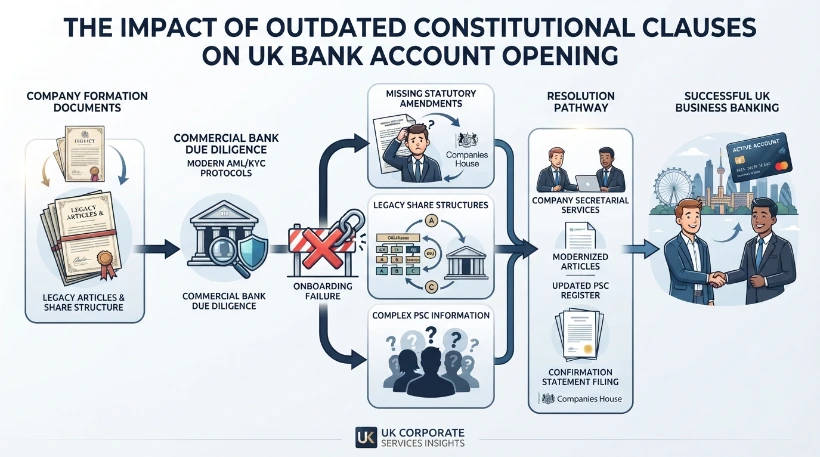
Banking compliance teams operate under stringent legislative controls. When legacy documents list defunct share classes or incorrect shareholder names, automated verification systems flag the entity for manual review. Manual reviews often result in prolonged onboarding delays or outright application denials.
Corporate entities frequently neglect updating internal rules following equity reorganizations. Banks demand absolute alignment between the Public Register and internal corporate governance. Discrepancies between Companies House filings and constitutional texts create immediate legal friction.
Resolving these discrepancies requires filing formal updates swiftly. Businesses can reference the guide on Can You Change Your Company’s Articles of Association? to understand the procedural requirements for amending constitutional rules.
What Steps Keep Corporate Rules Aligned With Lenders?
Maintaining alignment with institutional lenders requires auditing share registries annually, recording board resolutions accurately, and updating constitutional amendments immediately through official channels.
Corporate secretaries must execute regular internal reviews of governance documents. Systematic audits catch structural errors before submission to financial institutions.
Audit share registries annually to confirm accurate equity distribution
Record board resolutions promptly after every structural modification
File constitutional amendments with regulatory authorities immediately
Review borrowing powers before applying for commercial credit facilities
Executing these actions consistently eliminates administrative bottlenecks during bank onboarding. Form My Company assists directors in maintaining compliant governance frameworks. Order Your Articles of Association Today From Form My Company to secure professional document preparation tailored for UK banking standards.
Explore our Supplementary Company Documents guide,
How to Present Your Articles of Association to a Bank or Investor
Model vs Bespoke Articles of Association: Which Should You Use?
Frequently Asked Questions
Can I update my Articles of Association after my company is incorporated?
Yes, registered companies can alter their constitutional rules by passing a special resolution with a 75% shareholder majority. Form My Company provides professional Supplementary Company Documents to ensure these amendments comply with UK corporate law standards.
Why do banks require updated Articles of Association for business accounts?
UK commercial banks review constitutional documents to verify authorized share classes, confirm voting thresholds, and validate legal ownership structures. Maintaining clean corporate records prevents compliance blocks and accelerates financial application approvals.
How often should a UK company review its constitutional documents?
Companies should review their internal governance rules annually or immediately following any significant equity restructure, share transfer, or director appointment. Regular audits ensure corporate records align perfectly with filings held at Companies House.
What information must be included in a bank-ready corporate constitution?
A bank-ready constitution must explicitly detail share transfer restrictions, precise director quorum rules, and clear limitations on corporate borrowing powers. Financial institutions look for these explicit provisions to satisfy strict anti-money laundering and know-your-customer protocols.
What happens if my company articles do not match our Companies House filings?
Discrepancies between internal governance rules and public registry filings trigger compliance failures during bank onboarding and commercial credit checks. Resolving these mismatches requires filing formal updates and ensuring constitutional alignment across all corporate documents.