
GDPR rules for recruitment and interviews require UK employers to process candidate personal data lawfully, transparently, and securely. Organizations must collect only necessary information, obtain explicit consent when required, provide comprehensive privacy notices, and delete candidate records safely after completing the hiring evaluation process.
Why does GDPR apply to candidate interviews?
GDPR applies to candidate interviews because job applications involve processing sensitive personal data like CVs, identity documents, and assessment notes. UK employers must protect applicant privacy rights, maintain lawful processing grounds, and ensure strict data protection compliance throughout every recruitment stage.
Data protection laws govern every interaction between employers and job applicants. When a candidate submits an application or attends a meeting, the organization becomes a data controller. This legal status imposes strict responsibilities regarding how information is collected, stored, and shared.
Organizations process various applicant data points. Three common examples include contact details, employment history records, and professional references. Collecting this information requires a valid legal basis under data protection legislation.
Employers often rely on legitimate interests or contractual necessity as legal grounds. Legitimate interests cover standard recruitment evaluations. Contractual necessity applies when processing data to take steps at the request of the individual prior to entering into a contract.
Transparency remains a core requirement during recruitment interactions. Organizations must inform candidates about data collection practices before interviews occur. Privacy notices should explain what data gets gathered and how long records remain active.
Data minimization principles dictate that hiring managers collect only relevant information. Asking for excessive personal details unrelated to job performance violates compliance mandates. Employers must restrict data collection to professional qualifications and work eligibility credentials.
Security measures must protect physical and digital interview records. Unauthorized staff cannot access candidate evaluation notes or assessment scores. Proper access controls prevent data breaches during the hiring cycle.
What candidate data can employers legally collect?
Employers can legally collect data strictly necessary for assessing job suitability, verifying professional qualifications, and checking legal working eligibility. Permissible data types include work history records, professional certifications, and identity verification documents required for employment screening.
Information gathering must align strictly with job requirements. Hiring teams evaluate candidates based on objective professional criteria. Unnecessary data collection creates compliance liabilities and privacy risks.
Specific documentation standards apply to standard hiring workflows. Three essential validation items include passport checks, right-to-work verification documents, and professional reference contacts. These documents prove legal employment eligibility and candidate authenticity.
Special category data requires heightened legal protection under data protection frameworks. This category includes racial origin, religious beliefs, and biometric data. Collecting special category data during interviews is generally prohibited unless specific statutory exceptions apply.
Criminal record checks demand careful legal justification. Employers cannot request criminal history details unless statutory regulations mandate disclosure for specific roles. Standard background checks require explicit legal authorization and documented candidate consent.
Notes taken during interviews constitute personal data under regulatory frameworks. Candidates possess the legal right to request access to their interview feedback notes. Interviewers must write objective, job-related comments free from subjective bias or discriminatory remarks.
Retaining candidate information requires defined retention schedules. Unsuccessful applicant records cannot remain in corporate databases indefinitely. Clear timelines govern when data deletion or anonymization must occur.
How long can companies keep interview records?
Companies can keep unsuccessful interview records for a maximum period of six months to defend against potential employment tribunal claims. Organizations retain successful candidate records within employee files for the duration of employment plus statutory post-termination retention periods.
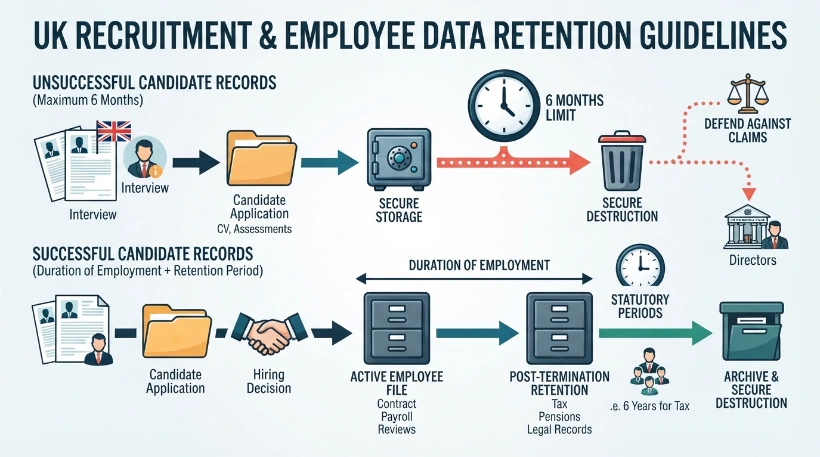
Retention schedules prevent indefinite data hoarding and ensure compliance with limitation periods. UK employment law sets specific timeframes for bringing discrimination claims. Retaining records for six months covers standard tribunal filing windows.
Data retention policies must specify exact destruction timelines for different record types. Three standard retention durations include six months for rejected applications, seven years for payroll tax records, and one year for talent pool profiles. Talent pools require active candidate consent for extended retention.
Secure disposal mechanisms protect privacy after retention periods expire. Digital files undergo permanent deletion from recruitment management systems. Physical documents containing personal data require secure shredding services.
Candidates hold the right to request immediate data erasure before retention periods expire. Employers must honor deletion requests unless legal obligations require continued data storage. Statutory exceptions include ongoing tax audits or active legal disputes.
Audit trails help compliance officers monitor data lifecycle management. Regular reviews identify expired records within recruitment software platforms. Automated deletion protocols reduce human error and ensure timely data purging.
What rights do job applicants have under GDPR?
Job applicants possess comprehensive rights to access, rectify, erase, and restrict the processing of their personal data. Candidates can submit formal subject access requests to inspect interview notes, review evaluation scores, and verify lawful data handling practices.
Individual rights empower candidates to control their personal information during recruitment cycles. Organizations must establish clear procedures for handling data subject requests within statutory deadlines.
Key rights available to job applicants include specific legal safeguards. Three primary candidate entitlements involve accessing interview feedback notes, correcting inaccurate CV details, and requesting complete data deletion. These mechanisms ensure accountability across hiring operations.
Subject access requests require prompt corporate responses. Organizations must fulfill data access requests within one calendar month of receipt. Providing complete copies of interview notes satisfies transparency mandates.
Rectification rights allow candidates to update incorrect information. If an applicant notices an error in reference checks or application forms, employers must correct the data immediately.
Restriction of processing applies when accuracy disputes arise. While employers verify disputed information, data usage pauses temporarily. This safeguard prevents the dissemination of incorrect evaluation metrics.
Where should compliant interviews take place?
Compliant interviews should take place in secure, private professional environments that protect candidate confidentiality and data security. Organizations book external meeting spaces when internal offices lack adequate acoustic privacy or secure visitor registration protocols.
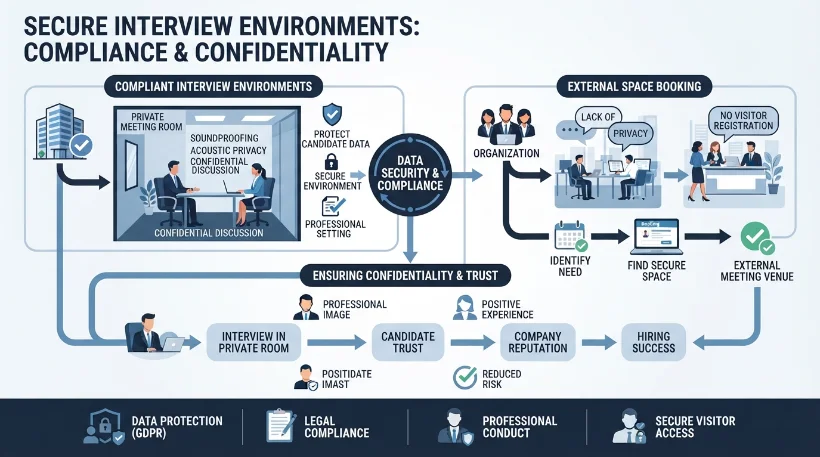
Physical security directly impacts regulatory compliance during face-to-face meetings. Interview environments must prevent unauthorized eavesdropping and protect physical documents from public view.
Professional meeting spaces offer essential security features for recruitment events. Three key facility standards include soundproof acoustic walls, secure digital visitor check-ins, and locked document storage. These measures safeguard confidential applicant discussions.
Form My Company provides specialized interview rooms designed for secure candidate evaluations. These professional environments ensure complete confidentiality for sensitive hiring discussions.
Hosting interviews in controlled spaces prevents data breaches involving physical documents. Leaving printed CVs unattended in open areas violates privacy regulations. Dedicated interview venues maintain strict access control protocols for all attendees.
External facility bookings streamline compliance for growing businesses. Organizations lacking permanent office infrastructure rely on managed workspaces to maintain professional recruitment standards.
How does Form My Company support recruitment compliance?
Form My Company supports recruitment compliance by offering secure interview rooms that protect candidate privacy and confidentiality. Businesses book Book GDPR-Compliant Interview Rooms With Form My Company to conduct professional hiring evaluations without data security risks.
Navigating recruitment regulations requires reliable physical infrastructure. Organizations must ensure that evaluation spaces maintain strict privacy standards. Using professional facilities eliminates compliance vulnerabilities associated with improvised meeting locations.
Managed workspace providers deliver targeted solutions for hiring managers. Three core facility benefits include private acoustic meeting spaces, secure visitor management logging, and professional corporate environments. These features support legal compliance during face-to-face interactions.
Securing appropriate spaces enhances the candidate experience while maintaining data protection standards. Applicants feel valued when meetings occur in professional, private settings. Transparent visitor registration logs demonstrate corporate accountability.
Operational efficiency improves when businesses utilize dedicated booking services. Administrative teams secure compliant spaces quickly without managing long-term commercial leases.
GDPR compliance during recruitment requires strict adherence to data minimization, lawful processing grounds, and secure record retention. Organizations must protect candidate privacy rights at every stage of the hiring lifecycle. Form My Company simplifies physical compliance challenges by providing secure, private spaces. Businesses utilize Interview Rooms to conduct lawful, confidential, and professional candidate evaluations.
Explore our Interview Rooms guide,
What Are the Legal Accessibility Duties for UK Event Hosts?
How Do You Plan an Inclusive Meeting for a Diverse Team?
Frequently Asked Questions
Are employers allowed to keep interview notes under GDPR?
Employers can legally retain interview notes for a limited period, typically six months, to defend against potential employment tribunal claims. Form My Company provides professional interview rooms that help businesses maintain organized and secure recruitment documentation protocols.
What candidate data is restricted during a job interview?
Interviewers must avoid collecting special category data like racial origin, religious beliefs, or health details unless specific statutory exceptions apply. When hiring managers book Interview Rooms through Form My Company, they ensure candidate evaluations remain focused strictly on professional qualifications and job suitability.
Do candidates have the right to see their interview feedback notes?
Job applicants possess the legal right to submit a subject access request to inspect their interview notes and evaluation scores. Organizations utilizing Form My Company workspace solutions can easily manage candidate privacy requests by keeping accurate and objective hiring records.
How long should unsuccessful candidate CVs be stored?
Unsuccessful candidate CVs and application records should generally be deleted or anonymized after six months unless explicit consent for a talent pool is obtained. Form My Company assists growing businesses by offering flexible Interview Rooms that streamline professional recruitment workflows without data clutter.
Why do companies need private spaces for candidate interviews?
Private interview spaces protect candidate confidentiality and prevent data breaches involving physical documents or overheard conversations. Utilizing dedicated Interview Rooms via Form My Company ensures that hiring organizations maintain compliance with strict UK data protection standards.