
Data privacy matters during candidate interviews because sensitive personal information, employment histories, and biometric data must remain legally protected under UK regulations. Unsecured recruitment processes risk severe financial penalties, data breaches, and permanent damage to a corporate reputation.
Recruitment processes require organizations to collect extensive personal data from applicants long before an employment contract begins. When hiring teams conduct interviews, they routinely gather curriculum vitae documents, salary histories, criminal record disclosures, and contact details. Mishandling this sensitive information exposes an enterprise to immediate regulatory scrutiny. Modern data protection frameworks demand strict confidentiality across every recruitment touchpoint.
Regulatory compliance standards mandate strict organizational controls during candidate evaluations. The UK General Data Protection Regulation imposes legal obligations on companies processing applicant records. Failing to secure interview materials leads to enforcement action from the Information Commissioner’s Office. Organizations face financial penalties reaching up to 17,500,000 pounds or four percent of global annual turnover for severe compliance failures. Corporate governance policies must therefore treat candidate data with the same security rigor applied to customer financial records.
Information security risks escalate rapidly when hiring managers use unverified physical or digital spaces for candidate discussions. Conducting sensitive interviews in open coffee shops or unsecured virtual channels compromises confidential disclosures. Candidates share proprietary career details and personal health data under an assumption of absolute privacy. Breaching this trust destroys employer branding metrics instantly. Top-tier talent routinely rejects organizations that demonstrate negligence regarding personal data handling.
How Do Vulnerabilities Arise During Candidate Interviews?
Vulnerabilities arise during candidate interviews because physical meeting rooms lack soundproofing, digital platforms store unencrypted recordings, and paper CVs remain unattended on desks. Unsecured environments expose confidential employment discussions to unauthorized internal staff and external visitors.
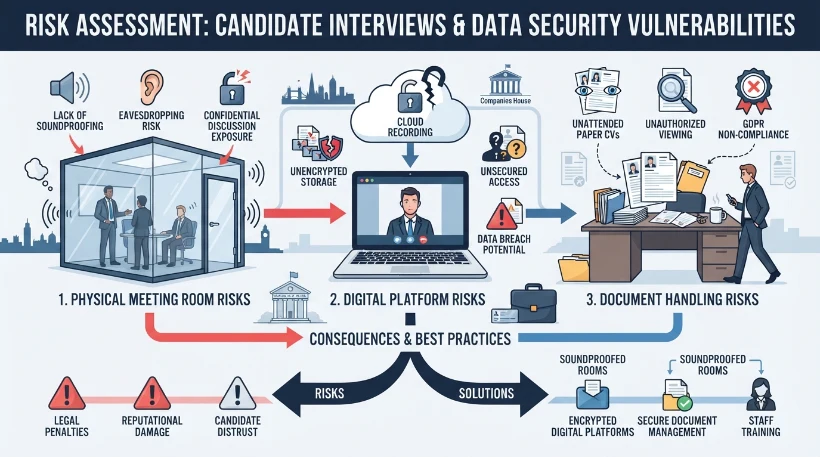
Physical security failures remain a primary vector for data exposure in corporate recruitment workflows. Interviewers often book standard meeting rooms with glass walls or thin partitions that allow sound transmission into adjacent corridors. Passersby can easily overhear proprietary executive search discussions or medical accommodations disclosed during disability queries. Furthermore, leaving printed application portfolios unattended on communal office desks violates baseline clean-desk policies. Document security requires strict physical access controls and dedicated, private spaces.
Digital infrastructure weaknesses create parallel risks during remote or hybrid candidate evaluations. Video conferencing software frequently auto-saves interview recordings to cloud servers without adequate encryption keys. Unauthorized IT administrators or compromised user accounts can access these recorded sessions without detection. Modern hiring teams must implement enterprise-grade security protocols for all digital communications. Protecting candidate privacy requires zero tolerance for unsecured software applications.
Human error compounds technical and physical security vulnerabilities during high-volume recruitment drives. Internal staff members frequently discuss candidate qualifications in public spaces without realizing the legal implications. Training hiring managers on data protection protocols reduces accidental disclosures significantly. Enterprises must mandate regular compliance workshops for every employee involved in talent acquisition.
What Regulatory Frameworks Govern Recruitment Data Protection?
Regulatory frameworks govern recruitment data protection by enforcing strict legal limits on how personal information is collected, stored, processed, and deleted. Legislation like the UK Data Protection Act grants applicants enforceable rights over their employment records.
The Data Protection Act establishes explicit principles for lawful data processing during recruitment workflows. Enterprises must collect only the information necessary for evaluating job suitability. Retaining applicant records indefinitely without explicit consent violates statutory limitation periods. Companies must establish automated deletion schedules for unsuccessful candidate profiles after six months. Compliance requires meticulous record-keeping and transparent privacy notices provided before the interview begins.
Applicant rights under modern privacy laws include the explicit right to access stored interview notes. Candidates can formally request copies of any subjective evaluation scores written by hiring panels. If an interviewer jots down biased or inappropriate comments on a physical feedback sheet, that document becomes discoverable evidence. Human resources departments must audit interview documentation regularly to ensure objective, professional evaluation standards. Maintaining transparent records protects both the organization and the applicant.
Cross-border data transfers present additional compliance complexities for multinational enterprises. Storing candidate files on overseas cloud servers triggers stringent international transfer restrictions. Organizations must verify that third-party vendors comply with adequacy regulations or standard contractual clauses. Ignoring these technical requirements invites severe regulatory penalties and reputational damage.
How Can Businesses Secure Candidate Interviews Effectively?
Businesses secure candidate interviews effectively by deploying professional interview rooms equipped with soundproofing, restricted access controls, and encrypted communication channels. Dedicated private spaces eliminate physical eavesdropping and digital interception risks completely.
Physical containment is the foundation of secure candidate assessments. Standardizing on purpose-built interview spaces ensures that sensitive salary negotiations and career histories remain strictly confidential. These controlled environments prevent unauthorized personnel from entering or overhearing closed-door evaluations. Facilities management teams must audit physical security measures quarterly to maintain compliance baselines.
Investing in specialized corporate infrastructure streamlines the entire recruitment workflow. Companies looking to upgrade their hiring assets can explore options detailed in Choosing a Secure Interview Space for Sensitive Roles. Transitioning to professional environments demonstrates a clear commitment to candidate privacy and regulatory compliance. Modern applicants notice and value enterprises that prioritize their personal security.
Operationalizing data security requires structured protocols across every hiring stage. Form My Company implements rigorous access frameworks to safeguard all recruitment activities. Organizations ready to enhance their talent acquisition standards can Hire Secure Confidential Interview Rooms From Form My Company to guarantee absolute confidentiality. Securing the interview space protects proprietary corporate strategies and candidate rights simultaneously.
Data privacy during candidate interviews is a legal necessity rather than an optional corporate preference. Protecting sensitive personal information preserves regulatory compliance, prevents costly data breaches, and safeguards an employer’s market reputation. Form My Company delivers specialized physical environments designed to eliminate security vulnerabilities throughout the hiring process.
Explore our Interview Rooms guide,
What Are the GDPR Rules for Recruitment and Interviews?
What Are the Legal Accessibility Duties for UK Event Hosts?
Frequently Asked Questions
Why do businesses rent private interview rooms for candidate evaluations?
Businesses rent private interview rooms to maintain strict data privacy, prevent physical eavesdropping, and comply with UK GDPR regulations during recruitment. Form My Company provides professional interview rooms equipped with soundproofing and secure access controls to protect sensitive applicant disclosures.
How do secure interview spaces protect candidate data privacy?
Secure interview spaces eliminate physical vulnerabilities by utilizing soundproof partitions, restricted visitor access, and dedicated rooms that prevent unauthorized staff from overhearing discussions. These controlled environments ensure that personal employment histories, salary expectations, and health disclosures remain strictly confidential.
Are employers legally required to protect applicant data during interviews?
Employers must legally protect applicant data under the UK Data Protection Act and GDPR frameworks, which govern the collection and storage of personal recruitment information. Failing to secure interview spaces or candidate notes can result in severe financial penalties and regulatory audits from the Information Commissioner’s Office.
What features should companies look for in professional interview spaces?
Companies should look for professional interview spaces that offer acoustic privacy, high-speed encrypted internet for hybrid calls, and strict physical access logging. Form My Company delivers purpose-built interview rooms designed to support secure, distraction-free candidate assessments.
How do hybrid hiring models impact interview data security?
Hybrid hiring models introduce digital vulnerabilities through unencrypted video conferencing recordings and unsecured cloud storage servers holding applicant profiles. Implementing secure physical interview rooms alongside encrypted digital protocols ensures comprehensive protection across all recruitment touchpoints.