
Choosing a professional company stamp requires selecting the correct impression type, matching the exact company details to official registration documents, opting for self-inking mechanisms for clarity, and picking a durable layout that fits official UK corporate documents.
What Types of Company Stamps Are Available for UK Businesses?
UK businesses use three main stamp types: traditional rubber stamps requiring separate ink pads, self-inking stamps with internal ink reservoirs, and pre-inked stamps producing high-resolution impressions.
Traditional rubber stamps need separate ink pads. These units cost less initially. They require physical storage for the separate ink pad.
Self-inking stamps contain an internal mechanism. When you press down, the rubber die rotates and hits an internal ink pad. This design accelerates stamping speed for high-volume document execution.
Pre-inked stamps use oil-based ink stored directly inside the stamp die. These units produce fine lines and sharp corporate seals. They eliminate moving parts inside the frame.
Selecting the right device depends on daily usage volume and document types. High-volume offices choose self-inking models for speed. Executive offices select pre-inked models for superior impression quality.
What Information Must Be Included on a Professional Stamp?
A professional company stamp must display the official registered company name, the exact company registration number, and the registered office jurisdiction location.
UK corporate regulations dictate precise details for official stationery and impressions. Including accurate details prevents legal disputes over document validity.
| Element Required | Specification Details | Regulatory Purpose |
| Company Name | Exact registered name | Establishes legal entity identity |
| Company Number | 8-character alphanumeric code | Links document to Companies House records |
| Jurisdiction | England, Wales, Scotland, or NI | Defines governing corporate legislation |
When directors sign physical contracts, stamping the document adds an extra layer of authentication. Maintaining accurate corporate data on stamps aligns with proper statutory recordkeeping. Correct corporate maintenance often overlaps with managing your official PSC Register to ensure transparent ownership tracking.
How Do You Select the Right Size and Shape for Your Stamp?
Selecting the correct stamp size involves balancing text length with document space, choosing rectangular layouts for address blocks, and utilizing round formats for formal corporate seals.
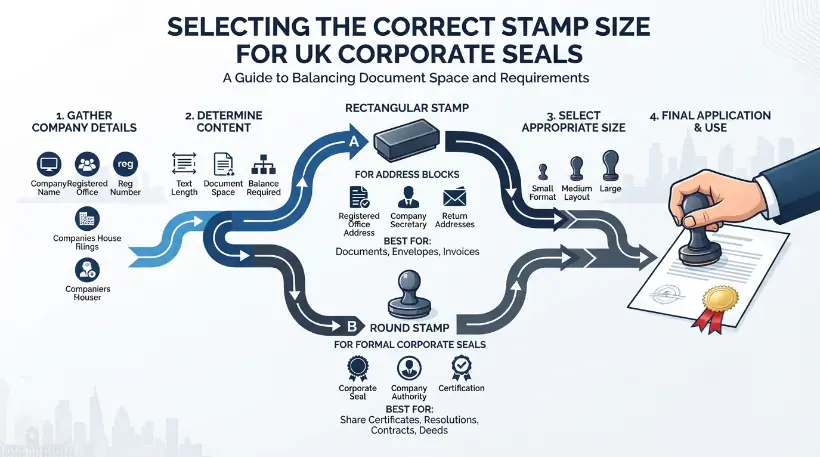
Rectangular stamps accommodate long company names and registration numbers across multiple lines. Standard dimensions measure 40 millimeters by 15 millimeters for basic details. Larger rectangular formats measure 60 millimeters by 30 millimeters to include registered office addresses.
Round stamps project a traditional corporate seal appearance. Diameters typically range between 38 millimeters and 45 millimeters. These circular designs fit neatly beside handwritten signatures on certificates.
Pocket-sized stamps measure under 50 millimeters in total length. Mobile consultants utilize these compact units during client meetings. Desktop models offer heavier frames for daily office use.
Which Ink Colors and Types Suit Corporate Documents?
Corporate documents require black or dark blue quick-drying oil-based inks that resist smudging, photocopying distortion, and chemical alteration.
Black ink dominates official UK corporate paperwork. Black impressions scan clearly into digital archives and photocopiers. Dark blue ink provides a traditional signature contrast on paper contracts.
Oil-based inks penetrate paper fibers instantly. Water-based inks smudge when exposed to moisture on paper. Pigment-based inks prevent document tampering because chemical solvents cannot easily lift the dried ink.
Refilling mechanisms require matching ink formulations. Mixing different ink types damages the internal rubber die permanently. Manufacturers specify compatible refill bottles for every stamp model.
How Does a Stamp Integrate with Corporate Compliance and Governance?
Company stamps integrate with governance by authenticating share certificates, validating physical contracts, and marking official board resolutions securely.
Corporate governance requires verifiable proof of document execution. While UK law does not mandate physical stamps for all transactions, banks and foreign authorities frequently demand stamped documentation.
Validating share certificates requires a clear corporate impression next to director signatures. Marking physical agreements with a company stamp deters unauthorized alterations.
Maintaining accurate governance records extends beyond physical stamping. Form My Company provides comprehensive business infrastructure tools, ensuring your business stays fully compliant. Proper document authentication supports seamless operational workflows across all departments.
Explore our Company Pack guide,
PSC Change Notifications: How to Meet the 14-Day Deadline?
When to Choose Certified Copies Over Standard Printouts?
Frequently Asked Questions
What is included in a standard company pack from Form My Company?
A standard company pack from Form My Company typically contains physical or digital copies of essential incorporation documents, including the certificate of incorporation, memorandum and articles of association, and share certificates. These compiled records provide newly incorporated businesses with immediate access to their statutory documentation.
Why do UK businesses need a corporate company pack?
UK businesses need a corporate company pack to streamline administrative setups, open business bank accounts, and maintain proper statutory compliance. Financial institutions and legal entities regularly request these verified constitutional documents to authenticate corporate identity.
How long does it take to receive a company pack?
Digital company packs are usually delivered via email within hours of successful company incorporation through Form My Company. Physical presentation packs containing bound documentation typically arrive within 2 to 3 business days via standard courier services.
Can I update my company pack if my registered office changes?
You must update your company records with Companies House whenever your registered office address changes. Form My Company assists businesses in generating updated constitutional documents and revised corporate stationery reflecting current registration details.
What is the difference between a digital and a printed company pack?
Digital company packs provide instant PDF downloads of statutory registers and certificates suitable for fast electronic verification. Printed company packs feature professionally bound, high-quality physical copies designed for boardrooms, auditing reviews, and formal presentations.