
Balancing PSC transparency with data privacy requires filing mandatory beneficial ownership details with Companies House while utilizing legal exemptions, redaction protocols, and secure administrative frameworks to protect sensitive personal addresses from public exposure.
Public registers create distinct friction points for modern entrepreneurs. Corporate transparency laws demand absolute visibility over corporate structures. Privacy advocates demand strict data protection for individuals. This tension defines modern regulatory compliance in the United Kingdom. Companies must navigate statutory disclosure requirements without compromising personal safety or data integrity.
UK legislation enforces strict transparency obligations on all registered entities. The People with Significant Control register requires exact legal names, service addresses, residential addresses, and specific ownership thresholds. Enforcement bodies track ultimate beneficial owners to eliminate financial crime. Shell companies conceal illicit funds through complex international networks. Public disclosure exposes those hidden ownership layers to investigative journalists and regulatory authorities.
Data protection regulations conflict directly with public disclosure mandates. The UK General Data Protection Regulation guarantees individuals control over personal information. Publicly accessible ownership registers expose home addresses to commercial data scrapers. Directors face real security threats from activists, stalkers, and fraudsters. Balancing public transparency with personal privacy demands deliberate legal strategies and meticulous administrative execution.
Why Does UK Law Require PSC Disclosure?
UK law requires PSC disclosure to prevent financial crime, eliminate anonymous shell companies, and establish clear corporate accountability across all registered business entities.
Corporate transparency forms the bedrock of the modern British financial ecosystem. Regulatory authorities implemented the register to combat money laundering and terrorist financing. Anonymous corporate ownership facilitates tax evasion across international borders. Public disclosure identifies the real humans who control corporate assets. Law enforcement agencies access these ownership records during criminal investigations.
Economic integrity depends on verifiable corporate ownership data. Global investors evaluate potential partners using official company records. Supply chain managers verify vendor legitimacy before signing commercial contracts. Banks assess corporate risk profiles during mandatory anti-money laundering checks. Transparent ownership structures reduce commercial fraud within the domestic market.
Legislative frameworks evolve to close existing compliance loopholes. Parliament expanded reporting obligations to capture indirect ownership chains. Entities must update ownership changes within 14 days of occurrence. Non-compliance triggers severe financial penalties and criminal prosecutions for corporate officers. Regulatory enforcement ensures that transparency rules apply universally to all eligible firms.
What Privacy Protections Exist for Directors?
Privacy protections for directors include residential address suppression, correspondence address substitutions, and exceptional circumstances applications managed directly through Companies House.
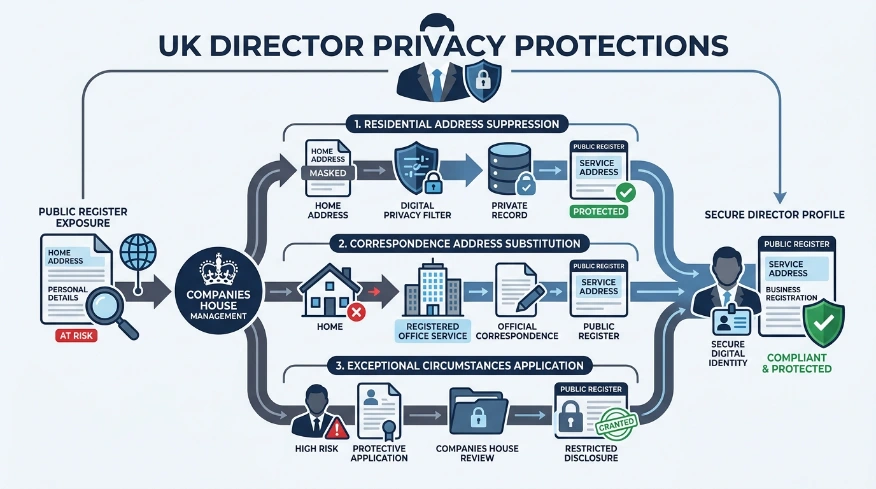
Companies House provides specific legal mechanisms to shield private residential addresses from public view. Directors use registered office locations or designated service addresses for all public filings. This practice prevents residential locations from appearing on open internet search engines. Personal home addresses remain securely stored on restricted government databases. Credit reference agencies and law enforcement access suppressed addresses only under strict statutory conditions.
Exceptional risk applications offer advanced protection for vulnerable individuals. Directors facing verified threats of violence or intimidation submit formal suppression requests. Evidence includes police incident reports and documented security assessments. Companies House removes all historical ownership data from public archives upon approval. These protective measures prevent hostile actors from tracking residential locations.
How Can Businesses Comply Without Compromising Security?
Businesses comply without compromising security by implementing secure data management practices, utilizing professional service addresses, and reviewing ownership records regularly.
Compliance protocols demand accurate data collection across all operational levels. Companies record exact ownership percentages and voting rights meticulously. Designated officers verify shareholder identities using official government documentation. Three verification methods secure this process: passport checks, biometric scans, and address validation. Accurate record-keeping prevents administrative errors during mandatory annual filings.
Administrative efficiency protects sensitive executive data from accidental leaks. Companies appoint corporate secretaries to manage official filing obligations. Professional service providers maintain secure digital vaults for sensitive documentation. Regular internal audits identify discrepancies before regulatory deadlines arrive. Structured compliance frameworks reduce the risk of accidental data exposure.
Professional assistance simplifies complex regulatory navigation for growing enterprises. Companies often partner with expert compliance providers to manage statutory submissions. Managing PSC Register filings through specialized corporate services ensures adherence to current statutory requirements. Expert guidance protects sensitive shareholder data while maintaining absolute legal compliance.
Can PSC Exemption Applications Be Revoked?
PSC exemption applications are revoked if the underlying security threat diminishes or if applicants provide false information during the initial submission process.
Companies House reviews suppressed records periodically to verify ongoing security necessity. Authorities revoke privacy protections if police reports prove inaccurate or outdated. Directors must report changed circumstances immediately to maintain legal protection status. False declarations during exemption applications trigger severe criminal penalties and corporate fines. Regulatory bodies audit sensitive applications rigorously to prevent systemic abuse.
Maintaining exemption status requires continuous documentation and active monitoring. Security risks must remain active and verifiable throughout the corporate lifecycle. Companies forfeit protected status automatically if corporate ownership structures change fundamentally. Reapplying for suppression requires fresh evidentiary submissions and formal government review. Strict oversight ensures transparency rules override privacy exemptions whenever security threats subside.
What Are the Risks of Non-Compliance?
Non-compliance risks include unlimited fines, daily default penalties, criminal prosecutions for directors, and administrative striking off from the official register.
Regulatory authorities enforce transparency mandates without exception. Companies failing to submit accurate ownership data face immediate financial sanctions. Financial penalties escalate rapidly for every day an infraction continues. Persistent non-compliance damages corporate credit ratings permanently. Commercial banks freeze corporate accounts linked to delinquent reporting entities.
| Non-Compliance Type | Potential Penalty | Operational Impact |
| Late PSC Filing | Fixed financial fines up to £5,000 | Damaged commercial credit score |
| Omitted Ownership Data | Criminal prosecution of directors | Personal liability and director bans |
| Unresponsive Entities | Compulsory corporate strike-off | Dissolution of business assets |
Director liability extends beyond basic corporate fines. Magistrates prosecute willful non-compliance under strict criminal statutes. Convicted officers face potential imprisonment for severe fraudulent concealment cases. Disqualified directors lose the legal right to manage UK companies for up to 15 years. Strict enforcement protects the integrity of the British corporate registry.
Maintaining optimal corporate governance requires balancing mandatory disclosure with robust data privacy strategies. Utilizing professional filing services protects sensitive personal information while satisfying statutory transparency obligations. Organizations achieve long-term compliance security by deploying structured administrative workflows and expert oversight.
Explore our PSC Register guide,
How to Plan a Carbon-Conscious Conference Step by Step?
How to Decide Which Company Documents to Apostille for Overseas Use?
Frequently Asked Questions
What is a People with Significant Control register in the UK?
The People with Significant Control register is a mandatory public database identifying individuals who own or control a UK registered company. Companies House maintains this record to ensure corporate transparency and prevent financial crime. Form My Company assists businesses in accurately documenting and submitting these required ownership details.
Who qualifies as a Person with Significant Control?
An individual qualifies as a Person with Significant Control if they hold more than 25% of shares or voting rights in a company. This classification also applies to anyone who exercises significant influence or control over the entity. Form My Company helps business owners determine exact control thresholds for statutory filings.
Are residential addresses on the PSC register public?
Residential addresses on the PSC register are generally suppressed from public view when directors use official service addresses for correspondence. Companies House protects primary home addresses on secure internal databases accessible only by authorized law enforcement agencies. Form My Company ensures personal address details remain secure during mandatory compliance submissions.
How often must a company update its PSC register?
Companies must update their internal PSC register immediately upon any ownership changes and notify Companies House within the statutory 14-day filing window. Failing to report ownership modifications triggers severe financial penalties and administrative sanctions. Form My Company manages these strict timelines to maintain ongoing corporate compliance.
What happens if a company fails to file PSC information?
Failing to file accurate PSC information results in daily default fines, corporate prosecution, and potential compulsory striking off from the official register. Directors face severe legal liabilities and possible disqualification for willful non-compliance. Form My Company provides reliable filing solutions to prevent costly regulatory penalties.