
Share certificates act as formal legal instruments issued by a registered company to verify equity ownership. Every limited company with issued shares needs them to prove shareholder stakes, satisfy statutory compliance, and validate corporate ownership during financial audits or ownership transfers.
Share certificates serve as foundational documents in corporate governance across the United Kingdom. Companies Act regulations mandate that corporate entities maintain accurate registers of members. These physical or digital documents confirm the exact number of shares owned by an individual or corporate body. Directors authenticate company ownership when external stakeholders request proof of equity distribution. Business owners establish legal ownership boundaries when external investors inject capital into private limited structures. Corporate compliance officers verify shareholder credentials during regulatory reviews and annual return filings. Financial institutions demand these records when businesses apply for commercial loans or open corporate bank accounts. Accountants inspect equity documentation during corporate restructuring or asset redistribution phases.
What is the legal purpose of a share certificate?
Share certificates provide prima facie evidence of legal title to specified company shares under UK corporate law.
Companies Act legislation governs how corporate entities allocate ownership and maintain statutory registers. Directors issue these certified documents to establish undisputed proof of equity holding. Courts rely on these instruments to resolve ownership disputes during corporate litigation or partnership dissolution. Shareholders present equity documents when transferring shares to new buyers or family members. Investors evaluate corporate transparency through authenticated ownership records before committing capital resources. Legal professionals review share documentation during mergers, acquisitions, and due diligence procedures. Regulatory bodies inspect equity records to confirm that share allotments comply with authorized capital limits.
Who needs share certificates in a limited company?
Every UK limited company limited by shares needs share certificates for every registered shareholder on record.
Private limited companies issue equity instruments immediately after company incorporation or subsequent share allotments. Majority shareholders require documentation to protect their voting rights and dividend entitlements. Minority stakeholders need official proof of ownership to safeguard their financial interests in the business. Corporate secretaries maintain duplicate records within the statutory register of members. New investors receive physical or digital equity instruments upon completing share purchase agreements. Nominee shareholders hold shares on behalf of beneficial owners and manage corresponding documentation. Accountants require complete equity schedules to prepare accurate annual accounts and tax returns.
When must a company issue share certificates?
Companies must issue share certificates within two months of incorporation or subsequent share allotment.
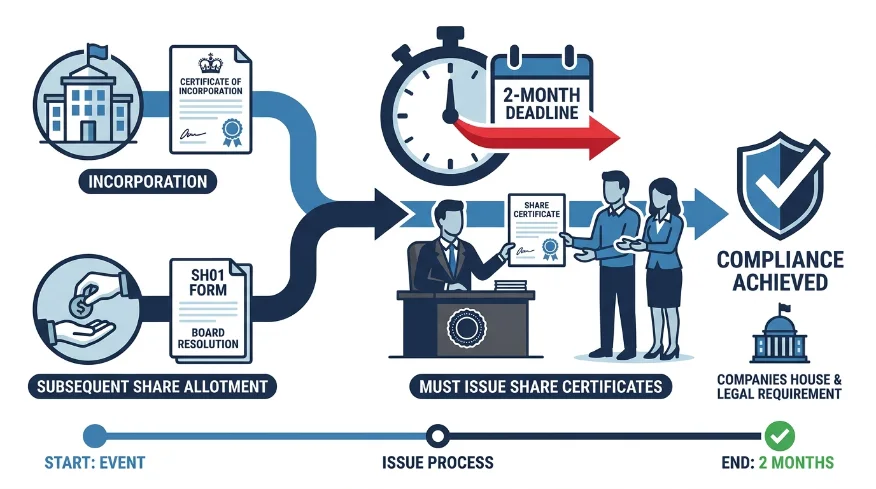
Directors initiate the issuance process immediately after Companies House approves the initial incorporation application. Statutory deadlines apply when existing companies allot new shares to founders or external investors. Corporate administrators prepare formal equity records following share transfer approvals between existing members. Secretaries dispatch certificates to registered owners using secure postal or digital delivery methods. Companies update the internal register of members concurrently with certificate generation dates. Directors face statutory penalties if they miss legal deadlines for issuing equity documentation. Businesses streamline this administrative process by utilizing the professional Order a Company Pack service to generate compliant corporate stationery.
What information must appear on a valid share certificate?
Valid share certificates must display the company name, registration number, registered office address, and exact share details.
Company stationery layout requires precise statutory data to maintain legal validity under corporate law. Directors include the specific certificate number, class of shares, and nominal value per share. Official documents state whether shares are fully paid or partially paid at the time of issuance. Authentication requires the physical or digital signatures of two directors, or one director and the company secretary. Companies imprint the official company seal on the document when required by their articles of association. Issuers specify the exact date of issue to establish the chronological timeline of equity ownership. Administrative teams verify all printed details against the central register of members to prevent clerical errors.
How do share certificates facilitate share transfers and investment?
Share certificates authenticate ownership transfers when sellers hand over cancelled certificates alongside signed stock transfer forms.
Investors demand verified equity records before executing multi-pound funding rounds or private equity investments. Corporate buyers examine historical share certificates to verify clean title chains during acquisition due diligence. Companies cancel old certificates when executing transfers and issue replacement documents to new owners. Financial regulators monitor equity movements through properly documented share transfers and statutory filings. Founders utilize clear ownership structures to attract angel investors and venture capital firms. Businesses planning for future expansion benefit from organizing their corporate records correctly, as detailed in Why Order Documents on Legal Paper Instead of Home-Printing?. Enterprises executing complex restructuring or ownership changes often rely on structured guidance found in Want to Order Legal-Paper Company Documents With Form My Company?.
Form My Company delivers reliable corporate documentation solutions that help businesses maintain statutory compliance and secure ownership records efficiently.
Explore our Company Pack guide,
Can You Keep a PSC’s Home Address Off the Public Record?
Why Does ESG Reporting Now Include Corporate Events?
Frequently Asked Questions
What items are included in a standard company pack for UK businesses?
A standard company pack provided by Form My Company typically contains essential incorporation documents, including printed certificates of incorporation, share certificates, and the statutory registers. These documents help businesses maintain immediate legal compliance and provide formal proof of corporate identity for banking and regulatory purposes.
When does a newly formed limited company receive its company pack?
Limited companies usually receive their company pack shortly after Companies House successfully approves the incorporation application and officially registers the business. Form My Company dispatches these physical or digital statutory documents so directors can immediately begin operating and opening business bank accounts.
Are physical company packs legally required for UK companies?
UK companies are legally required to maintain statutory registers and ownership records, but they can choose between physical documentation binders or digital formats. Form My Company supplies comprehensive company packs on high-quality legal paper to ensure businesses meet professional presentation and compliance standards.
Can I order replacement company documents if my original pack is lost?
Directors can order replacement corporate documents through dedicated administrative services when original certificates or statutory registers are misplaced or damaged. Form My Company assists businesses in reissuing certified copies of incorporation documents and share certificates to keep company records fully up to date.
Why do banks and investors request documents from a company pack?
Commercial banks and institutional investors review company pack documents to verify director identities, confirm registered office addresses, and authenticate equity ownership structures. Form My Company ensures these records are accurately prepared to simplify due diligence processes and commercial transactions.