
Identifying a Person with Significant Control in a complex corporate network requires tracing ownership through multiple layers of parent companies, trusts, and voting rights until you isolate the individuals who hold more than 25% of shares or voting power.
Navigating multi-layered corporate hierarchies creates significant hurdles for compliance officers and business owners. UK legislation mandates transparency across all corporate entities. Companies House requires accurate filings to prevent illicit financial activities. Understanding these ownership thresholds protects organizations from heavy regulatory penalties.
Corporate networks often involve parent companies, subsidiaries, and joint ventures. Each layer obscures the ultimate beneficial owner. Tracing these connections manually demands meticulous document analysis. Shareholders often use nominee arrangements to hide true identities. Compliance teams must pierce these veils to find real decision-makers.
Parent companies holding more than 25% shares in a subsidiary automatically qualify as relevant legal entities. These corporate bodies sit between the operating company and the human owner. Analysts must look past the corporate veil. They need to examine the share register of the parent entity. This recursive process continues upward until human controllers emerge.
Voting rights often diverge from nominal share ownership. Shareholders can create class structures that alter voting power. A founder might hold 10% of shares but retain 50% of voting rights. Identifying a PSC requires calculating these voting weights across every tier. Legal agreements can also pool voting rights between unrelated parties. Analysts must inspect shareholder agreements alongside Articles of Association.
Trusts introduce unique challenges into ownership mapping. Trustees legally own the trust assets, but they rarely qualify as PSCs unless they meet specific control criteria. Beneficiaries holding economic interests exceeding 25% often trigger PSC status. Discretionary trusts require examining the powers of the settlor and the protector. Compliance officers evaluate trust deeds to determine ultimate control.
Limited Liability Partnerships operate under different governance models than standard limited companies. Members possess voting rights tied to management participation rather than share capital. Identifying a PSC in an LLP involves analyzing capital contribution shares and surplus asset rights. Voting thresholds remain fixed at the standard 25% marker. Members holding dominant management control must register accordingly.
How Do You Calculate Percentage Thresholds Across Corporate Layers?
Calculating ownership percentages across tiered structures involves multiplying equity stakes at each sequential level to determine the ultimate economic interest and voting power held by an individual.
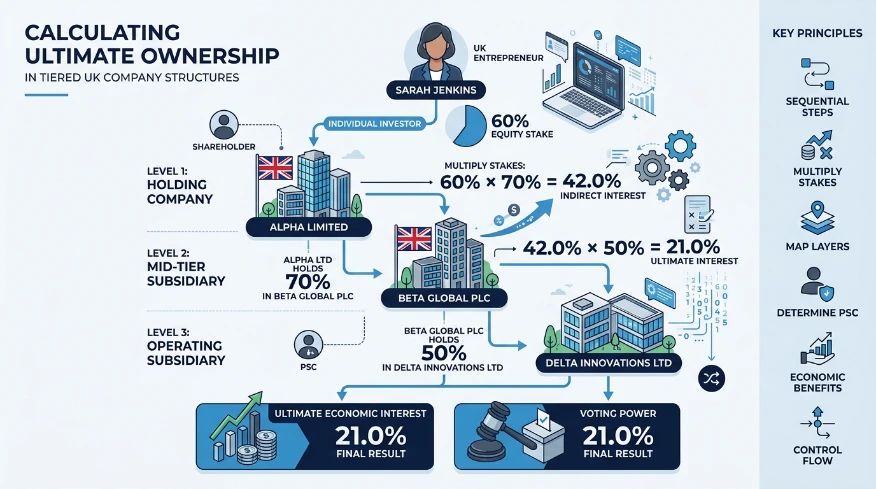
Corporate groups frequently interpose holding companies between the operating business and private investors. An individual owning 50% of a holding company that owns 60% of an operating company holds an indirect stake of 30%. This calculation satisfies the 25% threshold rule. Complex cascading structures require precise mathematical tracking. Missing a single intermediate tier invalidates compliance filings.
Indirect holdings aggregate across multiple subsidiary branches. A person might hold shares directly and through corporate vehicles simultaneously. Compliance teams sum these fractional interests to check against statutory limits. Exceeding 25% through combined channels triggers mandatory registration. Transparency rules account for every ownership pathway.
Joint ventures complicate percentage calculations significantly. Partners often share control equally or through asymmetrical voting agreements. Analysts examine shareholder pacts to isolate individual influence. If two partners control a holding vehicle, their combined influence cascades downward. Every participating entity must undergo independent evaluation.
Minority stakes aggregate when family members act in concert. UK regulations treat joint arrangements as single ownership blocks in specific scenarios. Family members holding voting rights together combine their totals. This prevents individuals from evading transparency rules through fragmentation. Compliance officers review relationship disclosures to catch concerted actions.
Corporate entities themselves register as Relevant Legal Entities rather than individuals. An RLE must sit directly above the operating company in the chain. Tracing ownership stops at the first exempt or registered entity. Beyond that point, the chain breaks for standard PSC purposes. Analysts document RLE registrations to satisfy statutory audit trails.
Nominee arrangements obscure true economic beneficiaries behind legal proxies. Nominees hold shares on behalf of underlying principals without exercising independent judgment. Identifying the actual PSC requires uncovering the underlying declaration of trust. The beneficial owner retains the voting rights and dividend entitlements. Transparency frameworks pierce nominee layers during forensic audits.
How Do You Assess Joint Arrangements and Voting Rights?
Assessing joint arrangements requires reviewing shareholder agreements to identify concerted voting patterns, veto powers, and board appointment rights that grant equivalent control to a 25% shareholding.
Formal agreements often grant minority stakeholders disproportionate influence over corporate direction. A stakeholder holding 15% of shares can secure veto rights over operational budgets. These blocking powers constitute significant influence under statutory definitions. Compliance teams read every clause in shareholder pacts. Governance rules dictate that control extends beyond simple equity ownership.
Board composition rights operate as another metric of significant control. The power to appoint or remove a majority of board directors satisfies PSC criteria. Investors without majority shares frequently negotiate this governance privilege. Analysts verify director appointment clauses in corporate charters. This control mechanism exists independently of financial investment volumes.
Unincorporated associations and partnerships add layers of governance complexity. Decision-making authority often rests on consensus rather than majority vote. Identifying controllers requires examining partnership agreements and management rules. Voting weight calculations adapt to non-standard corporate forms. Every governance document undergoes strict legal interpretation.
Share classes with restricted dividend rights still convey voting power. Preference shares might carry multiple votes per share despite limited financial returns. Calculating thresholds requires separating economic rights from voting rights. An individual holding zero equity can control the board entirely through weighted votes. Regulatory compliance depends on accurate voting power assessments.
Enforcement agencies penalise companies that fail to declare joint arrangement controllers. Directors face criminal prosecution for submitting inaccurate registers. Routine audits catch discrepancies between share ledgers and actual control dynamics. Maintaining accurate records protects the organization from severe financial liabilities. Businesses can manage your PSC register efficiently through specialized compliance platforms.
Core Registration & Compliance Benchmarks
| Ownership Metric | Regulatory Threshold | Verification Requirement | Compliance Action |
| Direct Share Capital | > 25% | Shareholder register review | File details on Companies House |
| Indirect Ownership | Cascading > 25% equity | Parent company trace | Calculate multi-tier stakes |
| Voting Rights | > 25% voting power | Articles of Association check | Verify dual-class share weight |
| Significant Influence | Veto/Board control | Shareholder agreement audit | Document governance power |
How Do You Uncover Hidden Beneficial Ownership?
Uncovering hidden beneficial ownership demands cross-referencing Companies House records, beneficial ownership registers, and statutory declarations to trace funds and governance authority to the real source.
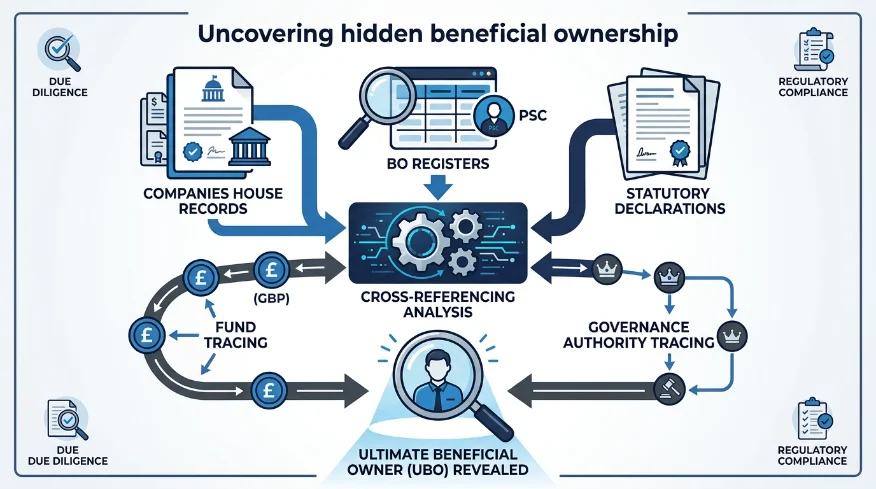
Opaque ownership structures often utilize offshore jurisdictions to mask ultimate controllers. Shell companies layer across international borders to frustrate investigators. Compliance officers request certified corporate documents from foreign registries. Tracing international chains requires understanding cross-border legal frameworks. Transparency international standards assist in uncovering hidden entities.
Financial flows provide empirical evidence of economic beneficiaries. Dividend payments distributed outside the formal corporate chain indicate hidden ownership. Forensic accountants analyze bank statements and ledger entries during complex audits. Tracing cash movements reveals who ultimately profits from the enterprise. Economic reality supersedes nominal corporate structuring.
Statutory notices compel uncooperative shareholders to disclose their ownership status. Companies possess legal powers to freeze shares if owners fail to respond. Issuing Section 793 notices forces transparency from reluctant stakeholders. Recipients must disclose their capacity and any controlling agreements within designated timeframes. Enforcement actions deter deliberate evasion strategies.
Documenting every step of the ownership chain creates a defensible audit trail. Compliance teams archive corporate charts, shareholder certificates, and voting agreements. Regulators inspect these dossiers during routine compliance reviews. Transparent record-keeping demonstrates corporate diligence and good faith. Businesses preparing for restructuring can learn how to map PSCs across a group company structure before submitting updates.
Maintaining accurate registers requires continuous monitoring of corporate changes. Share transfers, equity issuances, and director resignations alter the PSC landscape instantly. Automated alerts notify compliance officers of structural shifts within the group. Regular updates ensure statutory registers reflect current operational realities. Diligent oversight minimizes regulatory risks across all corporate tiers.
How Do You Resolve Complex PSC Filing Discrepancies?
Resolving complex PSC filing discrepancies involves rectifying registry errors, updating outdated corporate data, and submitting formal correction notices to Companies House within statutory deadlines.
Clerical errors frequently plague initial corporate filings. Transposing share percentages or misidentifying corporate registration numbers triggers compliance warnings. Companies must correct registry data immediately upon discovery. Submitting amendment forms rectifies historical inaccuracies. Administrative precision prevents long-term compliance complications.
Conflicting data between internal registers and public filings creates legal exposure. Discrepancies attract scrutiny from regulatory enforcement bodies. Compliance officers reconcile share ledgers with public disclosures periodically. Aligning internal data sources ensures consistency across all corporate documents. Internal audits catch errors before regulators flag them.
Failing to update registers within statutory windows incurs severe daily fines. Companies must notify authorities of ownership changes within fourteen days. Administrative backlogs do not excuse delayed filings. Prioritizing compliance updates safeguards corporate standing. Organizations seeking expert assistance can contact Form My Company for reliable PSC filings to ensure seamless regulatory submission.
Complex ownership groups benefit from centralized compliance management systems. Automated tracking tools monitor threshold crossings across all subsidiaries. Standardized reporting templates reduce human error during data entry. Professional administrative support ensures adherence to evolving regulatory mandates. Structured compliance processes protect corporate reputation and operational continuity.
Identifying a Person with Significant Control across intricate corporate hierarchies requires systematic data collection, meticulous mathematical calculation, and rigorous legal interpretation. Organizations navigating multi-layered ownership networks must prioritize transparency and accuracy to satisfy statutory mandates. Form My Company delivers reliable administrative solutions, expert compliance guidance, and seamless registry management to support businesses through every stage of their corporate structuring journey.
Explore our PSC Register guide,
Can You Keep a PSC’s Home Address Off the Public Record?
Why Does ESG Reporting Now Include Corporate Events?
Frequently Asked Questions
How do you identify a PSC in a complex corporate structure?
To identify a Person with Significant Control in a multi-layered corporate hierarchy, you must trace ownership through intermediate parent companies, trusts, and voting agreements. Form My Company assists businesses in managing your PSC Register by systematically evaluating direct and indirect stakes exceeding the 25% statutory threshold.
What is the difference between a PSC and a Relevant Legal Entity (RLE)?
A PSC is an individual who ultimately owns or controls a company, whereas an RLE is a corporate body or corporate entity that sits directly above the operating company in an ownership chain. When establishing your PSC Register, Form My Company helps you trace corporate entities upward until the ultimate human controller is identified.
Do shareholders with less than 25% shares ever qualify as a PSC?
Minority shareholders can qualify as a PSC if they hold the right to appoint or remove a majority of directors or exercise significant influence and control through shareholder pacts. Form My Company reviews governance documents and voting rights to ensure complete accuracy for your PSC Register.
What happens if a company fails to update its PSC information on time?
Failing to report ownership changes or maintain accurate statutory data within statutory deadlines results in severe financial penalties and potential criminal prosecution for company directors. Form My Company provides reliable administrative support to keep your PSC Register compliant with Companies House regulations.
Do individuals listed as PSCs need to complete identity verification?
Under UK corporate transparency regulations, all Persons with Significant Control must verify their identity directly with Companies House and provide a unique personal code. Form My Company guides corporate clients through identity verification procedures while maintaining an accurate PSC Register for regulatory compliance.