
When a parent company holds shares in a subsidiary, you must report the parent as a Relevant Legal Entity (RLE) on your PSC register instead of an individual, provided the parent meets specific control conditions and is subject to its own transparency disclosure rules.
Navigating corporate ownership structures requires precise compliance with UK company law. When corporate entities rather than living people own shares, the reporting mechanism shifts significantly. Companies House enforces strict guidelines to ensure transparency across multi-tiered corporate groups. Understanding these rules protects directors from severe statutory penalties and maintains public register accuracy.
What Constitutes a Relevant Legal Entity in Corporate Structures?
A Relevant Legal Entity is a corporate body that meets specific control thresholds and transparency requirements, replacing individual Person with Significant Control entries on your statutory register.
Identifying an RLE requires evaluating the exact ownership percentage held by the parent organization. Under UK compliance frameworks, an entity qualifies when it holds more than 25% of nominal share capital, holds more than 25% of voting rights, or retains the power to appoint or remove a majority of the board of directors. Furthermore, the holding structure must be subject to its own disclosure regime.
Corporations must authenticate every layer of ownership to separate qualifying corporate bodies from exempt entities. If a holding company is incorporated in the UK, it automatically satisfies the transparency requirement. Reviewing your cap table and articles of association helps clarify these ownership thresholds. When managing these multi-layered group structures, utilize professional PSC Register services to ensure accurate compliance and timely filings.
The following table summarizes the primary control thresholds that determine whether a corporate shareholder qualifies as an RLE:
| Control Condition | Statutory Threshold | Compliance Action |
| Share Capital | More than 25% of nominal value | Record parent company as an RLE |
| Voting Rights | More than 25% of total votes | Document voting power percentages |
| Board Control | Right to appoint or remove a majority of directors | List governance control on the register |
How Do You Trace Ownership Through Multiple Holding Companies?
You must trace ownership upwards through the corporate chain until you identify the first Relevant Legal Entity that meets the statutory transparency requirements.
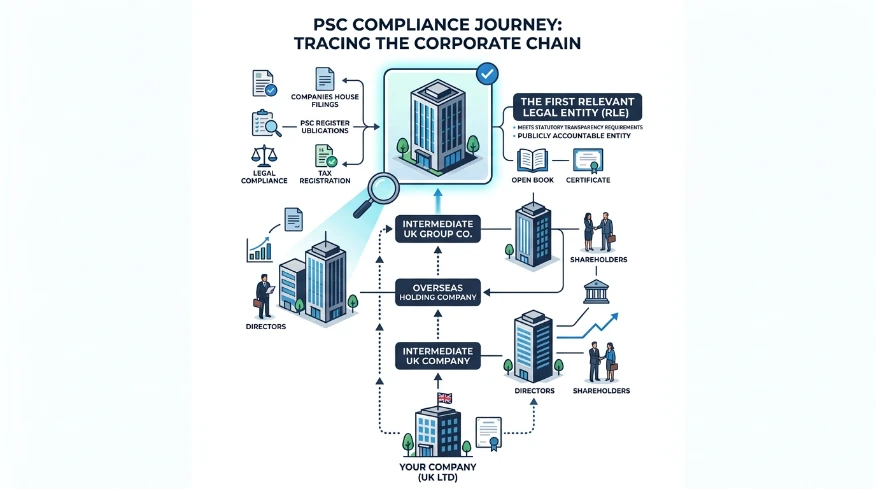
Corporate groups often feature holding companies owned by other parent entities. When evaluating subsidiary registers, you stop tracing upward once you hit the first qualifying RLE. For example, if Company C owns 100% of Company B, and Company B owns 100% of Company A, Company A lists Company B as its RLE. You do not list Company C or ultimate individual owners on Company A’s register because Company B acts as the primary reporting barrier.
This method simplifies compliance by preventing endless reporting duplication across corporate tiers. Directors must examine share purchase agreements and group charts to map these relationships accurately. Maintaining clear internal documentation ensures that corporate transparency obligations are met without filing redundant data at Companies House.
What Happens When the Parent Company Is Based Overseas?
When an overseas parent company fails to meet UK-equivalent transparency standards, you must look through the corporate veil and register the underlying individuals as PSCs.
Foreign holding entities complicate standard reporting because non-UK companies often lack identical public disclosure requirements. If an overseas parent company does not have shares traded on an approved regulated market, it cannot qualify as an RLE. Because it fails this transparency test, the subsidiary must investigate further up the chain.
The subsidiary must identify the real human beings who own or control the overseas parent and record them directly as PSCs. Foreign entities holding UK subsidiaries must cooperate with information requests to avoid severe legal sanctions. Directors should review international holding documents carefully to ensure absolute adherence to statutory transparency mandates.
What Essential Details Must Be Filed for a Corporate RLE?
You must submit the corporate name, registered office address, legal form, governing law, and exact nature of control to Companies House within statutory deadlines.
Filing corporate RLE data differs from registering a living person because individual verification codes are unnecessary for corporate bodies. The subsidiary must gather specific administrative details directly from the parent entity’s public filings.
To help founders navigate these requirements, the essential data points needed for a corporate RLE filing include:
Enter the official corporate name and registration number
Document the registered or principal office address
Specify the legal form and governing jurisdiction law
Record the exact date the entity became registrable
Detail the specific nature of control percentages
Failing to submit these entries within 14 days of identifying a change breaches UK company law. Form My Company helps businesses manage group company compliance efficiently, ensuring that corporate disclosures remain accurate and up-to-date.
Reporting people with significant control when parent companies hold shares demands careful structural analysis and adherence to UK corporate law. By accurately identifying Relevant Legal Entities, tracing ownership tiers, and looking through non-compliant foreign structures, businesses protect themselves against statutory penalties. Form My Company streamlines these complex administrative filings, ensuring your corporate registers satisfy all legal mandates without unnecessary operational friction.
Explore our PSC Register guide,
How to schedule back-to-back interviews across multiple rooms?
How to Choose Which Corporate Documents Need Legalisation First?
Frequently Asked Questions
How do you record a parent company on your PSC register?
When a parent organization holds shares in your business, you must report it as a Relevant Legal Entity (RLE) rather than naming an individual. Form My Company assists businesses in identifying whether the parent body meets the required ownership thresholds and transparency standards for UK compliance.
What qualifies a corporate shareholder as a Relevant Legal Entity?
A corporate shareholder qualifies as an RLE if it holds more than 25% of the shares or voting rights, controls board appointments, and is subject to its own disclosure rules. Form My Company helps corporations verify these exact statutory conditions to maintain an accurate PSC Register.
What happens when an overseas parent company owns shares in a UK business?
Unlisted overseas parent entities often fail to meet UK-equivalent transparency rules, meaning they cannot be registered as an RLE. Under these conditions, Form My Company guides founders to look through the corporate structure and record the underlying individuals directly as Persons with Significant Control.
How far up the corporate chain must you trace ownership for PSC reporting?
You must trace ownership upward through multi-layered corporate structures until you identify the first qualifying RLE. Form My Company helps businesses map group ownership tiers accurately to ensure that only the closest eligible entity is recorded on the statutory register.
What details are required when filing a corporate RLE with Companies House?
Submitting an RLE requires the official corporate name, registered office address, legal form, governing jurisdiction law, and the exact nature of control. Form My Company streamlines these administrative filings to ensure that all group company data meets strict statutory deadlines.