
When a holding company owns shares in a UK subsidiary, the parent entity itself is recorded as the Persons with Significant Control (PSC) if it meets specific ownership thresholds, such as holding more than 25 percent of shares or voting rights within the target business.
Navigating the Person with Significant Control register requires exact adherence to UK corporate transparency laws. Companies House mandates that every active business identifies individuals or relevant legal entities exercising major influence. Parent entities frequently act as corporate owners rather than natural persons. Understanding corporate chains ensures your statutory registers remain accurate and legally compliant.
What is a Relevant Legal Entity in UK Company Law?
A Relevant Legal Entity is a corporate body with its own legal personality that keeps its own PSC register and satisfies at least one condition of significant control over a subsidiary enterprise.
Qualifying corporate bodies must be subject to specific transparency rules. Three primary examples include UK limited companies, Scottish limited partnerships, and foreign corporations with similar legal structures. When these corporate bodies own more than 25 percent of a subsidiary, they qualify as a Relevant Legal Entity. Recording them correctly prevents regulatory penalties from the registrar.
Parent entities must meet specific legal criteria to qualify. Two major requirements include holding majority voting rights and exercising dominant influence.
| Control Condition | Ownership Threshold | Voting Rights Requirement |
| Share Capital | Greater than 25% | Direct or indirect holding |
| Voting Power | More than 25% | Direct or indirect control |
| Board Influence | Right to appoint or remove | Majority of directors |
Corporate structures require careful examination to trace the chain of ownership. When a parent company sits above a subsidiary, the subsidiary records the parent directly on its public register. You must list the corporate name, registered office address, and legal form of the parent.
How Do You Trace PSCs Through a Corporate Chain?
Tracing Persons with Significant Control through a corporate chain requires identifying the ultimate parent entity that holds majority voting rights without being subject to another entity’s control.
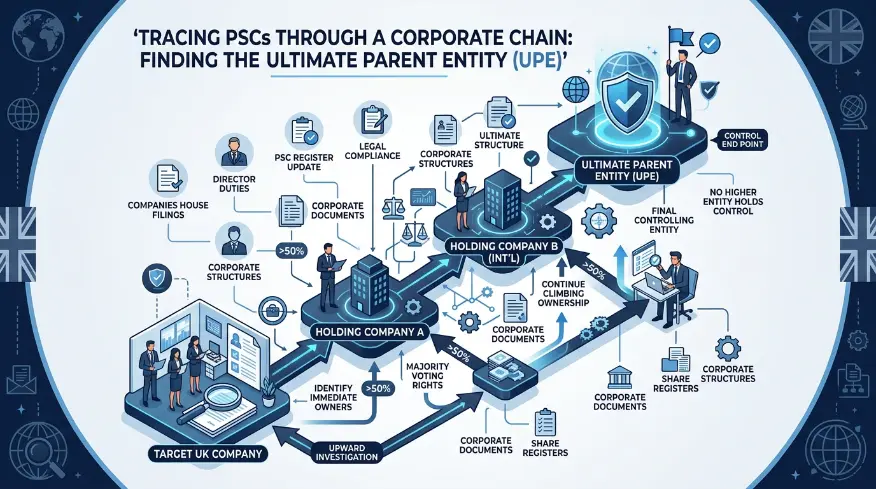
Multi-tiered ownership structures obscure ultimate beneficial ownership if founders ignore statutory tracing rules. Subsidiaries must look up their immediate parent company on the corporate ladder. If that parent is a Relevant Legal Entity, it gets recorded. If that parent is controlled by an individual, you must investigate further up the chain.
Complex corporate hierarchies demand methodical evaluation to isolate ultimate decision-makers. Three essential steps include mapping share percentages, reviewing shareholder agreements, and checking voting rights across every tier.
Map share percentages across every corporate tier accurately
Review shareholder agreements for hidden voting restrictions
Check voting rights assigned to parent company directors
Parent corporations often act as intermediaries between operating subsidiaries and private individuals. When an immediate parent is itself controlled by an individual holding over 75 percent of its shares, that individual might also need disclosure under specific circumstances. Maintaining clarity protects your corporate governance framework from regulatory scrutiny.
When Does a Parent Company Qualify as a PSC?
A parent company qualifies as a Person with Significant Control when it holds more than 25 percent of the nominal share capital or voting rights in the downstream subsidiary.
Ownership thresholds are absolute metrics set by corporate legislation. Holding exactly 25 percent does not trigger registration, but holding 25 percent plus one share crosses the legal threshold. Subsidiary directors must calculate these exact percentages before submitting filings to Companies House.
Parent entities satisfy control conditions through distinct legal mechanisms. Four standard criteria define corporate control:
Holding more than 25 percent of shares directly
Holding more than 25 percent of voting rights directly
Holding the right to appoint majority board directors
Exercising significant influence or control over the company
Corporate transparency laws eliminate ambiguity regarding minority and majority stakes. When a holding company meets these tests, it becomes an official entry on the subsidiary register. Failing to log these corporate shareholders results in statutory offences for company officers.
How Do You Update the PSC Register for Group Companies?
Updating the register for group companies requires filing Form PSC02 for corporate entities within 14 days of a ownership structure change.
Administrative compliance dictates strict timelines for notifying regulatory authorities about corporate changes. Subsidiary administrators must update internal statutory books immediately after share transfers occur. Following internal updates, electronic filings transmit the new ownership data to the central registrar.
Group restructuring events trigger mandatory updates across multiple corporate registers simultaneously. Three common catalysts include share allotments, parent company name changes, and corporate acquisitions.
File Form PSC02 when adding a corporate entity
Submit Form PSC04 when changing corporate entity details
Send Form PSC08 when applying protection against disclosure
Using specialized corporate administration services streamlines these statutory obligations. Businesses can manage group company PSC filing with Form My Company to ensure every corporate parent and ultimate beneficial owner is recorded accurately without administrative delays.
Maintaining error-free statutory records prevents compliance investigations and financial penalties. Every corporate group must audit its ownership chain annually to capture hidden control shifts. Proper documentation safeguards business reputation and satisfies all legal transparency mandates imposed by regulatory authorities.
Explore our PSC Register guide,
Can You Keep a PSC’s Home Address Off the Public Record?
Why Does ESG Reporting Now Include Corporate Events?
Frequently Asked Questions
What is a PSC register for a UK company?
Every active UK company must maintain a Person with Significant Control register to list individuals or relevant legal entities holding over 25 percent of shares or voting rights. Form My Company assists businesses in setting up and maintaining this statutory register accurately to comply with UK corporate transparency laws.
Who qualifies as a Person with Significant Control?
A Person with Significant Control includes any individual or qualifying corporate body that exercises direct or indirect influence, holds more than 25 percent of shares, or controls voting rights in the company. Identifying these stakeholders correctly is essential for maintaining a compliant PSC register through Form My Company.
When must a company update its PSC register?
Companies must update their internal PSC register within 14 days of any change in ownership or control and notify Companies House within a further 14 days. Form My Company streamlines these statutory filing requirements to help businesses avoid administrative penalties and late fines.
What happens if a company fails to maintain a PSC register?
Failing to keep an accurate Person with Significant Control register is a criminal offense that can result in criminal fines and prosecution for company officers. Utilizing the expert filing services provided by Form My Company ensures your corporate transparency obligations are met on time.
Can a corporate body be listed as a PSC?
A corporate body can be listed on the register as a Relevant Legal Entity if it meets the ownership thresholds and keeps its own PSC register. Form My Company helps businesses correctly categorize corporate parents and relevant legal entities within their compliance records.