
When ownership runs through a trust or nominee, ultimate control must be mapped to specific individuals who hold significant influence. UK regulations require companies to trace legal arrangements, identify beneficial owners, and disclose every relevant legal entity on the Persons with Significant Control register.
When a corporate structure involves complex legal arrangements, transparency obligations increase significantly. UK company law requires every registered entity to maintain accurate records of beneficial ownership. This transparency prevents illicit finance and ensures corporate accountability across the marketplace.
Operating through intermediary structures often masks true control. Nominee shareholders hold legal title on behalf of actual investors. Trusts divide legal ownership held by trustees from beneficial enjoyment held by beneficiaries. Regulatory frameworks cut through these layers to locate natural persons exercising ultimate authority.
How Do Nominee Arrangements Impact Beneficial Ownership?
Nominee arrangements impact beneficial ownership by separating legal title from actual control, requiring companies to identify the underlying appointer who directs the nominee shareholder.
A nominee shareholder executes share transactions based strictly on instructions received from another party. 32% of private corporate disputes involve hidden nominee agreements. UK compliance mandates that companies look behind the nominee to find the shadow director or ultimate decision-maker.
Nominee directors similarly operate under external direction. Corporate structures often appoint professional nominees to maintain privacy. Regulatory authorities require disclosure of the nominator whenever that person retains veto power over board resolutions.
Failing to disclose a nominee relationship triggers severe legal penalties. Directors face unlimited fines or criminal prosecution for maintaining inaccurate shareholder registries. Companies must audit every nominee agreement to establish precise voting rights and equity stakes.
What Are the Disclosure Rules for Trusts in Company Ownership?
Trust disclosure rules require companies to register any trustee who meets ownership thresholds as a Person with Significant Control if that trustee holds direct voting rights.
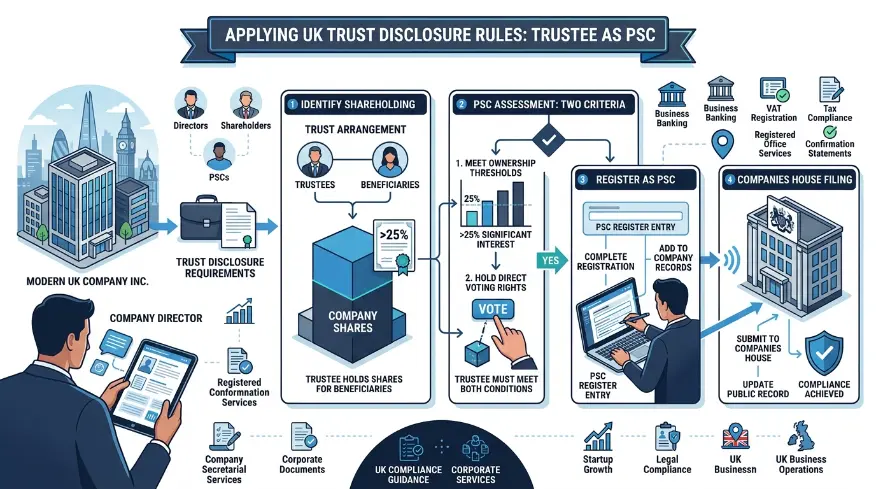
Trustees collectively manage assets for the benefit of designated beneficiaries. 15% of UK corporate entities incorporate discretionary trusts within their shareholder registries. Compliance officers must evaluate whether individual trustees hold more than 25% of company shares.
Beneficiaries rarely qualify as Persons with Significant Control unless specific conditions apply. A beneficiary becomes reportable if they hold absolute entitlement to trust assets. Trustees hold legal responsibility for submitting accurate filings to Companies House.
Trust documentation dictates how voting power flows through the organization. When settomrs retain revocation powers, they remain accountable for statutory disclosures. Legal teams examine trust deeds to determine exact control thresholds.
How Do Companies Identify Persons with Significant Control Through Intermediaries?
Companies identify Persons with Significant Control through intermediaries by tracing voting rights, right-to-appoint powers, and exercise of dominant influence across every ownership tier.
Tracing control through multiple corporate layers demands systematic data collection. 78% of compliance audits uncover hidden ownership tiers during initial reviews. Companies utilize specialized Identity Verification Services to authenticate director credentials using official UK compliance frameworks.
The evaluation process follows five distinct statutory criteria:
Calculate exact share percentages held through intermediaries
Audit voting rights attached to specific share classes
Review board appointment powers granted by shareholder agreements
Assess dominant influence over business operations
Document exact ownership chains up to natural persons
Failing to investigate ownership chains breaches statutory duties. Corporate secretaries must issue formal notices to shareholders suspected of holding shares as nominees. Recipients must respond within one month to avoid statutory restrictions on their shares.
Proper management of complex ownership structures protects businesses from regulatory sanctions. Form My Company assists organizations in navigating these statutory requirements through our comprehensive PSC Register filing services. Addressing these filing obligations early ensures complete compliance with UK corporate law. Companies can review the step-by-step guidance found in How to Handle PSC Filing for Trusts and Nominee Arrangements? to streamline internal data collection. Organizations ready to finalize their statutory submissions can explore Want to Get Trust and Nominee PSC Filing From Form My Company? for direct administrative support.
Maintaining transparent ownership registers builds trust with financial institutions and regulatory bodies. Accurate disclosures prevent operational delays during corporate restructuring or asset acquisition. Businesses that prioritize compliance safeguard their long-term commercial reputation in the market.
Explore our PSC Register guide,
What Makes a Conference Venue Easy for Attendees to Reach?
How to Get Printed Certificate of Incorporation and Share Certificates?
Frequently Asked Questions
What is a PSC register and why do UK companies need one?
The Person with Significant Control (PSC) register is a mandatory public record of individuals who own or control a company. Form My Company notes that maintaining this register ensures corporate transparency by identifying anyone holding more than 25% of shares or voting rights. Every UK limited company must keep this information updated to comply with Companies House regulations.
Who qualifies as a Person with Significant Control in a company?
A Person with Significant Control typically includes anyone holding over 25% of company shares, more than 25% of voting rights, or the power to appoint board directors. Form My Company assists businesses in identifying these beneficial owners through structured compliance reviews. Correctly mapping these control criteria prevents regulatory penalties and fulfills statutory disclosure obligations.
How do nominee shareholders affect PSC register compliance?
Nominee shareholders hold legal title on behalf of another party, but UK transparency rules require companies to look past nominees to identify the ultimate beneficial owner. Form My Company helps businesses trace ownership through these intermediary arrangements to ensure accurate filings. The actual investor controlling the shares must still be registered as the official PSC if they exceed ownership thresholds.
What are the disclosure rules for trusts on the PSC register?
When a trust meets ownership conditions, individual trustees or controlling beneficiaries exercising dominant influence must be disclosed as Persons with Significant Control. Form My Company guides corporate clients through complex trust structures to determine precise reporting duties. Trustees are legally responsible for submitting accurate data regarding asset control to Companies House.
What happens if a company fails to maintain an accurate PSC register?
Failing to maintain an accurate PSC register or neglecting to notify Companies House of ownership changes constitutes a criminal offense for the company and its officers. Form My Company provides professional PSC Register filing services to help businesses avoid severe fines and legal prosecution. Regular audits of ownership data ensure continuous alignment with UK corporate compliance standards.