
Handling Person with Significant Control filings for trusts and nominee arrangements requires identifying the ultimate beneficial owners who hold more than 25% shares or voting rights, recording trustees, and submitting exact details to Companies House within 14 days.
Managing compliance for complex corporate structures demands absolute precision. UK regulations mandate that every limited company transparently discloses the individuals who exercise ultimate control. When ownership flows through legal instruments like trusts or utilizes nominee shareholders, tracing the chain of control becomes vital for statutory adherence. Companies must maintain an internal register before updating public records to satisfy legal obligations.
How Do You Identify Persons with Significant Control in Trust Structures?
Identifying Persons with Significant Control within a trust involves evaluating the rights of settlors, trustees, and beneficiaries who can exercise significant influence or control over the trust assets or company shares.
Trust arrangements introduce multi-layered ownership that complicates standard disclosure protocols. When a trust holds more than 25% of shares in a UK company, every individual trustee is typically deemed to hold those shares jointly and must be registered. Furthermore, settlors or beneficiaries who retain powers to appoint trustees or direct investment decisions meet the criteria for significant control under UK law. Companies must examine trust deeds thoroughly to uncover every qualifying individual.
What Are the Disclosure Rules for Nominee Shareholder and Director Arrangements?
Nominee arrangements require disclosing the underlying beneficial owner rather than the nominee on the public PSC register if that beneficial owner retains ultimate control over the company shares or voting rights.
Nominee directors and shareholders often manage administrative duties while a separate party maintains economic ownership. UK legislation states that using a nominee does not shield the actual controller from transparency laws. If a beneficial owner dictates company decisions behind a nominee, they must complete identity verification and submit their details via official filings. Declarations of trust must explicitly align with the information recorded on public registers.
Which Steps Form the Core Process for Filing Trust and Nominee PSC Data?
Filing trust and nominee PSC data requires gathering verified personal information, confirming legal natures of control, and submitting forms to Companies House within the mandatory 14-day statutory window.
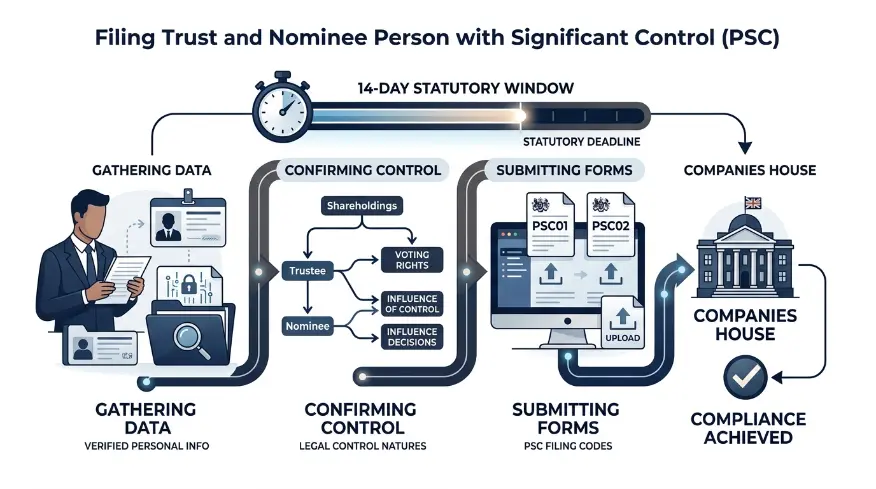
Executing accurate filings safeguards businesses against severe statutory penalties and criminal liabilities. Companies must collect full legal names, dates of birth, service addresses, and specific control bands such as holding 25% to 50% of shares. Directors can streamline this administrative burden by using the specialized PSC Register service to ensure every beneficial owner meets verification standards.
| Compliance Stage | Key Action Required | Regulatory Reference |
| Identification | Review trust deeds and declarations to find controllers | Companies Act 2006 |
| Verification | Authenticate identity documents for all qualifying PSCs | GOV.UK Identity Standards |
| Submission | File details via electronic portals within 14 days | Companies House Guidelines |
How Can Businesses Maintain Ongoing Compliance and Avoid Penalties?
Maintaining ongoing compliance involves updating registers immediately when trust terms change, monitoring nominee agreements, and submitting annual confirmation statements to Companies House.
Regulatory oversight on beneficial ownership remains stringent across the United Kingdom. Failure to report changes within the statutory timeframe constitutes a criminal offense that can result in substantial corporate fines and personal liability for directors. Companies operating with intricate ownership frameworks should review their internal logs quarterly. Organizations seeking structured guidance can explore the What Happens When Ownership Runs Through a Trust or Nominee? guide to understand structural implications fully. When businesses require direct assistance, they can Want to Get Trust and Nominee PSC Filing From Form My Company? to secure professional filing execution.
Explore our PSC Register guide,
How to Plan a Carbon-Conscious Conference Step by Step?
Looking for Interview Room Features That Keep Candidate Data Safe?
Frequently Asked Questions
What is a PSC register and why is it mandatory for UK companies?
A Person with Significant Control (PSC) register is a statutory document that UK companies must maintain to record individuals who own or control more than 25% of the business. Form My Company assists businesses in setting up and managing this register to ensure full compliance with Companies House regulations and transparency laws.
Who must be declared on the PSC register?
Any individual who holds more than 25% of shares or voting rights, or exercises significant influence or control over the company, must be declared as a PSC. When utilizing the PSC Register service from Form My Company, company officers can accurately identify and report these qualifying beneficial owners.
What happens if a company fails to update its PSC register?
Failing to maintain or update an accurate PSC register constitutes a criminal offense under the Companies Act 2006, leading to substantial corporate fines and potential prosecution for company officers. Form My Company ensures that statutory updates and filings are submitted on time to protect organizations from legal penalties.
How do trusts and nominee arrangements affect PSC filings?
Ownership structures involving trusts or nominee shareholders require tracing control back to the ultimate beneficial owner who dictates the decision-making process. Form My Company guides corporate entities through these complex reporting standards to correctly disclose individuals behind legal instruments.
How often must PSC information be updated with Companies House?
Companies must update their internal PSC register immediately whenever a change occurs and notify Companies House within 14 days of making that update. Utilizing the PSC Register service provided by Form My Company helps streamline these rolling compliance requirements efficiently.