
Did you know that the moment your company is registered, your home address could be visible to anyone with an internet connection? While receiving your digital certificate is a massive milestone, it’s just the first step in a high-stakes transition from founder to director. You’ve likely worked hard to get this far, so it’s natural to feel anxious about what to do after forming a limited company uk to avoid fines or privacy leaks.
We’ve designed this guide to strip away the intimidation factor of complex administrative processes. You’ll learn how to master your post-incorporation duties with a definitive roadmap covering legal compliance, financial setup, and professional infrastructure. We’ll walk you through managing 2026 tax obligations like the 19% small profits rate, setting up statutory registers, and keeping your private residence off the public record so you can build your business with total confidence.
Key Takeaways
- Understand exactly what to do after forming a limited company uk by prioritising the organisation of your statutory registers and core incorporation documents.
- Learn how to establish a secure financial foundation by opening a dedicated business bank account and registering with HMRC for Corporation Tax within the mandatory three-month window.
- Protect your personal privacy and enhance your brand image by utilising a professional registered office address to keep your home residence off the public Companies House record.
- Master your ongoing compliance duties by distinguishing between annual accounts and confirmation statements to ensure you never miss a critical filing deadline.
- Transition from a startup mindset to a professional corporate operation by setting up the necessary infrastructure for client meetings and board reviews.
Organising Your Post-Incorporation Documents and Statutory Records
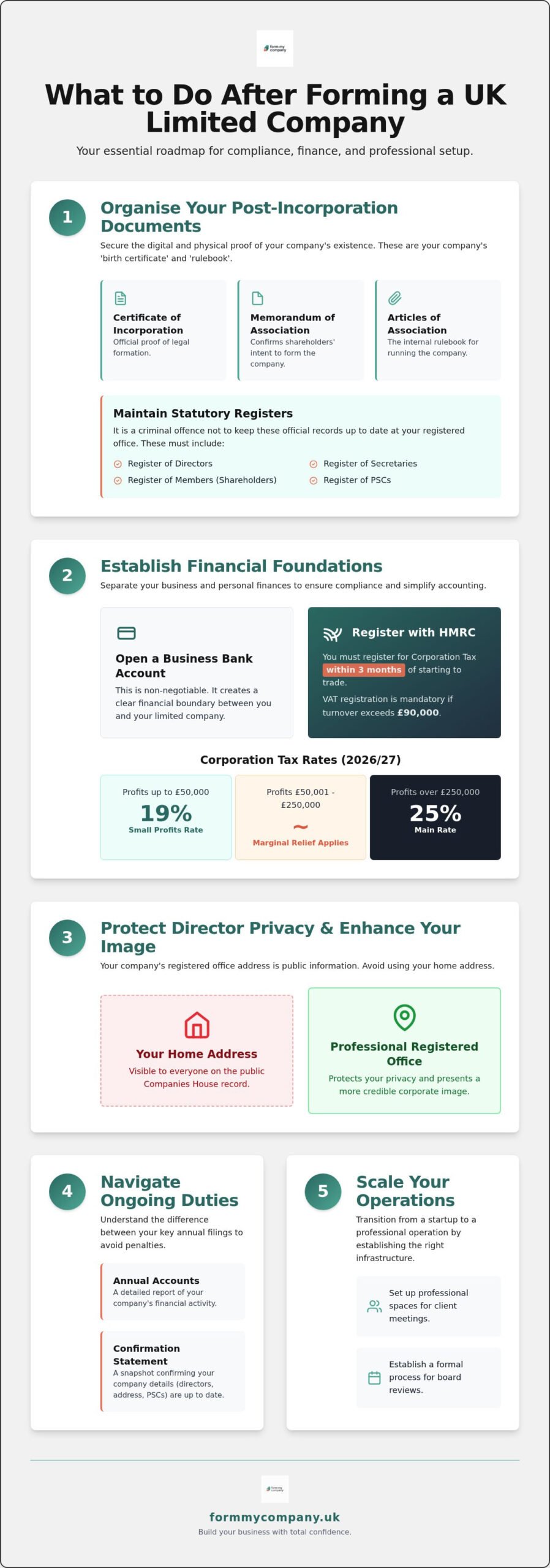
Once the notification from Companies House arrives, you’ve officially crossed the threshold into business ownership. Understanding your limited company structure is vital at this stage, as your new entity is a distinct legal person with its own rights and responsibilities. Knowing what to do after forming a limited company uk starts with securing the digital and physical proof of its existence. You’ll receive three fundamental documents: the Certificate of Incorporation, the Memorandum of Association, and the Articles of Association. Think of these as your company’s birth certificate and its rulebook.
Whilst digital versions are standard, many high-street banks and international partners still prefer the authority of a physical Company Pack. Having these bound and ready demonstrates a level of professional readiness that digital files sometimes lack. Establish a secure filing system immediately to house these records alongside your first year of administrative receipts and contracts.
Securing Official Company Certificates
Beyond the founding documents, you must issue Share Certificates to all shareholders. These are essential for proving ownership and are often requested during funding rounds or when selling the business. Keep your Memorandum and Articles of Association in a secure, accessible place. You’ll need to refer to them whenever you make significant changes to how the company is run. If you plan to trade or open bank accounts abroad, you may need Apostilled Documents to verify your company’s legal standing with foreign authorities.
Setting Up Your Statutory Registers
It’s a legal requirement under the Companies Act 2006 to maintain statutory registers at your registered office. These aren’t just for show; they are the official record of your company’s governance. You must keep registers for Directors, Secretaries, Members, and People with Significant Control (PSCs). Failing to keep these records up to date is a criminal offence that can lead to fines for the company and its directors. If the thought of manual record-keeping feels overwhelming, you can use a Company Secretarial Service to automate the process. This ensures your registers remain compliant and reflect any changes in ownership or leadership immediately, allowing you to focus on growth rather than paperwork.
Establishing Financial Foundations: Banking and HMRC Registration
Once you’ve organised your documents, the next step in what to do after forming a limited company uk is separating your personal and business finances. Unlike a sole trader, a limited company is a distinct legal entity. Mixing your personal savings with company revenue isn’t just bad practice; it creates a logistical nightmare for your annual accounts. You must treat every pound the company earns as the company’s property. Opening a dedicated account is the only way to maintain this boundary effectively.
You’ll need your Certificate of Incorporation to satisfy “Know Your Customer” (KYC) requirements. Most banks will also ask for proof of ID and address for all directors. This step is non-negotiable for anyone looking to build a transparent and compliant business.
Opening Your Business Bank Account
Modern founders often choose between traditional high-street banks and agile digital-first accounts. High-street banks offer physical branches and complex lending products, whilst digital accounts provide faster setup and seamless app integration. If you’re an international founder, the process can be more stringent. You might need to use Identity Verification Services to confirm your status before a UK bank will approve your application. Regardless of your choice, ensure the account integrates with your chosen accounting software to save time on future filings.
Registering for Corporation Tax and VAT
You must register for Corporation Tax with HMRC within three months of starting to trade. This includes activities like buying stock, renting premises, or advertising. For the 2026/27 tax year, the small profits rate is 19% for profits of £50,000 or less, whilst the main rate is 25% for profits over £250,000. Marginal relief is available if your profits fall between these two figures.
VAT registration is mandatory if your taxable turnover exceeds the £90,000 threshold. However, many businesses choose to register voluntarily before reaching this limit to reclaim VAT on business expenses. If you’re unsure about the timing, seeking VAT Registration Assistance early can prevent costly errors. Finally, if you plan to pay yourself a director’s salary, you’ll need to set up a PAYE scheme. This ensures you’re correctly deducting National Insurance contributions, which for 2026/27 are 8% for employees on earnings between £12,570 and £50,270. Our PAYE registration assistance can help you get this right from day one.
Protecting Director Privacy and Enhancing Your Corporate Image
Many new business owners are surprised to learn that Companies House is a completely public register. When considering what to do after forming a limited company uk, protecting your personal data should be a top priority. Every director must provide both a service address and a registered office address. If you use your home for these roles, you’re effectively inviting the public, cold callers, and disgruntled customers to your front door. Separating your commercial identity from your personal life isn’t just about privacy; it’s about building a professional boundary that allows your business to stand on its own.
Using a professional business address also shifts the perception of your brand. A residential street name rarely inspires the same confidence as a recognised business district. By choosing a strategic location, you elevate your brand credibility from a home-based startup to a serious market contender.
The Strategic Value of a Registered Office Address
The law requires every UK company to have a physical address where official mail can be delivered and legal notices served. A Registered Office Address Service provides a prestigious location that satisfies these legal requirements whilst keeping your home residence off the public record. This setup ensures that all statutory mail from HMRC and Companies House is received and handled with care. You’ll never have to worry about missing an important legal notice amongst your personal post, as professional handlers ensure every document is accounted for and forwarded to you promptly.
Implementing Virtual Office and Call Answering Services
Projecting a professional presence doesn’t require the heavy overheads of a physical office lease. Using Virtual Offices allows you to manage your business identity and mail forwarding through a centralised system. It gives you the flexibility to work from anywhere whilst maintaining a fixed, high-profile presence in the business world.
You can further enhance this trust by implementing professional Call Answering. First impressions are everything in business. When a potential client calls and hears a dedicated receptionist answer in your company name, it immediately signals scale and reliability. It removes the distraction of unwanted sales calls and ensures you never miss a genuine lead because you were busy with the day-to-day running of the company. These virtual tools are essential for any founder who wants to focus on growth without sacrificing their personal privacy or professional standards.
Navigating Ongoing Companies House Compliance Duties
After the initial rush of formation, your focus must shift toward long-term maintenance. Compliance isn’t a one-off task; it’s a series of legal duties that ensure your company remains in good standing. A major part of what to do after forming a limited company uk involves managing the flow of information to Companies House. You must distinguish between your annual accounts, which report financial performance, and your confirmation statement, which confirms your administrative data. Whilst the accounts deal with the past year’s numbers, the statement ensures the public record accurately reflects your current structure.
Create a compliance calendar the moment you receive your incorporation date. This helps you track deadlines for filings and notifications. If you change a director or issue new shares, you must update the public record immediately. Companies House has the power to prosecute directors or strike off companies that fail to meet these obligations. Being proactive is the only way to protect your status as a director.
Filing the Annual Confirmation Statement
Every 12 months, you must verify that the information held on the public register is correct. This process involves checking your Standard Industrial Classification (SIC) codes, your registered office address, and your list of shareholders. As of February 2026, the fee for filing a confirmation statement digitally is £50, whereas paper filing is significantly more expensive at £110. You can save time and ensure compliance by choosing to File A Confirmation Statement through a professional portal. This reduces the risk of rejection due to clerical errors and ensures your filing fee is processed securely.
Maintaining the PSC Register and RLE Records
Transparency regarding company ownership is a strict legal requirement under current UK law. You must identify and record any Person with Significant Control (PSC). Typically, this is anyone holding more than 25% of shares or voting rights. If your company is owned by another corporate entity, you must record them as a Relevant Legal Entity (RLE). Keeping your PSC Register up to date is essential whenever ownership or voting rights change. Failure to provide accurate PSC information is a criminal offence that can lead to significant fines. Our company secretarial service can manage these complex updates for you, ensuring your records always reflect the current state of your firm.
Scaling Your Operations with Professional Infrastructure
Moving beyond the initial setup phase requires a fundamental shift in your approach. You must transition from a startup mindset to a professional corporate operation that can handle increased scrutiny and revenue growth. A significant part of what to do after forming a limited company uk involves building the infrastructure that supports your brand’s reputation. Your business needs to look, act, and feel like a secure entity from the very first client interaction. This means moving away from makeshift solutions and adopting professional tools that scale with your success. Understanding what to do after forming a limited company uk means preparing for these transitions before they happen.
Scaling isn’t just about sales figures. It’s about how you manage your internal governance and your external image. As your operations expand, the administrative burden increases, making it vital to have streamlined processes for team changes and professional engagements.
Utilising Professional Meeting and Interview Spaces
Whilst working from home is often efficient, meeting high-value clients in cafes or living rooms can damage your professional credibility. It signals a lack of permanence that might make investors or partners hesitate. Accessing Meeting Rooms and Boardrooms on an ad-hoc basis allows you to host reviews and presentations in a focused, corporate environment. This setup provides the privacy and technology required for serious business discussions without the long-term cost of a commercial lease. Similarly, as you begin to hire, using dedicated Interview Rooms for recruitment drives ensures you attract top-tier talent by presenting a professional front from the outset.
Managing Director Appointments and Company Changes
Growth often leads to changes in leadership or the addition of specialist expertise to your board. The administrative process for a Director Appointment must be handled with precision to ensure your company’s legal records remain accurate. You must notify Companies House within 14 days of the appointment and update your internal registers as discussed in previous sections. Conversely, ensuring legal compliance during a Director Resignation is equally critical. You must formalise the departure to protect both the individual and the company from future liability. Maintaining these records whilst keeping Companies House informed of board changes ensures your corporate structure remains robust as you scale. This methodical approach to infrastructure prevents the “growing pains” that often derail promising new ventures.
Building a Future-Proof Business
Transitioning from a successful registration to a fully operational business requires a methodical approach to compliance and infrastructure. By organising your statutory registers and securing your financial foundations through HMRC and banking setup, you protect the legal integrity of your new venture. Prioritising director privacy with a professional address service ensures your home remains a sanctuary whilst your brand projects the authority needed to scale.
Mastering what to do after forming a limited company uk isn’t just about ticking boxes; it’s about creating a resilient framework that allows you to focus on growth. As an authorised Companies House formation agent, we provide the expert VAT support, compliance assistance, and virtual office solutions you need to navigate these first 30 days and beyond with absolute confidence.
Explore our comprehensive UK Company Formation Packages and post-incorporation services to secure your privacy and streamline your administrative duties today. You’ve done the hard work of starting up; now let’s ensure your business is built to last.
Frequently Asked Questions
How soon after forming a company do I need to register for Corporation Tax?
You must register for Corporation Tax with HMRC within three months of starting to trade. Trading activities include buying equipment, advertising your services, or renting office space. If you miss this deadline, your company may face penalties. Registering early ensures you’re prepared for the 19% small profits rate or the 25% main rate depending on your projected earnings for the 2026/27 tax year.
Can I use my home address as the registered office for my limited company?
Yes, you can use your home address, but doing so makes your private residence part of the public record at Companies House. This exposes you to cold callers and potential privacy risks. Most directors choose a Registered Office Address Service to maintain a professional image whilst keeping their home address private. This is a key part of what to do after forming a limited company uk to protect your personal life.
What is the difference between a confirmation statement and annual accounts?
A confirmation statement verifies that your company’s administrative information, such as director details and SIC codes, is correct. Annual accounts are financial reports that show your company’s profit, loss, and balance sheet for the year. Whilst the confirmation statement is about who you are and where you’re located, the accounts are about your financial performance. Both have strict, separate filing deadlines that you must meet to stay compliant.
Do I need to register for VAT immediately after incorporation?
You only need to register for VAT if your taxable turnover exceeds the £90,000 threshold within a 12-month period. However, you can choose to register voluntarily before reaching this limit. This allows you to reclaim VAT on business expenses and can make your company appear larger to potential clients. If you’re unsure of the benefits, our VAT registration service can help you decide when to register based on your projections.
What are the penalties for late filing with Companies House?
Late filing of annual accounts results in automatic civil penalties ranging from £150 to £1,500 depending on the length of the delay. If you’re late two years in a row, these fines double. For confirmation statements, there isn’t an automatic fine, but failing to file is a criminal offence. It can lead to the company being struck off the register or the directors being prosecuted in court for a breach of duties.
How do I issue share certificates to my shareholders?
You issue share certificates by completing the document with the shareholder’s name, the number of shares, and the company seal or director signatures. These certificates serve as the primary proof of ownership for your investors. It’s best practice to issue them within two months of share allotment. Most founders receive these as part of a Digital & Print Package or a comprehensive Company Pack during their initial setup phase.
What is a PSC register and why does my company need one?
A PSC register lists “Persons with Significant Control,” which typically includes anyone holding more than 25% of the company’s shares or voting rights. The UK government requires this register to ensure corporate transparency and prevent financial crime. You must keep this record up to date and report any changes to Companies House. It’s a mandatory legal requirement that applies to almost all UK limited companies, regardless of their size.
Do I need to appoint a company secretary for my limited company?
No, private limited companies are no longer legally required to appoint a company secretary. However, many directors still choose to have one to manage complex administrative duties and ensure they never miss a filing deadline. If you prefer not to appoint an individual, you can use a professional company secretarial service to automate your compliance tasks and maintain your statutory registers with total accuracy whilst focusing on your business growth.