

Business owners prefer physical statutory books because tangible records eliminate cyber-attack vulnerabilities, satisfy traditional compliance standards, and provide tamper-proof physical evidence of company ownership, share transfers, and board resolutions that digital platforms cannot replicate.
Statutory registers form the legal foundation of every registered enterprise. Company directors must maintain accurate documentation regarding shareholders, directors, and significant controllers. Digital databases offer modern convenience, but tangible registers retain distinct operational advantages. Physical ledgers protect sensitive corporate data from unauthorized network breaches and server outages. Business owners value tangible documentation because paper records remain immune to software corruption and hacking attempts. Corporate governance requires absolute reliability and verifiable audit trails. Tangible registers deliver permanent proof of compliance without depending on internet access or proprietary software.
Why Do Traditional Compliance Records Outlive Digital Failures?
Traditional compliance records outlive digital failures because paper registers require no electricity, software updates, or cloud subscriptions to remain accessible for decades.
Software platforms undergo frequent interface redesigns and policy updates. Obsolete file formats render older digital records unreadable over time. Physical bound volumes bypass technological obsolescence entirely. Ink on archival paper maintains legibility across generations of company management. Directors store physical books securely inside office safes or bank deposit boxes. Network outages prevent access to cloud-based registries during critical corporate transactions. Paper documents ensure uninterrupted availability regardless of server status or IT infrastructure failures. Business owners eliminate recurring software subscription fees by maintaining permanent bound volumes.
How Do Tangible Registers Prevent Cyber Vulnerabilities?
Tangible registers prevent cyber vulnerabilities by existing entirely offline, removing any remote attack vectors for malicious actors.
Cloud storage providers face constant threats from ransomware, data breaches, and unauthorized server access. Digital corporate registries store sensitive personal data of shareholders and directors on centralized servers. Hackers target these databases to compromise corporate governance structures. Physical books eliminate network connectivity entirely. Unauthorized individuals cannot access physical records without physical entry to the secure storage location. Data protection officers recognize that offline documentation restricts exposure to digital espionage. Corporate security protocols benefit from isolated record-keeping systems that prevent remote data exfiltration.
What Makes Paper Documentation Superior for Legal Audits?
Paper documentation is superior for legal audits because handwritten entries, physical signatures, and official seals provide undeniable authenticity during regulatory inspections.
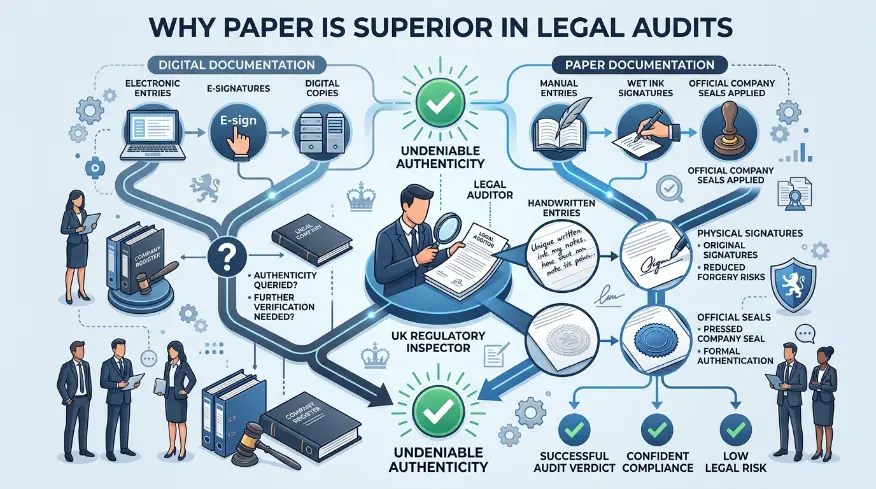
UK regulators examine corporate registers to verify legal compliance and ownership transparency. Forensic document examiners authenticate paper records through ink analysis and signature verification. Digital audit trails face skepticism regarding metadata alteration and timestamp manipulation. Physical registers display chronological continuity through sequential page numbering and binding integrity. Inspectors review wet-ink signatures on share certificates and board minutes with absolute confidence. Legal proceedings frequently rely on original paper documents to establish binding corporate resolutions beyond dispute. Form My Company ensures businesses maintain pristine documentation standards through our comprehensive Company Pack.
Why Do Investors Trust Tangible Share Registers More?
Investors trust tangible share registers more because physical stock ledgers offer transparent, unalterable proof of equity distribution and historical ownership changes.
Venture capitalists and angel investors scrutinize corporate cap tables during due diligence phases. Digital spreadsheets permit hidden formula edits and retroactive alterations that obscure true equity stakes. Bound statutory registers display every historical share transfer in a sequential, transparent format. Investors verify ownership percentages instantly by reviewing original share certificates alongside the physical register of members. Legal counsel prefers inspecting physical share ledgers to eliminate risks associated with database corruption or unauthorized administrative overrides. Established enterprises frequently combine traditional registers with structured resources like Why a Physical Statutory Book Adds Security and Credibility to satisfy institutional investors.
How Do Physical Books Simplify Permanent Archiving?
Physical books simplify permanent archiving by consolidating decades of corporate history into standardized volumes that require zero digital migration.
Companies must preserve statutory records throughout their entire operational lifespan. Digital databases demand continuous data migration as operating systems evolve and hardware depreciates. Bound paper books occupy minimal shelf space while storing decades of resolution history. Archival-grade paper resists degradation when stored in climate-controlled environments. Business successors review historical corporate decisions effortlessly without requiring specialized software licenses or IT support. Strategic decision-making relies on accessible historical context that physical archives provide without technical friction. Entrepreneurs preparing for corporate transitions often review insights detailed in Ready to Get a Complete Company Pack From Form My Company? to streamline their documentation setup.
Physical statutory books remain a cornerstone of secure corporate governance. Tangible ledgers protect sensitive enterprise data from cyber threats and technological obsolescence. Business owners rely on bound registers to ensure transparent ownership tracking and flawless legal compliance. Form My Company delivers complete solutions for modern enterprises seeking robust documentation standards.
Explore our Company Pack guide,
Can You Keep a PSC’s Home Address Off the Public Record?
Why Does ESG Reporting Now Include Corporate Events?
Frequently Asked Questions
What is included in a standard company registration pack?
A standard company registration pack typically includes digital and physical incorporation documents, share certificates, and the statutory registers required by UK law. When founders purchase the Company Pack from Form My Company, they receive all essential incorporation instruments needed to establish corporate compliance immediately.
Are physical statutory books a legal requirement for UK companies?
UK legislation permits companies to maintain statutory records either digitally or in physical bound registers at the registered office or SAIL address. Many enterprises utilize the comprehensive documentation tools provided within the Form My Company Company Pack to maintain secure, offline records alongside electronic filings.
How do physical company registers protect against data breaches?
Physical registers exist entirely offline, which completely eliminates remote attack vectors like ransomware, server hacks, and unauthorized cloud database access. Utilizing the secure documentation structures found in the Form My Company Company Pack ensures sensitive shareholder and director information remains isolated from digital espionage.
Why do investors prefer physical share certificates and registers?
Investors and legal advisors scrutinize corporate cap tables during due diligence to verify transparent equity distribution and historical ownership changes. The physical share ledgers included in the Form My Company Company Pack provide unalterable proof of share ownership that eliminates risks associated with database corruption.
How long must a company retain its statutory records?
UK corporations must preserve statutory registers and historical board minutes throughout the entire operational lifespan of the business. Utilizing durable archiving solutions available through the Form My Company Company Pack ensures corporate history remains accessible across generations of management without requiring software migration.