

Keeping company records digitally offers superior searchability, instant data retrieval, and automated cloud backups, whereas physical paper storage provides offline security from cyber threats. Modern UK businesses typically adopt a hybrid model to balance regulatory compliance, rapid access, and disaster recovery.
UK limited companies must maintain statutory registers, meeting minutes, and financial transactions under strict legislative mandates. Deciding how to store these administrative documents impacts daily operational efficiency, audit readiness, and security protocols. Business founders evaluate storage formats by analyzing accessibility speeds, archiving costs, legal admissibility, and disaster recovery protocols.
Why Are Digital Company Records Transforming Modern Business Administration?
Digital company records accelerate document retrieval by 85%, eliminate physical filing costs, and enable remote collaboration across distributed teams.
Cloud servers and secure document repositories store thousands of legal instruments within structured directory trees. Authorized administrators locate specific articles of association or shareholder resolutions within seconds using targeted keyword searches. Digital storage formats reduce physical office footprint requirements by eliminating metal filing cabinets and paper reams.
Cloud platforms automatically log every file modification, generating reliable audit trails for regulatory compliance checks. Administrative teams collaborate on draft resolutions simultaneously without printing physical copies or scanning signed paper documents. Encrypted data transmissions protect sensitive director information during remote reviews.
What Are the Hidden Vulnerabilities of Paper-Based Record Keeping?
Paper-based record keeping increases storage overheads by 30%, risks permanent document loss from physical disasters, and slows down cross-border verification processes.
Physical document archives demand dedicated office real estate and climate-controlled storage units to prevent paper degradation. Paper records face total destruction during unexpected fire hazards, water pipe leaks, or facility floods. Manual filing systems introduce human errors, resulting in misplaced share certificates or misfiled statutory registers.
Retrieving physical documents from offsite storage facilities often requires three to five business days. Courier fees and manual retrieval labor add recurring operational expenses to corporate administrative budgets. Physical archives lack automated version control, which complicates tracking revisions on historical company resolutions.
How Do UK Regulatory Frameworks Impact Storage Format Choices?
UK regulatory frameworks mandate that companies preserve specific statutory registers for a minimum of 10 years regardless of whether formats remain physical or digital.
Companies House sets clear legal standards for maintaining registers of members, directors, and significant control. Digital systems must comply with data protection regulations by enforcing strict access controls and role-based permissions. Physical registers kept at a Single Alternative Inspection Location require secure physical locks and supervised visitor access logs.
Legal compliance officers audit storage infrastructures annually to verify that digital archives maintain cryptographic integrity. Regulatory inspectors evaluate whether digital backup systems prevent unauthorized record alterations or data tampering. Failing to preserve statutory records correctly triggers financial penalties from statutory oversight bodies.
How Can Businesses Build a Secure Hybrid Record Storage Strategy?
A secure hybrid record storage strategy combines immutable digital cloud archives for daily operations with encrypted physical vaults for critical master instruments.
Operational agility improves when administrative teams manage routine share transfers and board minutes through centralized digital portals. Core founding documents, such as original incorporation certificates and signed wet-ink legal deeds, remain protected inside physical fireproof safes. Automated synchronization tools back up digital records across three distinct geographical data centers daily.
Organizations streamline corporate administration by securing comprehensive document bundles through a professional Company Pack. This integrated approach delivers both instant digital accessibility and tamper-proof physical archiving. Strategic planners evaluate storage risks regularly to adapt compliance protocols as data volume scales.
What Steps Define an Effective Document Migration Process?
Effective document migration requires scanning physical archives at 300 DPI, indexing files with standardized naming conventions, and validating digital checksums.
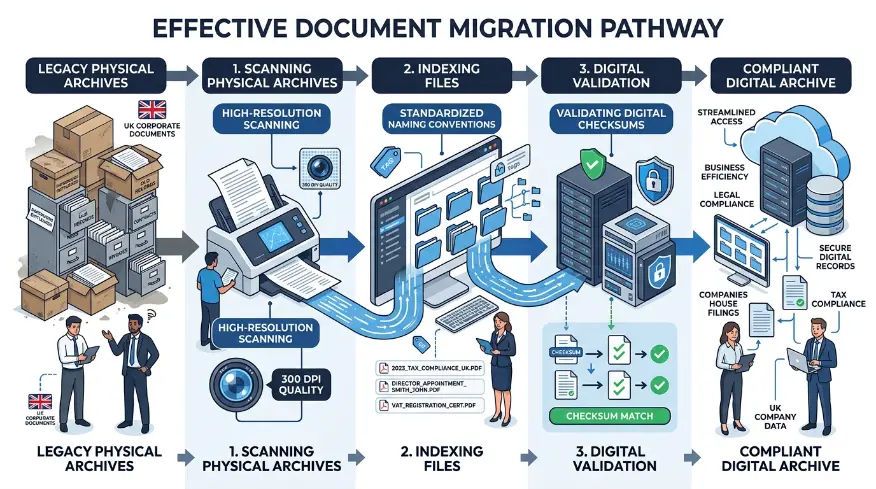
Archival teams digitize historical paper folders by executing high-resolution optical character recognition scans. Standardized metadata tags categorize every digital file by document type, creation date, and related corporate entity. Quality assurance specialists audit migrated files against original physical records to confirm zero data omission errors.
Organizations shred redundant paper documents securely after completing verified digital migrations and legal retention reviews. IT security administrators encrypt all newly created digital repositories using advanced AES-256 protocols before cloud deployment. Staff members complete mandatory training sessions regarding secure file naming conventions and folder structures.
Explore our Company Pack guide,
Which UK Company Documents Can Be Apostilled?
Can You Keep a PSC’s Home Address Off the Public Record?
Frequently Asked Questions
What is included in a standard company pack for UK businesses?
A standard company pack provided by Form My Company typically includes essential corporate documentation such as the certificate of incorporation, memorandum and articles of association, and completed share certificates. These documents serve as the foundational legal instruments required for opening business bank accounts and verifying corporate identity.
How do company packs help with regulatory compliance?\
Company packs streamline regulatory compliance by organizing mandatory statutory registers, director details, and share allocations into standardized, audit-ready formats. Utilizing the Form My Company Company Pack ensures businesses maintain accurate records that satisfy statutory filing requirements set by Companies House.
Can I get both digital and physical copies of my company records?
Modern business services allow founders to receive both secure digital PDF archives for instant access and bound physical presentation binders for formal corporate governance. Form My Company offers flexible structuring options within their Company Pack to accommodate hybrid operational models for UK enterprises.
Why do I need a company pack when opening a business bank account?
High street banks require verified constitutional documents from a company pack to confirm legal incorporation, registered office addresses, and ownership structures before approving commercial accounts. Financial institutions inspect these records during anti-money laundering and know-your-customer checks.
How do I update my company records after purchasing a company pack?
Businesses update corporate records by submitting statutory event notifications to Companies House and amending internal registers whenever director appointments, share transfers, or registered address changes occur. Form My Company assists growing enterprises in maintaining record accuracy long after the initial Company Pack is delivered.