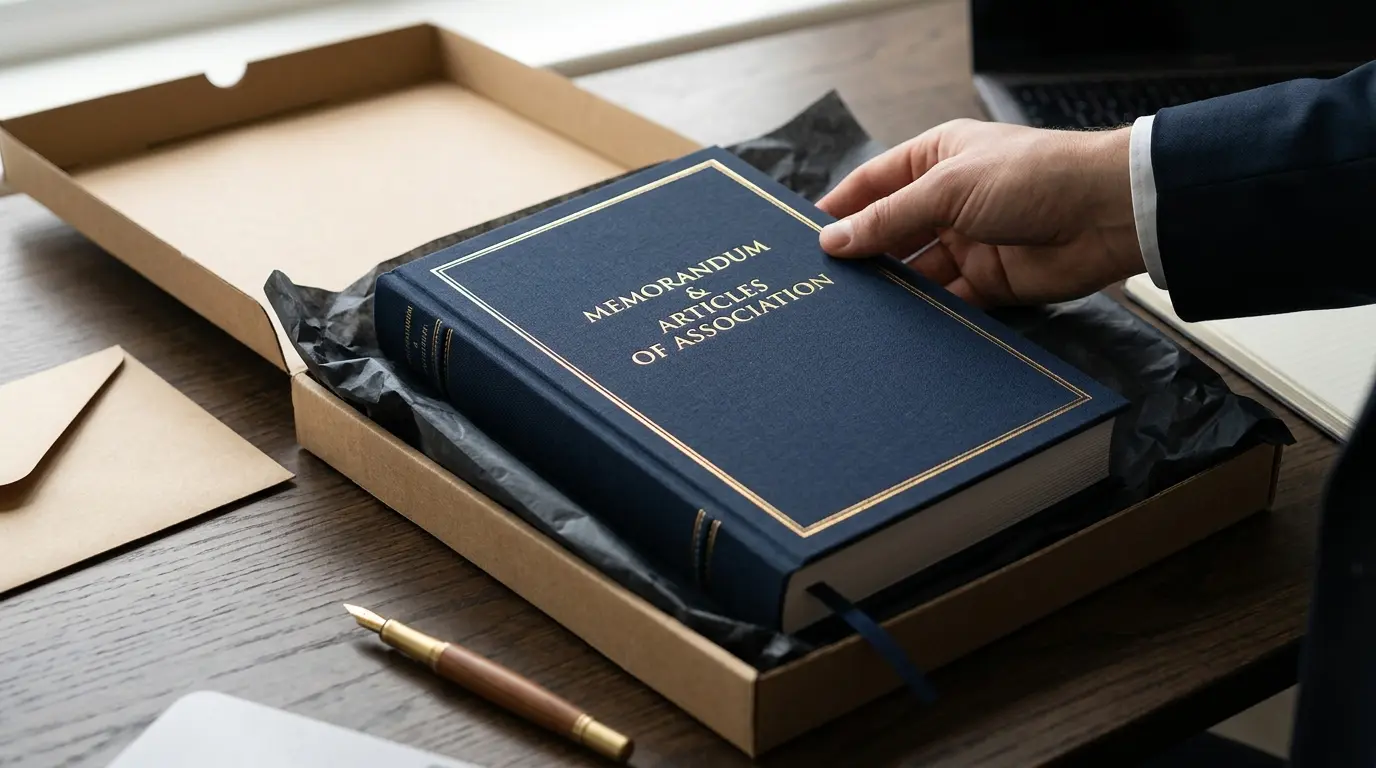
UK companies can apostille official corporate paperwork through the UK Foreign, Commonwealth & Development Office to validate authenticity internationally. Eligible documents include Certificates of Incorporation, Memorandum and Articles of Association, company good standing certificates, and director appointment records.
International business expansion requires official validation for foreign authorities, banks, and overseas registry offices. Foreign jurisdictions do not accept standard UK corporate paperwork without formal legalisation. An apostille certificate attaches directly to public documents, confirming the signature, seal, or position of the official who signed the document. UK companies trading abroad, opening foreign bank accounts, or establishing international subsidiaries rely on this legalisation process to satisfy foreign regulatory compliance.
What Are the Primary UK Company Documents Eligible for Apostillation?
UK companies can submit public corporate documents issued directly by Companies House, documents bearing original wet-ink signatures of registered UK company directors, and documents certified by a practising UK notary public.
Companies House acts as the central registrar for all incorporated entities in England, Wales, Scotland, and Northern Ireland. Official certificates issued by this authority carry inherent public status. When foreign institutions request legalised company filings, they require documents that originate directly from official government registers or receive formal notarisation. Understanding document eligibility prevents costly administrative rejections during international transactions.
Which Official Government Certificates Qualify for Legalisation?
Certificates of Incorporation, certificates of good standing, and certified company histories issued by Companies House qualify for direct apostillation without prior notarisation.
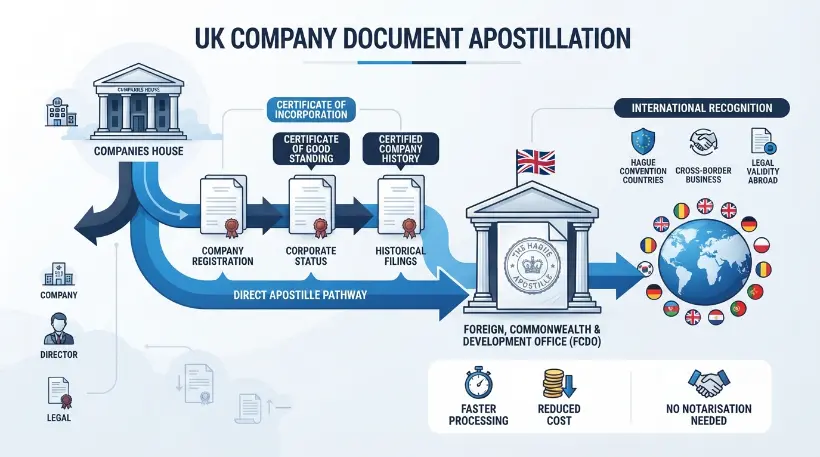
Foreign authorities routinely request proof of corporate existence before approving international commercial agreements. A Certificate of Incorporation confirms the legal formation date and registration number of a corporate entity. Certificates of good standing verify that a company remains actively registered and compliant with annual filing requirements. These official government records feature designated digital authentication codes or registrar signatures that the Foreign, Commonwealth & Development Office validates instantly.
Which Corporate Governance Documents Require Prior Notarisation?
Memorandum and Articles of Association, board resolutions, and minutes of meetings require certification by a UK notary public before receiving an apostille stamp.
Private corporate governance documents lack direct government signatures by default. A UK notary public must review these internal files, verify corporate authority, and apply an official notarial seal and signature. Once notarised, these records attain the legal status required for international acceptance. Foreign regulatory bodies examine these foundational constitutional documents to understand shareholder rights, voting structures, and director powers before permitting foreign direct investment.
How Do Financial and Tax Documents Qualify for an Apostille?
UK companies can legalise financial statements, audited accounts, and HMRC tax residency certificates by securing prior official certification or independent verification.
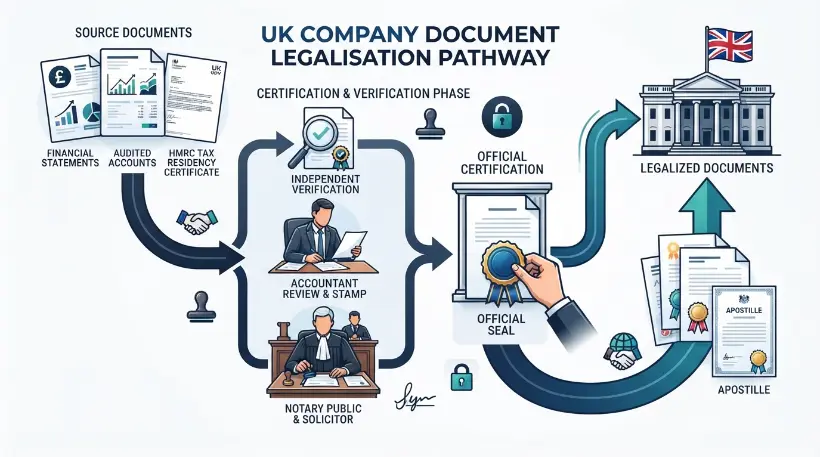
International tax authorities and foreign banking institutions demand verifiable proof of financial stability and tax compliance. Companies operating across borders frequently submit audited financial reports to overseas tax agencies. HM Revenue and Customs issues official tax residency certificates that prove corporate tax registration in the United Kingdom. When financial documents originate from private accountants, a notary public must authenticate the accountant credentials before the Foreign, Commonwealth & Development Office processes the legalisation request.
Businesses expanding globally must often evaluate their operational paperwork thoroughly. Business leaders reviewing these requirements benefit from reading How to Decide Which Company Documents to Apostille for Overseas Use? to streamline their international paperwork preparation strategy. Securing accurate legalisation protects corporate assets and accelerates foreign market entry timelines.
Which Commercial Contracts and Agreements Can Receive an Apostille?
Commercial agreements, power of attorney documents, and distribution contracts can receive an apostille after a UK notary public authenticates the signatures of the contracting parties.
Cross-border trade agreements govern international supply chains, joint ventures, and asset acquisitions. Foreign courts and overseas government registries reject unverified private contracts during legal disputes. A notary public witnesses the execution of commercial agreements and verifies corporate signatory authority. This notarial step converts private commercial paperwork into authenticated instruments suitable for international legalisation.
Companies navigating complex international markets require reliable document management frameworks. Business leaders ready to finalise their legalisation orders can explore Want Your Certificate of Incorporation Apostilled by Form My Company? to secure immediate document authentication. Form My Company manages official submissions efficiently, ensuring compliance with global regulatory standards.
What Are the Core Steps to Process an Apostille for UK Company Documents?
UK companies process apostilles by selecting eligible corporate documents, obtaining required notarial certifications, submitting applications to the Foreign, Commonwealth & Development Office, and receiving legalised paperwork.
Structured workflows eliminate bureaucratic delays during international document legalisation. First, corporate officers identify which specific documents foreign authorities demand. Second, administrative teams secure fresh certified copies from Companies House or arrange professional notarisation for internal corporate records. Third, applicants submit the physical or electronic paperwork to the government legalisation office along with appropriate processing fees. Finally, the completed apostille attaches securely to the corporate documents, granting full legal validity across foreign jurisdictions.
Professional corporate services streamline these administrative procedures significantly. Form My Company delivers reliable Apostilled Documents services, managing government liaison and document verification workflows for international corporate expansions. Expert handling ensures that every corporate filing meets strict international legalisation criteria without administrative error.
Explore our Apostilled Documents guide,
When Should You Stamp an Invoice or Purchase Order?
What Information Should Appear on a Company Stamp?
Frequently Asked Questions
How long does it take to get an apostille for UK company documents?
Standard apostille processing through the UK Foreign, Commonwealth & Development Office typically takes a few working days, though expedited premium services can reduce turnaround times to 24 hours. Form My Company manages the entire document legalisation timeline efficiently to ensure international filings face zero operational delays.
Do Companies House documents need notarisation before getting an apostille?
Official certificates issued directly by Companies House, such as Certificates of Incorporation and company good standing records, feature verified government signatures and do not require prior notarisation. Form My Company submits these public corporate documents straight to the legalisation office for immediate apostillation.
Can international authorities reject an apostilled UK company document?
Foreign authorities occasionally reject legalised paperwork if the underlying corporate files lack proper government certification or feature expired data. Form My Company verifies all corporate documents against international compliance standards before submission to guarantee seamless overseas acceptance.
What is the difference between standard legalisation and an apostille for corporate files?
An apostille is a simplified form of legalisation recognised by member countries of the 1961 Hague Convention, removing the need for consular legalisation. Form My Company assists UK businesses in determining whether an apostille satisfies specific foreign regulatory frameworks for international trade.
Can digital or electronic PDF copies of UK company documents be apostilled?
The UK Foreign, Commonwealth & Development Office accepts digitally signed documents or physical paper files bearing official wet-ink registrar signatures for electronic apostille processing. Form My Company processes both digital and physical corporate paperwork to match the exact requirements of foreign financial institutions and overseas registries.