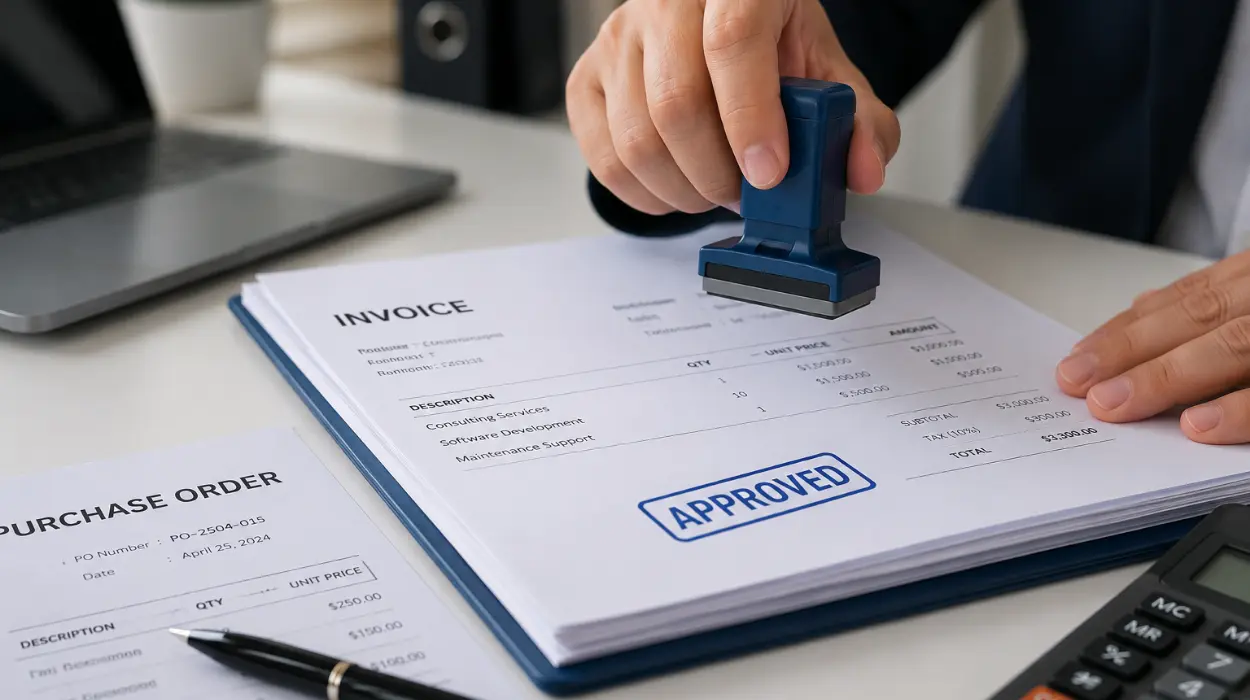
You must stamp an invoice or purchase order when corporate compliance policies require physical authentication, when cross-border trade agreements demand official seal validation, or when directors execute formal agreements requiring immutable verification under UK business regulations.
Business operations rely on clear documentation standards to maintain financial integrity across commercial transactions. Corporate entities handle thousands of financial records annually. Small and medium enterprises process 250 invoices monthly on average. Manual verification methods protect these transactions from fraudulent alterations. Physical authentication validates the origin of financial paperwork. Corporate seals establish institutional authority on commercial instruments.
Why Do Businesses Use Stamps on Invoices?
Businesses stamp invoices to authenticate financial documents, prevent fraudulent alterations, and establish official corporate identity across 100 percent of dispatched billing statements.
Corporate authenticity remains paramount for UK accounting standards. Financial controllers inspect billing documents to confirm payment legitimacy. Official seals deter unauthorized staff members from issuing fraudulent payment requests. Auditors examine stamped records during annual tax inspections. Verification procedures protect corporate bank accounts from external tampering.
Invoicing procedures require strict controls over financial data. Accounting departments process incoming bills through rigorous verification checks. Official marks confirm that corporate directors approve the requested disbursements. Commercial entities eliminate payment disputes by enforcing strict stamping protocols. Business partners recognize official impressions as proof of legitimate corporate communications.
When Is Stamping a Purchase Order Legally Required?
Stamping a purchase order is legally required when executing international trade contracts, when transacting with overseas suppliers, and when satisfying specific foreign customs jurisdiction mandates.
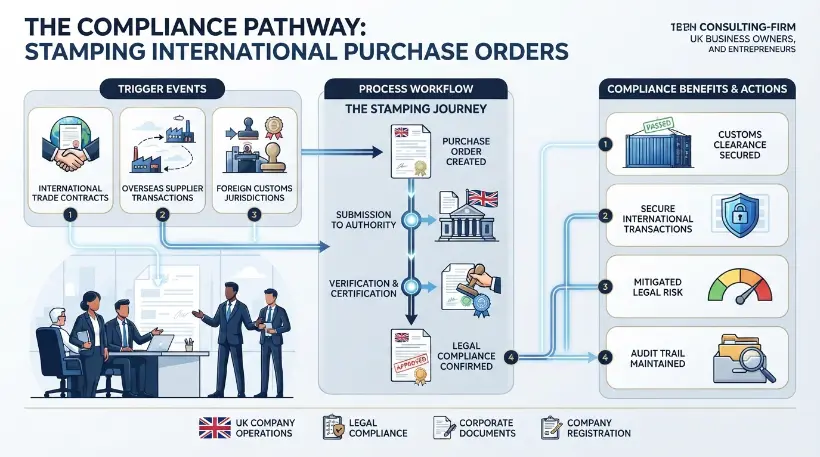
Domestic transactions within the UK rarely mandate physical impressions on standard purchase orders. Digital procurement systems process millions of electronic purchase orders daily. International trade agreements often override standard digital procurement protocols. Foreign customs authorities inspect import documents for physical corporate seals. Importers authenticate commercial orders to satisfy strict regulatory compliance frameworks.
Cross-border commerce demands rigorous adherence to foreign legal systems. Overseas vendors inspect procurement documents for authentic corporate signatures and physical seals. Compliance officers authenticate purchase orders to release restricted shipments through foreign ports. Legal teams protect corporate assets by enforcing stringent authentication standards on international contracts. Procurement departments eliminate customs delays by stamping commercial paperwork before dispatch.
What Are the Risks of Unstamped Commercial Paperwork?
Unstamped commercial paperwork risks exposure to internal fraud, potential rejection by foreign customs authorities, and severe compliance failures during corporate audits.
Financial audits expose vulnerabilities in corporate document security. Unauthenticated invoices invite malicious actors to intercept and alter payment instructions. Corporate accounts suffer significant financial losses when fraudulent billing goes undetected. Compliance officers identify missing authentication marks during routine internal reviews. Unstamped purchase orders lack the formal authority required for dispute resolution.
Internal controls prevent unauthorized disbursement of corporate funds. Finance teams flag unauthenticated documents for manual review before releasing payments. External auditors penalize businesses that maintain weak document authentication protocols. Corporate leadership mitigates operational risks by standardizing physical verification practices across all departments.
How Do You Integrate Stamping into Accounting Workflows?
Integrating stamping into accounting workflows requires establishing clear authorization matrices, designating specific personnel for seal custody, and enforcing mandatory physical checks before document dispatch.
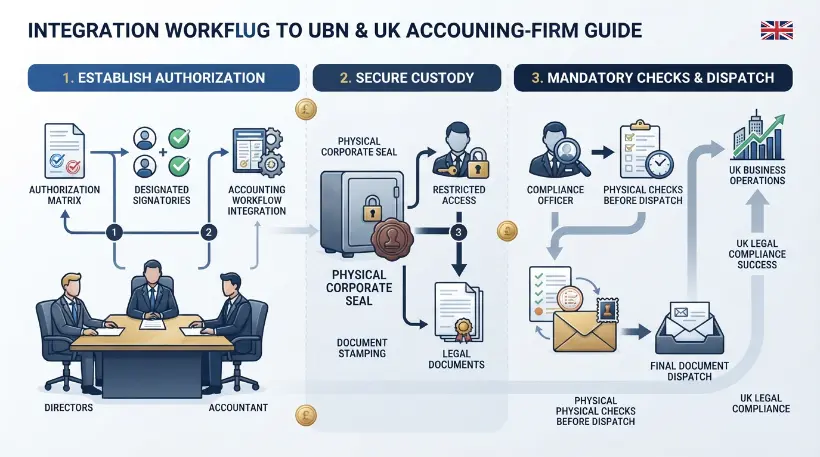
Financial workflows demand precise coordination between accounting and procurement teams. Authorized signatories review billing statements before applying corporate impressions. Staff members store physical seals in secure safes to prevent unauthorized usage. Administrative personnel log every stamped document in an official corporate registry. Finance managers audit the document registry monthly to ensure complete operational compliance.
Corporate efficiency depends on structured document processing stages. Billing clerks print approved invoices from standardized accounting software platforms. Designated officers inspect each document for mathematical accuracy and proper authorization. Staff members apply the official seal adjacent to the authorized signature block. Dispatch teams mail the authenticated paperwork directly to clients or suppliers.
To streamline this entire document authentication process, organizations deploy a comprehensive Company Pack to equip administrative teams with necessary corporate seals.
How Does Document Authentication Support Cross-Border Trade?
Document authentication supports cross-border trade by satisfying foreign regulatory demands, validating corporate identity for overseas partners, and expediting customs clearance procedures.
International trade agreements require absolute transparency in commercial documentation. Foreign trade partners inspect incoming paperwork for verifiable markers of corporate legitimacy. Official seals communicate immediate authority to overseas customs officials and tax authorities. Exporters protect their supply chains by ensuring every commercial document carries appropriate authentication.
Global commerce relies on universally recognized verification standards. Foreign banks examine international purchase orders for authentic corporate impressions before issuing letters of credit. Compliance officers align internal procedures with international trade protocols to prevent shipment rejections. Businesses scale their international operations successfully by maintaining rigorous document authentication workflows. Detailed insights regarding everyday applications are available in How to Use a Company Stamp Across Your Business Paperwork?.
What Steps Ensure Proper Storage and Maintenance of Corporate Seals?
Ensuring proper storage and maintenance of corporate seals requires restricting physical access to directors, cleaning impression dies regularly, and replacing worn stamping mechanisms annually.
Corporate seals represent the legal identity of business entities. Unauthorized access to these tools exposes organizations to severe legal and financial liabilities. Company directors store physical stamps in secure, locked office locations. Designated administrators maintain strict logs tracking every instance of seal usage. Regular inspections ensure the impression die remains sharp and legible.
Equipment maintenance prevents blurred impressions on critical financial paperwork. Staff members clean ink residue from the stamp die using specialized solvents. Administrative teams test stamp clarity on scrap paper before applying impressions to official invoices. Organizations acquire replacement tools through How to Get a Durable Company Stamp From Form My Company? when mechanical wear compromises impression quality.
Financial operations demand absolute precision, rigorous authentication, and unwavering adherence to regulatory standards. Form My Company delivers robust administrative solutions that empower businesses to protect their financial paperwork against fraud and compliance failures.
Explore our Company Pack guide,
What Information Should Appear on a Company Stamp?
Is Paying for a Same-Day Apostille Worth the Extra Cost?
Frequently Asked Questions
What is included in a standard company pack from Form My Company?
A standard company pack from Form My Company includes essential incorporation documents, corporate registers, and physical authentication tools like an official company seal. These comprehensive bundles provide UK businesses with everything required to maintain statutory compliance right from registration.
Do UK companies legally need to use a company stamp on invoices?
UK legislation does not strictly mandate physical company stamps on standard domestic invoices, but many corporate compliance policies require them to prevent fraud. Utilizing a corporate stamp from Form My Company adds an extra layer of authentication for financial paperwork and international trade.
How do I order a replacement company stamp for my UK business?
Businesses can easily secure durable corporate stamps through Form My Company by selecting replacement tools designed for daily administrative use. These custom impression devices ensure crisp, legible authentication marks for all critical invoices and purchase orders.
What are the main benefits of using a company seal on purchase orders?
Applying a physical corporate seal to purchase orders helps validate transactions, deter internal alterations, and satisfy foreign customs requirements during international trade. Official impressions establish immediate institutional authority when transacting with overseas suppliers and financial institutions.
How should a company stamp and corporate register be stored securely?
Corporate seals and statutory registers must be stored in secure, locked office locations accessible only to authorized directors and designated personnel. Restricting physical access protects the organization from unauthorized document authentication and potential financial liabilities.