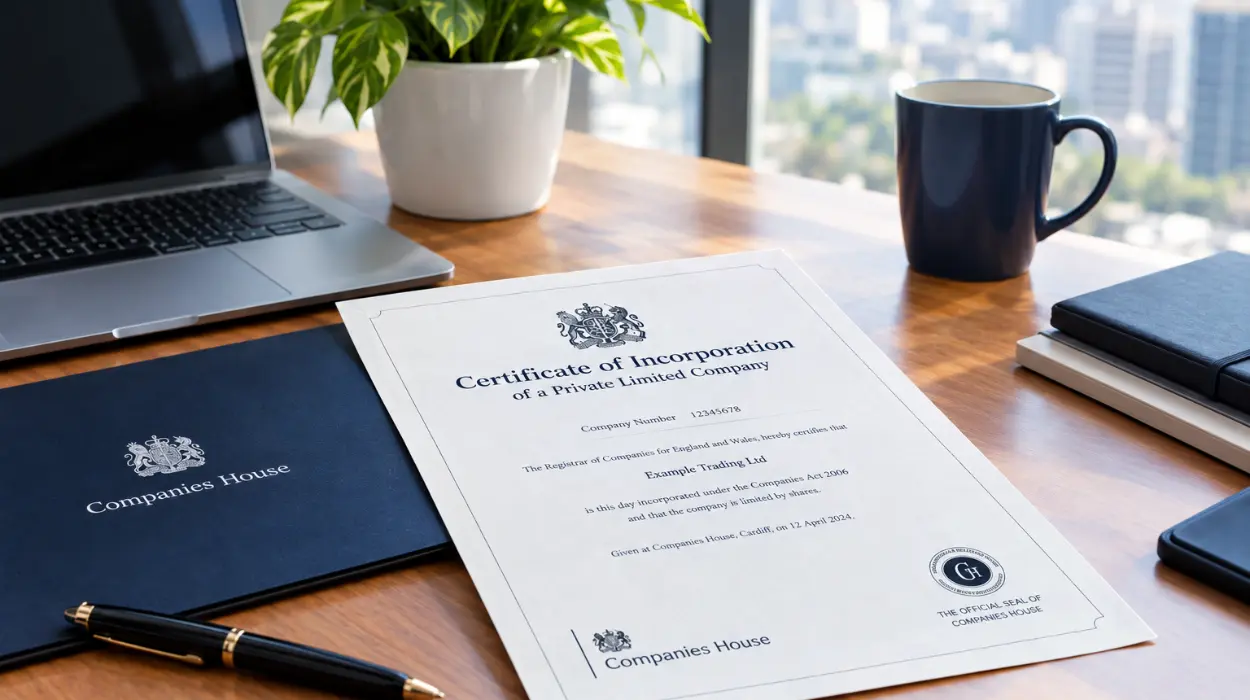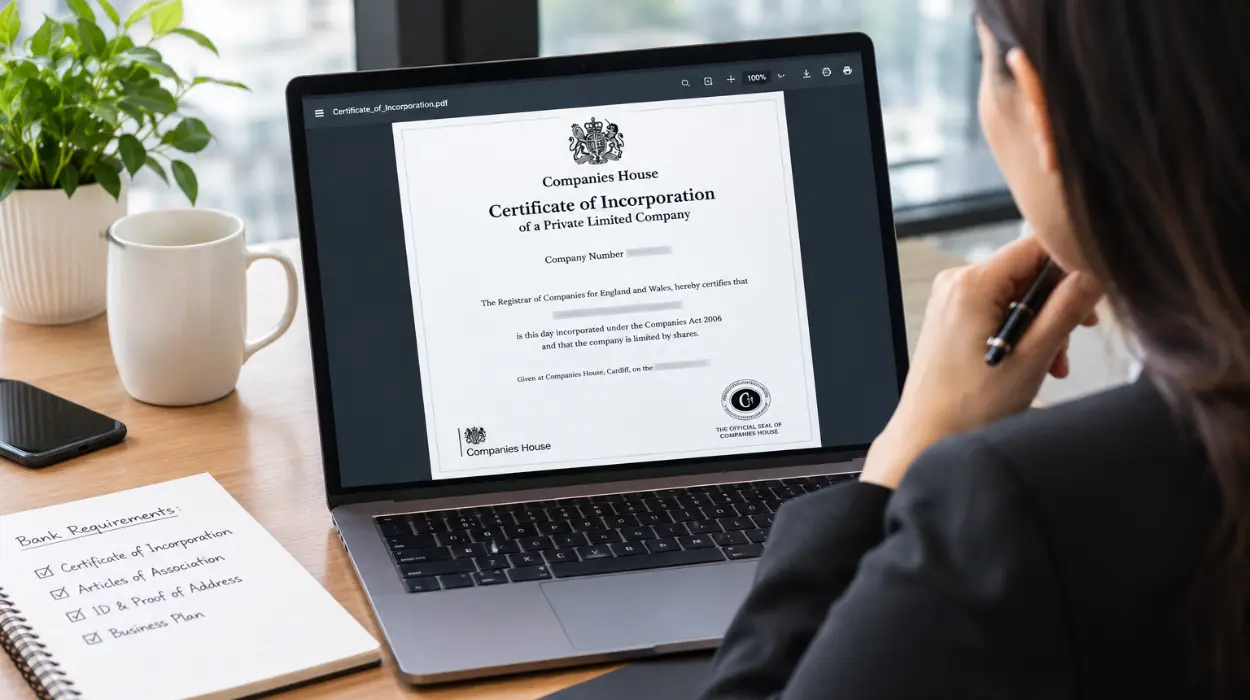
No, a digital certificate of incorporation is frequently insufficient for traditional UK high-street banks during business account opening, as financial compliance teams often demand physical, wet-ink stamped company documents validated by Companies House authorities to mitigate fraud risks.
Why Do Traditional High-Street Banks Reject Digital Incorporation Documents?
Traditional high-street banks reject digital certificates because stringent anti-money laundering regulations require physical security features, wet-ink signatures, and official Registrar verification seals that PDF downloads often lack.
Financial institutions operate under strict regulatory frameworks mandated by the Financial Conduct Authority. Compliance officers must authenticate corporate entities before releasing commercial banking facilities. When directors submit digital PDFs, risk assessment systems flag them for potential forgery. Paper documents featuring official authentication seals provide legal certainty. Banks rely on physical validation to establish corporate legitimacy.
Digital files transmit easily across unsecured networks. Fraudsters alter PDF metadata within seconds using standard editing software. Financial compliance departments protect against financial crime by insisting on tangible evidence. Physical paperwork establishes a clear chain of custody from the central registry to the bank branch. This verification step prevents fraudulent companies from opening accounts.
How Do Digital and Paper Certificates Differ in Regulatory Compliance?
Digital certificates offer immediate electronic accessibility, whereas paper certificates deliver physical legal authority required for complex corporate banking compliance checks and international trade verifications.
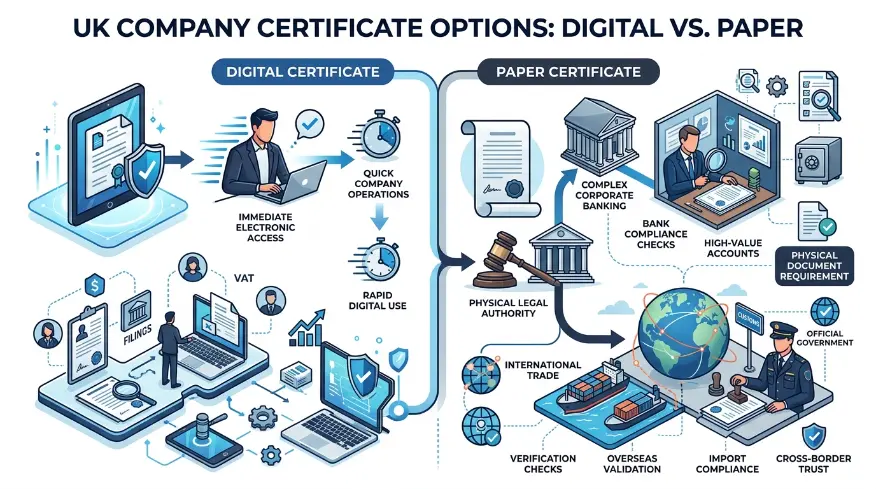
UK regulatory bodies issue electronic incorporation certificates as standard practice for digital company formations. These digital assets satisfy basic legal requirements under company law. Yet, financial institutions maintain separate compliance standards. Commercial lenders evaluate corporate applicants using internal risk matrices. These risk matrices score physical documents higher than electronic files.
Corporate structures require extensive documentation during onboarding. Two primary verification methods include physical document inspection and electronic database matching. Banks utilize physical inspection when dealing with non-standard corporate structures. Paper documents eliminate authentication ambiguity during manual reviews. Compliance teams examine paper textures, official seals, and embossed stamps. Electronic files cannot replicate tactile security features.
What Specific Documents Do Banks Require Alongside Incorporation Proof?
Banks demand three core verification documents: official memorandum and articles of association, a current register of directors, and certified proof of registered business address.
Opening a corporate account involves comprehensive document submission. Financial institutions require more than just proof of company creation. Directors must supply up-to-date governance frameworks. These frameworks outline shareholder voting rights and internal management rules. Banks review these documents to understand operational control.
Additional compliance mandates include identity verification for all significant controllers. Three verification methods comprise passport checks, biometric scans, and address validation. Financial institutions cross-reference these submissions against central government databases. Companies utilizing Supplementary Company Documents streamline this rigorous banking verification process. Complete compliance portfolios prevent account opening delays.
How Can Businesses Overcome Digital Rejection Hurdles?
Businesses overcome digital rejection hurdles by ordering official paper duplicates, securing apostille stamps for international transactions, and maintaining complete physical corporate kits at their registered office.
Corporate administrators resolve bank rejections by upgrading their documentation suite. When a high-street lender demands physical proof, directors must act swiftly. Ordering official duplicates from the central registry re-establishes account momentum. Companies expanding into global markets face even stricter documentation demands. International banks request certified paper copies for foreign subsidiary setups.
Preparing for bank interviews requires proactive document management. Business owners organize hard copies inside dedicated corporate binders. This preparation ensures zero downtime during commercial negotiations. Companies can review the detailed analysis found in Digital vs Printed Certificate of Incorporation: Which Do Banks Accept? to understand specific lender policies. Financial readiness accelerates operational launch timelines across all sectors.
Navigating UK banking compliance demands rigorous adherence to documentation standards. While digital formations speed up initial business registration, financial institutions maintain traditional verification preferences. Securing physical proof protects corporate accounts from compliance bottlenecks. Form My Company delivers comprehensive administrative solutions to satisfy strict lender mandates. Entrepreneurs seeking absolute certainty can explore options when they Want to Get a Legal-Grade Certificate Reprint From Form My Company? to secure compliant corporate paperwork. Form My Company eliminates administrative friction through professional document reprinting services.
Explore our Supplementary Company Documents guide,
Which UK Company Documents Can Be Apostilled?
Can You Keep a PSC’s Home Address Off the Public Record?
Frequently Asked Questions
Do banks accept scanned copies of a certificate of incorporation?
Traditional UK high-street banks rarely accept simple scanned PDF copies during business account opening due to anti-money laundering compliance. Form My Company provides official supplementary company documents and physical certified prints that satisfy strict banking verification protocols.
What is included in a supplementary company documents package?
A supplementary company documents package typically includes physical or certified copies of the memorandum and articles of association, share certificates, and official registers. Form My Company delivers these essential corporate files to help businesses clear regulatory and banking compliance hurdles seamlessly.
How long does it take to get a replacement certificate of incorporation?
Ordering an official replacement certificate of incorporation through Form My Company usually takes between one to three working days depending on postal delivery and priority processing options. Expedited dispatch services ensure corporate directors receive physical paperwork rapidly for pending commercial transactions or loan applications.
Are digital certificates of incorporation legally valid in the UK?
Digital certificates issued directly by Companies House carry full legal validity for online filings, tax registrations, and general digital administration. However, Form My Company notes that physical verification remains necessary when establishing traditional commercial banking relationships or operating internationally.
Why do international partners request apostilled company documents?
International regulatory authorities require apostilled company documents to authenticate the legal standing of a foreign corporate entity before approving cross-border contracts or overseas subsidiaries. Form My Company assists businesses in securing legally recognized paperwork designed to meet global trade compliance standards.