
Hiring an all-in-one assistant to eliminate telephone interruptions often creates more management overhead than it resolves. Every growing business owner knows the frustration of broken concentration, just as they know the sting of missing a lucrative sales enquiry whilst occupied in client meetings. Juggling frontline customer communication alongside strategic projects is exhausting, especially when full-time in-house hires aren’t practical. When weighing up Call Answering vs. Virtual Assistants: Making the Right Choice depends entirely on the operational friction you need to remove.
You already recognise that protecting your focus is vital for long-term momentum, but selecting the wrong support model can quickly introduce unwanted training burdens. This guide will help you discover whether a professional call answering service or a virtual assistant best suits your operational requirements, budget, and growth strategy. We’ll compare communication workflows, administrative capacity, and overall flexibility so you can establish an exceptional corporate presence without stretching your resources.
Key Takeaways
- Understand the distinct roles of specialised inbound call handlers versus multi-task administrative virtual assistants to solve your precise operational bottlenecks.
- When comparing Call Answering vs. Virtual Assistants: Making the Right Choice depends on whether you require reliable real-time voice coverage or broader administrative task delegation.
- Account for hidden supervisory overheads, contrasting the hands-on management needed for independent freelancers with the ready-to-deploy reliability of team-backed answering infrastructure.
- Apply a practical two-step audit to quantify your missed telephone opportunities and separate frontline customer enquiries from routine back-office workflows.
- Discover how pairing telephone answering with virtual office services and meeting facilities establishes a unified, credible corporate presence for modern remote businesses.
Understanding the Core Distinctions: Call Answering vs. Virtual Assistants
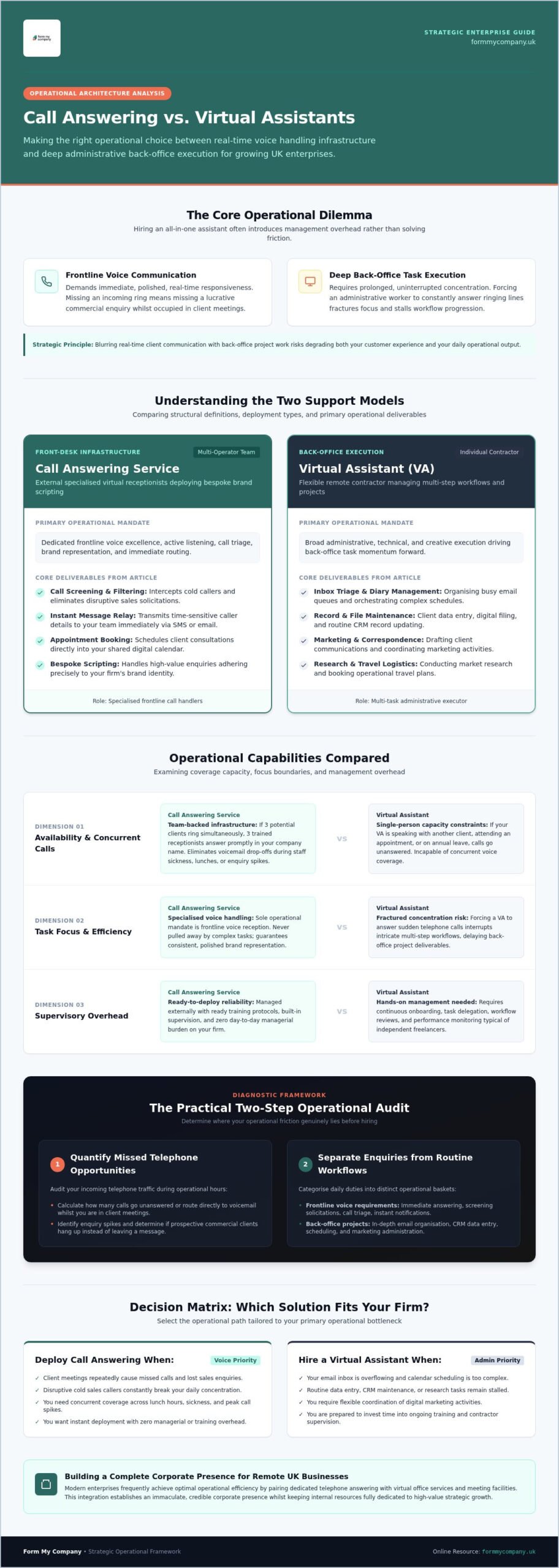
Growing UK enterprises often bundle telephone management and general administrative support into a single operational basket. This confusion is understandable, yet it frequently leads to misallocated resources and operational friction. When evaluating Call Answering vs. Virtual Assistants: Making the Right Choice begins with separating real-time client communication from back-office task execution. Inbound telephone calls demand immediate, polished responsiveness. Deep administrative work, by contrast, requires uninterrupted concentration. Blurring these distinct functions risks degrading both your customer experience and your daily operational output.
The Dedicated Call Answering Model Explained
A professional telephone answering service functions as an external, specialised front desk for your business. Instead of delegating varied administrative duties to an individual assistant, this model deploys dedicated virtual receptionists who answer incoming enquiries using bespoke brand scripting.
Core deliverables of this model include:
- Screening cold callers and filtering out disruptive sales solicitations
- Relaying time-sensitive messages to your team via email or SMS instantly
- Booking appointments directly into your shared digital calendar
Deploying dedicated call answering ensures your enterprise captures every high-value commercial opportunity during operational hours, maintaining an immaculate brand presence while you focus on core delivery.
The Virtual Assistant Model Explained
A virtual assistant (VA) operates as a flexible remote contractor handling a broad spectrum of administrative, technical, or creative tasks. Unlike reception teams standing by for incoming rings, VAs concentrate on project-based execution that drives back-office workflows forward.
Common virtual assistant deliverables include:
- Triage of busy email inboxes and complex diary management
- Client record organisation, data entry, and digital file maintenance
- Coordinating digital marketing activities and drafting client correspondence
Because a VA focuses on multi-step workflows, requiring them to constantly answer incoming telephone lines fractures their concentration and delays project delivery. Recognising this structural boundary is key to selecting the support model that genuinely matches your operational needs.
Operational Capabilities Compared: Scope, Availability, and Focus
Balancing customer accessibility with deep project work is a persistent operational challenge. When assessing Call Answering vs. Virtual Assistants: Making the Right Choice hinges on whether your daily friction stems from unattended telephone enquiries or stalled back-office projects. Both options relieve pressure, yet they deploy fundamentally different operational mechanics.
Availability and Coverage: Infrastructure vs. Individual Capacity
A professional call answering service relies on team-backed infrastructure. If three potential clients ring simultaneously, three trained receptionists answer promptly in your company name. This multi-operator framework guarantees operational continuity during staff sickness, lunch breaks, and unexpected enquiry spikes, ensuring lines never ring out to voicemail.
An independent virtual assistant operates under single-person capacity constraints. If your VA is speaking with another client, attending an appointment, or taking annual leave, incoming calls go unanswered. While individual VAs provide bespoke attention, a single remote worker cannot deliver concurrent telephone coverage.
Task Diversity vs. Specialised Communication Excellence
Virtual receptionists focus entirely on frontline voice excellence. They excel at active listening, efficient call triage, brand representation, and swift message routing. They do not get pulled away by external tasks because call handling is their sole operational mandate. Understanding the premium virtual receptionist features that elevate your brand helps clarify precisely why dedicated call handling outperforms generalist administrative support for inbound communication.
Virtual assistants offer broad administrative capability. They organise complex files, conduct market research, handle travel logistics, and maintain CRM records. Forcing a VA to provide constant phone coverage disrupts their workflow. Splitting focus between intricate tasks and sudden telephone interruptions invariably reduces output quality on both fronts.
| Operational Dimension | Call Answering Service | Virtual Assistant |
|---|---|---|
| Availability & Redundancy | Team-backed coverage; eliminates busy tones and covers leave seamlessly | Single-operator capacity; limited availability during meetings or leave |
| Core Deliverables | Frontline call screening, message relaying, appointment capture | Diverse back-office administration, research, document creation |
| Management Overhead | Low; provider manages staff training, equipment, and quality control | Moderate to high; requires hands-on direction, onboarding, and task review |
| Scalability | Instant; absorbs sudden enquiry surges without operational delays | Restricted; capped by the freelancer’s agreed weekly hourly capacity |
For growing enterprises seeking to maintain continuous accessibility alongside remote agility, exploring integrated virtual office services establishes an immediate, resilient foundation for inbound communications.
Financial and Management Overhead: Calculating True Operational Costs
Assessing external support requires looking past initial headline rates. Business owners frequently underestimate the internal time needed to direct external personnel. When weighing up Call Answering vs. Virtual Assistants: Making the Right Choice demands a transparent calculation of both financial structures and ongoing managerial overheads.
Billing Models: Retainers vs. Usage-Based Pricing Structures
Telephone answering services typically operate on tiered usage models, charging per call or per minute of active voice interaction. If seasonal demand dips, your operational expenditure adjusts automatically. This setup provides predictable cash-flow protection because you pay strictly for completed client engagements.
Virtual assistants generally bill via monthly retainers or hourly blocks. You purchase an agreed quantity of hours each month, committed in advance. If your business experiences a quiet trading period, that retainer remains payable regardless of whether you assign enough tasks to fill the hours. Conversely, sudden spikes in administrative demand can quickly exhaust contracted hours, triggering surplus fees or delayed project turnaround.
Training, Oversight, and Management Demands
Founder time is an expensive operational resource. Introducing external help should reduce your working hours rather than expand your management checklist.
Call answering services provide an efficient, low-friction integration:
- Onboarding requires supplying core business facts, call forwarding instructions, and agreed brand scripts.
- The provider assumes full responsibility for receptionist training, software licences, quality monitoring, and line maintenance.
- Daily involvement is limited to reading structured call summaries delivered to your inbox.
Integrating a virtual assistant demands deeper, ongoing supervisory commitments:
- You must configure software permissions, train them on internal systems, and define specific standard operating procedures.
- Delegated tasks require regular quality reviews, status check-ins, and ongoing task assignment.
- Unclear briefs often lead to scope creep or misaligned deliverables, requiring founder intervention to correct.
If your priority is eliminating administrative bottlenecks without taking on supervisory responsibilities, a specialised call handling solution keeps operational overhead low. If you have the managerial bandwidth to train and oversee a generalist contractor, a virtual assistant provides broader utility across varied back-office projects.
Decision Framework: How to Select the Ideal Solution for Your Firm
Selecting operational support requires an objective look at where your business loses momentum each day. Rather than guessing which model works best, apply a structured diagnostic process. When considering Call Answering vs. Virtual Assistants: Making the Right Choice comes down to five straightforward steps:
- Audit interruption patterns: Track your working hours for one week. Quantify how many inbound calls interrupt focused work and how many slip through to voicemail.
- Categorise daily friction: Divide bottlenecks into frontline communication tasks (answering queries, screening callers) versus back-office execution (drafting proposals, reconciling invoices).
- Assess budget and required hours: Decide whether your revenue model benefits more from per-call variable pricing or a committed monthly retainer.
- Identify your commercial priority: Determine whether rapid inbound lead capture or back-office task delegation will drive immediate revenue growth.
- Evaluate a hybrid model: Consider whether deploying specialised answering infrastructure alongside targeted administrative support provides the most balanced setup.
When a Professional Call Answering Service Is Your Best Choice
A telephone answering service represents the most efficient investment when inbound communication drives immediate revenue. If prospective clients ring your line and move to a competitor after reaching voicemail, missed calls mean direct financial losses. It also serves firms where directors lose entire afternoons answering basic pricing questions or screening unsolicited sales calls.
Implementing structured call answering ensures your business maintains seamless, professional client greetings throughout the working day without disrupting internal operations.
When Hiring a Dedicated Virtual Assistant Makes Better Sense
A virtual assistant is the logical path when operational logjams sit firmly within internal administration. If your primary headache involves sorting overflowing inboxes, updating CRM databases, drafting proposals, or executing research, a VA delivers targeted relief. These tasks demand deep contextual knowledge of your business, which standard call scripting cannot provide. When your telephone lines remain relatively quiet but administrative backlogs delay customer delivery, hiring an assistant resolves the bottleneck effectively.
Ready to secure your business communications? Explore our professional call answering packages today to capture every incoming enquiry effortlessly.
Building a Complete Frontline Infrastructure for Modern UK Enterprises
Capturing inbound calls is only one element of projecting corporate authority. When reviewing Call Answering vs. Virtual Assistants: Making the Right Choice extends beyond daily call logs into your broader operational identity. Relying on personal mobile numbers or listing a residential address on public filings inadvertently signals a fledgling operation. True business resilience requires aligning your telephone handling with a cohesive, professional operational presence.
Integrating Phone Answering with Professional Virtual Offices
Pairing a dedicated telephone answering team with an established commercial address immediately transforms market perception. Utilising comprehensive virtual offices gives remote enterprises the authority of a recognised corporate headquarters without the prohibitive overheads of traditional commercial leases. Incoming calls are managed with bespoke brand scripting, while corporate post is received and processed under a recognised business location.
This integrated framework also solves critical privacy and compliance concerns. Listing a private residential address on public records invites unsolicited mail and compromises personal security. Diverting statutory filings and customer enquiries through an official address service establishes a clear boundary between home life and commercial operations. Your company gains instant institutional credibility whilst your domestic privacy remains entirely protected.
Ensuring Professional Client Encounters from Calls to Meetings
A polished telephone greeting builds strong commercial trust, but high-value agreements often demand in-person collaboration. Transitioning from an articulate phone interaction to an informal coffee shop meeting undermines that initial credibility. Your physical touchpoints must reflect the high standard established during that first telephone contact.
Securing fully equipped meeting rooms provides the dedicated environment needed to host pitches, contract signings, and team strategy days. Form My Company delivers this complete infrastructure, combining telephone answering, compliance management, and corporate facilities under one flexible framework. You gain an adaptable corporate foundation that projects confidence at every touchpoint, allowing you to grow your business without taking on unnecessary operational risk.
Elevate Your Operational Presence Today
Evaluating Call Answering vs. Virtual Assistants: Making the Right Choice rests on diagnosing your daily operational bottlenecks. When complex back-office workflows and administrative tasks delay your project delivery, an independent virtual assistant provides valuable execution. However, when ringing phones scatter your concentration and leave prospective clients speaking to voicemail, a dedicated answering team protects your working hours while securing vital commercial enquiries.
Growing UK enterprises scale fastest when frontline communications align with an authoritative corporate identity. Combining professional call handling with registered address management and executive meeting facilities establishes immediate market credibility. Form My Company delivers comprehensive corporate services designed to eliminate administrative burdens, safeguard residential privacy, and elevate your commercial standing across every client touchpoint.
Protect your focus and capture every enquiry with professional call answering. Take control of your daily schedule, build lasting client trust, and position your enterprise for sustainable expansion today.
Frequently Asked Questions
Can a call answering service handle complex customer support queries?
No, call answering services focus primarily on frontline screening, basic customer triage, message relaying, and appointment bookings rather than technical troubleshooting. When resolving intricate queries, receptionists take detailed notes and forward the caller to your specialist team. When considering Call Answering vs. Virtual Assistants: Making the Right Choice involves recognising that deep, technical support requires either an internal specialist or a dedicated assistant trained extensively on your internal systems.
Will callers know they are speaking to an outsourced telephone answering service?
Callers won’t know they are speaking to an external team if your call handling scripts are configured properly. Professional virtual receptionists answer calls in your company name, following bespoke greeting protocols that mirror an in-house front desk. They access shared calendars, relay messages instantly via email or SMS, and handle customer enquiries seamlessly. Unless you explicitly instruct otherwise, callers assume they’re speaking directly with your permanent office staff.
Is it possible to combine a call answering service with a freelance virtual assistant?
Yes, combining both services creates a powerful, highly productive operational structure for growing UK businesses. A dedicated telephone answering team captures live inbound enquiries without interruption, screening cold callers and booking appointments. Meanwhile, your freelance virtual assistant focuses entirely on complex administration, data entry, and project workflows without constant phone disruptions. This division of labour protects your assistant’s concentration while ensuring you never miss a commercial sales opportunity.
How quickly can a UK business activate a professional call answering service?
Most professional call answering services can be set up and fully active within one to two working days. The onboarding process requires you to submit your business details, specify telephone forwarding rules, and agree on call answering scripts. Once you redirect your phone line to the allocated forwarding number, trained receptionists begin answering incoming calls immediately. This rapid deployment eliminates the lengthy recruitment, hiring, and software onboarding cycles required when bringing in new staff.
Does a virtual assistant answer inbound telephone calls in real time?
A virtual assistant rarely provides guaranteed real-time call answering because they juggle multiple projects and clients simultaneously. When assessing Call Answering vs. Virtual Assistants: Making the Right Choice depends on your phone volume. While a VA can make scheduled outbound calls or monitor voicemails, they can’t answer concurrent incoming rings whilst occupied with deep administrative tasks. If uninterrupted voice coverage during business hours is your priority, dedicated call answering remains the appropriate solution.
What happens if our business experiences an unexpected surge in telephone calls?
A call answering service absorbs unexpected call surges seamlessly through a multi-operator team infrastructure. If multiple customers ring at the exact same moment, different receptionists answer simultaneously, preventing callers from receiving busy tones or voicemail prompts. In contrast, an individual virtual assistant can only handle one phone line at a time. The multi-operator framework ensures reliable call handling continuity during marketing campaigns, seasonal spikes, or sudden press coverage.
How does telephone answering integrate with an official UK virtual office address?
Telephone answering pairs directly with virtual office services to establish a complete, compliant corporate presence nationwide. By combining an official business address with professional phone answering, you protect your residential privacy on public registers whilst projecting institutional authority to prospective clients. All corporate correspondence is sorted and forwarded at the address, while incoming commercial calls are professionally received and logged. It gives you the complete functionality of a corporate headquarters on flexible terms.