A utility bill can help prove where you live, but it may not show that you’re entitled to use an address as your company’s registered office. So, What Proof Do You Need to Use a Registered Office Address? The answer depends on who is asking and what they need to verify.
There isn’t one standard document for every situation. Permission to use an address is different from proof of your home address, and Companies House, an address provider, a bank or HMRC may each have separate checks. Companies House requires an appropriate registered office where official documents can be delivered and acknowledged. Other organisations may ask for evidence suited to their own process.
This guide explains what evidence may be relevant and how to check what a requester will accept. It separates Companies House requirements from address-provider checks, so you can confirm what to prepare before submitting paperwork. Form My Company offers a Registered Office Address Service. Before choosing any address arrangement, check that it meets the requirements of the organisation asking for proof.
Key Takeaways
- Ask the organisation requesting evidence what it accepts. Written permission from the property owner or address provider may help show you’re entitled to use the address.
- A utility bill, bank statement or council tax bill may help with an identity or residence check, but it doesn’t automatically prove permission to use an office address.
- Companies House, address providers and banks may ask for information for different reasons. Confirm the evidence, issue date, format and submission method each requires.
- Keep copies of submitted documents and written confirmation of your permission. These records can help if you receive follow-up questions.
- Before choosing an address service, check its written terms, whether the address can be used as a registered office and how correspondence is handled. A registered office and a virtual office can meet different business needs.
What proof is needed for a registered office address?
The evidence depends on who requests it and what they need to verify. A registered office is the company’s official address for formal communications, including documents sent by Companies House. The Registered office overview provides background, but check current Companies House guidance for UK requirements.
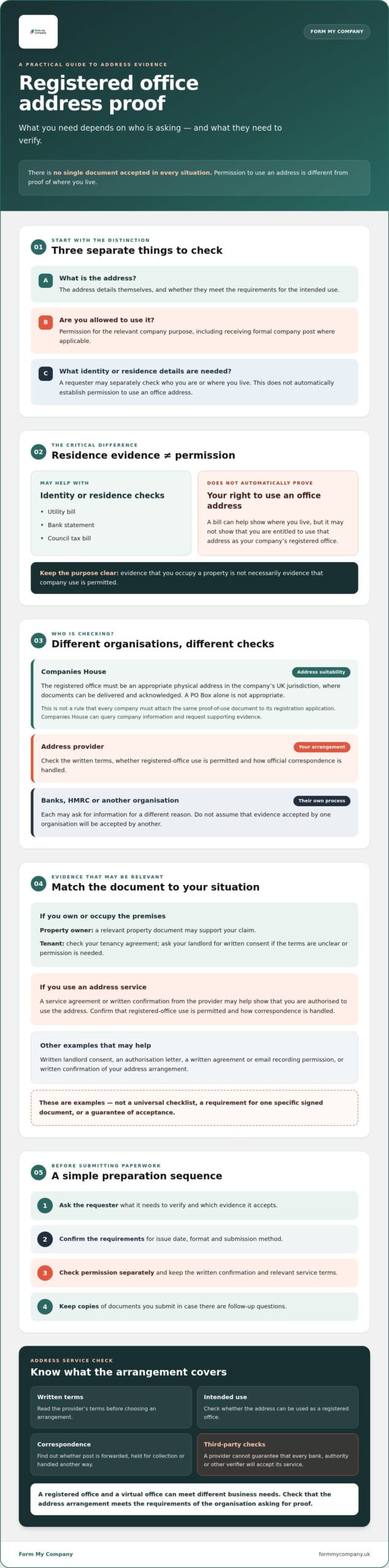
Keep three separate questions in mind: what is the address, do you have permission to use it, and what identity or residence information does the requester need? A bank statement in your name may help verify where you live, but it doesn’t necessarily show that you can use a different address for your company. Similarly, entering an address on a company filing isn’t the same as providing evidence of permission.
What does permission to use an address mean?
Permission means you have a genuine right to use the premises for the relevant company purpose. If you own the property, check whether any applicable arrangements limit its use. If it belongs to someone else, ask the owner or address provider for clear consent and review the service terms. A written agreement or email can help record permission, but there isn’t necessarily one specific signed document required in every situation. The organisation requesting evidence decides what it will accept.
Does Companies House require proof when you register?
Companies House requires an appropriate registered office address in the company’s UK jurisdiction. It must be a physical address where documents can be delivered and acknowledged. A PO Box alone isn’t appropriate. This is a requirement about the suitability of the address, not a rule that every company must attach the same proof-of-use document to its registration application. Companies House can query company information and request supporting evidence, so check its current guidance and the instructions for your filing.
In practical terms, provide an appropriate address and supporting evidence if Companies House asks for it. That doesn’t mean you can use an address without the owner’s or provider’s agreement. Confirm your permission separately and keep the confirmation and relevant service terms.
Form My Company offers a Registered Office Address Service. Review the terms and intended use before relying on a provider’s address, and check separately whether it meets the requirements of the organisation requesting evidence. A provider’s service can establish an address arrangement, but it can’t guarantee that every third party will accept it.
Which documents can help show you are entitled to use the address?
No single document has to be accepted by every organisation. The right evidence depends on who is checking and what they need to establish. A document might show that you occupy a property without confirming that you can use it for company correspondence. Section 86 of the Companies Act 2006 sets the requirement for a company to have a registered office, but a third party may ask for different evidence to confirm your arrangement.
Before sending documents, ask the requester what it accepts. Depending on your circumstances, useful evidence may include a property document, tenancy agreement, written landlord consent, authorisation letter, service agreement or written confirmation from the address provider. These are examples, not a universal checklist or a guarantee of acceptance.
Evidence when you own or occupy the premises
If you own the property, a relevant property document may support your claim. If you rent, check your tenancy agreement and ask your landlord for written consent if the terms are unclear or permission is needed. A tenancy agreement or proof that you live or work at an address doesn’t necessarily confirm that you can use it as a company’s registered office. Check that the proposed use, including receiving formal company post, is permitted.
Evidence when you use an address service
If a provider supplies the address, its service agreement or written confirmation of your arrangement may help show that you’re authorised to use it. Read the terms carefully. Confirm that registered-office use is permitted and find out how official correspondence is handled, including whether it is forwarded, held for collection or managed another way. Don’t assume the agreement will satisfy every bank, authority or other verifier.
Form My Company offers a Registered Office Address Service. Review the service terms and ask what confirmation is available before relying on the address for a particular application. You’ll still need to check the requirements of the organisation requesting evidence.
Before submitting documents, check that the details are current and consistent. The requester may specify an issue date, file type, certification or submission method. Check:
- Company details: the correct legal company name, if the company is already formed.
- Address wording: the full address, written consistently across the evidence and application.
- Permission details: who authorised the use and whether the intended company use is clear.
- Document requirements: any date range, format or delivery instructions set by the requester.
If the company name or address differs across documents, explain why and ask whether further evidence is needed. Keep copies of what you provide and written confirmation of permission, so you can respond clearly if questions arise.
Who may ask for registered office address proof, and why?
The organisation asking for evidence determines what you may need to provide. Companies House checks whether the registered office meets its rules. An address provider, bank or other verifier may have separate procedures. A document accepted by one organisation may not satisfy another, and not every request is a Companies House requirement.
| Who may ask? | Why they may ask | What to confirm |
|---|---|---|
| Companies House | To check company information, including whether the registered office is appropriate for formal communications. It may query information or request supporting evidence. | Check current Companies House guidance and the specific filing instructions. If you receive a query, ask what evidence is needed. |
| Address provider | To complete its own onboarding or confirm you’re authorised to use the address under its service terms. | Ask which documents it accepts, how permission is recorded and what uses the service agreement permits. |
| Bank | As part of its own checks on a business or customer. Its process may include verifying company or address details. | Request the exact document list, accepted alternatives, date limits and submission format. Don’t assume a Companies House record is enough. |
| Other verifiers | HMRC or another organisation may request information for its own administrative or verification process. | Check why evidence is needed and whether it wants proof of the company’s registered office, your residential address or both. |
Companies House checks versus provider checks
Companies House’s statutory rules require an appropriate registered office address in the correct UK jurisdiction, where documents can be delivered and acknowledged. An address provider may separately ask for evidence of identity, authority or intended use before agreeing to supply an address. The GOV.UK consultation on objecting to a registered office address discusses concerns about address misuse.
Companies House sets the address requirement; providers set their own onboarding procedures. Treat these as separate checks, even if both organisations ask for documents.
Why might a bank or another organisation request evidence?
Each organisation decides what it needs for its process. A bank may ask for more than a public register entry, while another verifier may want evidence that you can use the premises. A listed address shows what appears on the register; it doesn’t automatically prove permission or meet every external check.
Ask the requester to specify which evidence it accepts, any alternatives, how recent the documents must be and how to submit them securely. Clarifying this before you gather paperwork can help avoid sending the wrong proof or causing unnecessary delays.
Preparing and responding to address proof requests
A clear process can help you avoid sending the wrong document or correcting a filing later. If you’re asking, “What Proof Do You Need to Use a Registered Office Address?”, start with the organisation making the request. It may need evidence of your permission to use the address, proof of residence or confirmation of company details. These documents serve different purposes, so clarify the request before gathering paperwork.
A practical checklist before submitting documents
- Identify the requester and purpose. Check whether the request comes from Companies House, an address provider, a bank or another organisation, and what it is trying to verify.
- Ask what it accepts. Confirm the required evidence, acceptable alternatives, permitted issue date, file format and submission method. Ask how to send sensitive documents securely.
- Check your permission. Make sure the owner or provider has authorised the arrangement and that permission covers registered-office use and official correspondence.
- Match the details. Compare the company’s legal name and full address across the request, application and supporting documents. Use consistent wording, including any unit or flat number.
- Keep a record. Save the request, copies of submitted documents and written confirmation of your permission or provider arrangement.
Check dates and details before sending. An outdated document, a previous company name or a different version of the address can prompt questions. Don’t alter a document to make it match other records. Explain any difference to the requester and ask whether it needs an updated document or further evidence.
What if you cannot provide the requested document?
Ask whether there’s an alternative. The organisation may accept other documents or be able to review your circumstances another way. If permission is unclear, contact the property owner or address provider and request written clarification before stating that you’re entitled to use the address.
If there’s a disagreement about your legal right to use the premises, or you’re unsure how to meet a compliance requirement, consider seeking advice from a suitably qualified professional. Keep communications factual and retain copies of any new permission or updated evidence.
If you’re considering a dedicated address arrangement, review Form My Company’s Registered Office Address Service and compare its terms with the evidence requirements of the organisation making your request.
Choosing a registered office address service with clear permission
A suitable service should explain which address you can use, for what purpose and under what terms. Check that the address is eligible for registered-office use, that you have permission and that the arrangements for receiving official correspondence are clear. Companies House requires an appropriate address in the jurisdiction where the company is registered, where documents can be delivered and acknowledged. A provider’s service doesn’t guarantee that a bank or another organisation will accept the address for its own checks.
When comparing options, look for written terms that explain how your permission is recorded. This can help you understand the arrangement and respond if an organisation asks you to confirm it.
Questions to ask before agreeing to use an address
Ask whether the service permits registered-office use and what evidence or confirmation of permission you’ll receive. Check how official post is received, how you’ll be notified and whether correspondence is forwarded or handled another way. Read the terms for renewal, cancellation and what you’ll need to do if you change your registered office address.
Confirm the exact address wording to use on company records. It’s also important to understand what happens when official documents arrive, including what action you may need to take.
When a business address service may be useful
A dedicated business address may suit you if you want to keep business correspondence separate from your home address. A registered office address and a virtual office can serve different needs, so check what each service permits and includes rather than treating the terms as interchangeable. Form My Company offers both a Registered Office Address Service and Virtual Office Services. Explore the Virtual Offices service if you’re considering broader business-address needs.
Compare the permission, address eligibility, correspondence arrangements and written terms with your company’s needs. Then check any separate evidence requirements with the bank, authority or other organisation you’ll be dealing with. Form My Company’s Business Address service is one option to consider. Read the service details and confirm that it fits your intended use.
Choose your address with confidence
So, What Proof Do You Need to Use a Registered Office Address? Start by checking who’s asking and what they need to verify. Proof that you live at an address isn’t necessarily proof that you’re allowed to use it for your company. Ask which documents, formats and dates the requester accepts, then check that your company details and address are consistent across your records.
Before choosing an address arrangement, confirm that you have permission, understand how official correspondence will be handled and have reviewed the written terms. Companies House requirements and a bank’s or provider’s own checks are separate, so verify each one.
Form My Company offers a Registered Office Address Service and Virtual Office Services. Explore the Business Address service and check which arrangement fits your needs.
Frequently Asked Questions
What proof do you need to use a registered office address?
There isn’t one document that every requester must accept. What Proof Do You Need to Use a Registered Office Address? It depends on who is checking and what they need to verify. Written permission from the owner, a service agreement or confirmation from an address provider may help show you’re entitled to use the premises. Ask the requester for its document list, format and date requirements, and check current Companies House guidance.
Does Companies House require proof of a registered office address?
Companies House requires a company to have an appropriate registered office address, but don’t assume every filing requires the same proof document to be uploaded. Companies House, an address provider, a bank or another verifier may request supporting evidence for different reasons. Check current Companies House guidance and the instructions for your specific filing, and distinguish those rules from separate provider or bank checks.
Can I use my home as my company’s registered office address?
You may be able to use your home if it meets the current registered-office requirements and you’re entitled to use it for that purpose. The registered office is publicly available on the Companies House register and must be suitable for receiving formal communications. If you rent or another party has rights over the property, check your tenancy or other terms and obtain permission where needed before using the address.
Can I use a virtual office as a registered office?
Possibly, if the address meets the applicable requirements and the provider expressly permits registered-office use. Virtual office services vary, so check the agreement rather than assuming it includes this use. Confirm how official post is received and handled, and ask what written confirmation of permission is available. Check current Companies House guidance too. A provider’s service doesn’t guarantee that a bank or another organisation will accept the address.
Is a landlord’s permission enough to use an address as a registered office?
Landlord permission may help show you’re authorised to use the premises, but it may not satisfy every organisation’s evidence checks. Review your tenancy terms and, where appropriate, get written consent that clearly covers company use and receipt of official correspondence. If a bank, provider or other verifier has asked for proof, request its exact requirements and acceptable alternatives before relying on landlord consent alone.
What happens if I use a registered office address without permission?
Using an address without permission could lead to a dispute with the owner or provider, difficulty receiving important correspondence or problems responding to a verification request. The outcome depends on the circumstances and applicable rules. Confirm your right to use the address before entering it on company records, and keep written evidence of the arrangement. If permission is disputed or you’re concerned about compliance, seek advice from a suitably qualified professional.
Is proof of address the same as permission to use a registered office?
No. Proof of address usually shows a connection between a person or company and a location. Permission establishes that you’re allowed to use the address for a particular purpose, such as receiving company correspondence. One document might support both points, depending on what it says and what the requester accepts. Ask whether it needs proof of occupancy, owner consent, a provider agreement or another form of confirmation.