
A higher profit doesn’t automatically make switching from sole trader to limited company the cheaper option. The tax implications of moving from sole trader to Ltd depend on your profits, how you take money out and whether the extra administration is worthwhile. There is no single profit level that makes incorporation right for every business.
Weigh the decision before changing structure. As a sole trader, you pay Income Tax and National Insurance on your profits through Self Assessment. A limited company pays Corporation Tax on its profits, and you may also owe personal tax on salary or dividends you receive.
This guide explains how to assess whether a switch may suit your business, what happens to tax returns and National Insurance, and how to manage business assets and ongoing costs. It also covers the responsibilities that begin when the company starts trading, so you can plan the transition rather than focus on tax rates alone.
Key Takeaways
- Compare your expected profits and how you’ll take money from the business before deciding whether to incorporate.
- Plan for the company’s ongoing filing duties as well as any accountancy and administration costs.
- Keep track of deadlines for your final Self Assessment return and the company’s Corporation Tax responsibilities.
- Plan how equipment, contracts and other business assets will move to the new legal structure.
- Choose a company formation option that fits the structure you intend to set up.
When should I change from a sole trader to limited company?
Choose a structure by weighing tax, administration and your business plans, not profit alone. You can incorporate at any point, but company transactions cannot be backdated as sole-trader transactions.
Compare sole-trader and company tax
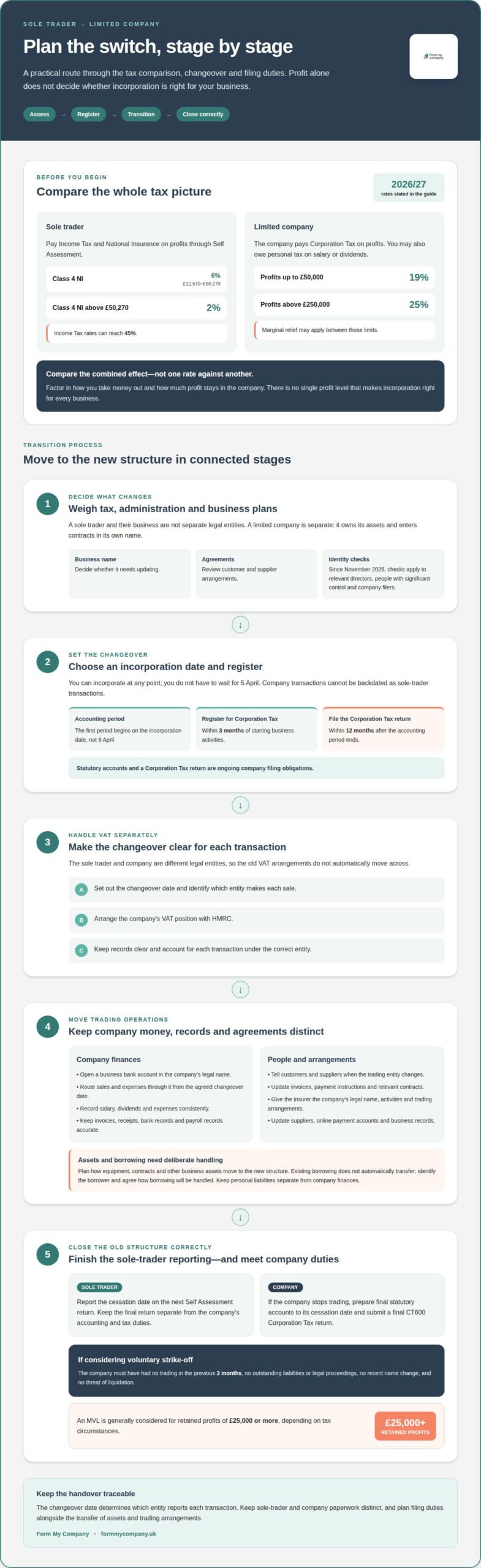
Compare your expected profits with how you’ll pay yourself before choosing a legal entity. For 2026/27, HM Revenue & Customs sets Class 4 National Insurance at 6% on sole-trader profits between £12,570 and £50,270, then 2% above £50,270. Corporation Tax is 19% on company profits up to £50,000 and 25% above £250,000; marginal relief may apply between those limits.
Income Tax rates can reach 45%, while company owners may also face personal tax on salary or dividends. Calculate the combined effect, including how much profit stays in the corporation, rather than comparing one rate with another.
Review the differences between business structures
List what changes when the business becomes a limited company. A sole trader and their business are not separate legal entities; a limited company is, so it owns its assets and enters contracts in its own name. Decide whether you need to update the company name, customer agreements and supplier arrangements.
Companies House identity verification has applied since November 2025 to directors, people with significant control and people filing on a company’s behalf. Include identity checks in your incorporation plan. Companies House identity verification is a practical step for relevant people.
- Set the incorporation date and register the company. You don’t have to wait for 5 April. The company’s first accounting period begins on its incorporation date, not 6 April. Register for Corporation Tax within three months of starting business activities. File its Corporation Tax return within 12 months after its accounting period ends. Statutory accounts and a Corporation Tax return are ongoing company filing obligations.
- Plan VAT as a separate transition task. A sole trader and a company are different legal entities, so don’t assume the old VAT arrangements automatically move across. Set out the changeover date, identify which entity makes each sale, and arrange the company’s VAT position with HMRC. Keep records clear across the transition and account for transactions under the correct entity.
- Close the old structure correctly if trading stops. Report the sole-trader cessation date on the next Self Assessment return. For a company, prepare final statutory accounts to its cessation date and submit a final CT600 Corporation Tax return. Voluntary strike-off requires no trading in the previous three months, no outstanding liabilities or legal proceedings, no recent name change, and no threat of liquidation. An MVL is generally considered for retained profits of £25,000 or more, depending on tax circumstances.
Accountancy costs and administrative responsibilities
- Budget for company accounting. A limited company has different reporting responsibilities from a sole trader, so plan for ongoing support and record-keeping. Accountancy costs are separate from incorporation costs and do not include the value of your own time managing records.
Before the company starts trading, decide who will prepare its accounts, Corporation Tax return and payroll records. If a director takes a salary, keep accurate pay records. Separate business transactions from personal spending, and retain the company’s invoices, receipts and bank records.
- Separate the new company’s finances. Open a business bank account in the company’s legal name and route its sales and expenses through it from the agreed changeover date. The company is a separate legal entity, so its funds are not your personal money. Use a consistent process to record salary, dividends and expenses.
Tell customers and suppliers when the trading entity changes. Update invoices, payment instructions and relevant contracts to identify the correct business. For example, if a sole trader issued an invoice, don’t direct the customer to pay the company without clear records showing which entity made the sale.
- Review insurance and trading arrangements. Give your insurer the new company’s legal name, activities and trading arrangements. A policy written for a sole trader may not identify the company as the insured business. Before relying on the policy for company trading, make sure the documents reflect the entity undertaking the work.
Update suppliers, online payment accounts and business records wherever the legal status or company name appears. Keep sole-trader and company paperwork distinct during the handover. A dated checklist helps you track updates to customer contracts, insurance documents and account details.
- Keep director’s loan records clear. A loan belonging to the old business doesn’t automatically transfer to the company. List existing borrowing and identify whether you or the sole-trader business is the borrower. Agree how any business borrowing will be handled before the company takes on trading commitments.
Keep personal liabilities separate from company finances and seek accounting advice before making payments. Don’t use the company bank account to repay them. Record money moving between you and the company separately, and get accounting advice on the treatment before recording transactions. This helps prevent personal liabilities from being mistaken for company costs.
If you’re preparing to establish the new structure, explore the company formation options that fit your plans.
Final self-assessment and corporation tax returns
Keep the final sole-trader return separate from the company’s accounting and tax duties. The changeover date determines which entity reports each transaction.
- Close off the sole-trader records. Record the date trading as a sole trader ends, then report that cessation date on your next Self Assessment return. The return is due annually by 31 January for the preceding tax year. Include income and allowable expenses belonging to the sole-trader period, not later company transactions.
Organise invoices and bank records by transaction date. If the business operated under both structures during the same tax year, keep the records clearly separated. This helps distinguish personal tax on sole-trader profits from the company’s Corporation Tax obligations.
- Register the company for Corporation Tax. A UK company must register with HMRC within three months of starting business activities. The company’s first accounting period begins on its incorporation date, so use that date to organise its records. Trading through the company creates a reporting period separate from your Self Assessment year.
Mark the accounting period end as soon as it is set. The company must file its Corporation Tax return within 12 months after that period ends. Late filing penalties start at £100, so assign responsibility for preparing and submitting the return before its deadline.
- Plan for Corporation Tax payment and rates. According to HM Revenue & Customs, the small profits rate is 19% for company profits up to £50,000. The main rate is 25% for company profits above £250,000, according to HM Revenue & Customs. Companies with profits between those thresholds may qualify for marginal relief.
Corporation Tax is normally due nine months and one day after the accounting period ends, according to HM Revenue & Customs. The final-period timing may differ. Set aside funds as profits arise, rather than treating the full company bank balance as available for personal use.
- Calculate personal tax on company withdrawals. Corporation Tax applies to company profits; salary and dividends can create separate personal tax consequences. Dividends can only be paid when the company is making a profit. For 2026/27, the dividend allowance is £500, and basic-rate taxpayers pay 10.75% on dividends above that allowance, according to HM Revenue & Customs.
Record each dividend and the company decision authorising it. Don’t treat sole-trader drawings as company dividends. When preparing your tax return, check your salary and dividend totals alongside other personal income so the company and personal figures remain distinct.
Transferring equipment and other business assets
List each asset before the company starts using it. A limited company is a separate legal entity, so record what it receives and how each transfer is treated.
Assess tax on asset transfers
- Value and document each transfer. List equipment, stock, vehicles and other business assets, then record whether the company buys or receives each item. Equipment moved to the new business should be purchased from the old business or its owner. Keep transfer records with the final sole-trader accounts and the company’s opening accounting records.
Capital Gains Tax may apply when assets are disposed of. Capital Gains Tax may apply to some business asset disposals, depending on the circumstances. The tax treatment of stock and other assets depends on their type and transfer terms, so don’t assume every item receives the same treatment.
Incorporation isn’t automatically tax-free. Incorporation relief may be relevant, but eligibility depends on the circumstances and the assets or business transferred. Ask an accountant or tax specialist to assess the tax and compliance implications before finalising the transfer.
Account for losses and capital allowances
- Prepare a closing schedule for tax records. List trading losses, capital allowances and any reliefs claimed by the sole trader. Don’t assume they transfer to the company or can be used against its profits. Link each item to the period and legal structure in which it arose.
Ask an accountant or tax specialist to assess how the transition affects each item. The answer may depend on the type of loss or allowance, the transfer terms and the dates involved. Record the treatment in the final sole-trader accounts and the company’s opening records.
- Keep personal assets and company property separate. Mark which items remain yours and which the company acquires. For example, if you keep a laptop personally, record its business use separately instead of listing it as company property. This helps distinguish your personal liabilities and obligations from those held by the company.
Identify assets subject to finance or other obligations, too. A loan belonging to the old business doesn’t automatically transfer to the new business. Record the lender, borrower and asset separately, and don’t treat a personal debt as a company liability.
For stock, record quantities and ownership at the changeover, then make sure sales after the transfer belong to the correct entity. Keep dated invoices and handover records so the final sole-trader figures and the company’s first records show which business owned each item.
Sole trader Income Tax and National Insurance
- Calculate tax using sole-trader profits. Add up business income and deduct allowable business expenses to establish taxable profits. Income Tax and National Insurance are paid on those profits through Self Assessment, rather than on the amount you withdraw for personal use. For 2026/27, the Personal Allowance is £12,570 of profit. The amount above it may be subject to Income Tax, depending on your total taxable income and circumstances.
Keep personal and business transactions distinct in your records. For example, drawings from a business account are not a substitute for calculating profit. Record income and expenses from the sole-trader period separately from company trading.
- Include Class 4 National Insurance in your calculation. For the UK 2026/27 tax year, sole traders pay Class 4 National Insurance at 2% on profits above £50,270, according to HM Revenue & Customs. This is a separate charge from Income Tax. Assess the profit attributable to your sole-trader period rather than applying the company’s tax treatment to earlier transactions.
Use your records to estimate the final Self Assessment bill before closing the sole-trader business. This can help you plan for tax due after the switch. Include income and expenses up to the cessation date, then report that date on your next Self Assessment return.
- Plan for Self Assessment payments. If your annual tax bill exceeds £1,000, payments on account are generally required. They are paid in two instalments, on 31 January and 31 July. These payments go towards the following tax bill, so account for them when managing cash flow during the transition.
Your Self Assessment return is due annually by 31 January for the preceding tax year. Keep the sole-trader records needed to complete it, even after company trading begins. If you also receive employed income, include it when calculating your personal tax position alongside business profits.
- Check whether Making Tax Digital applies. From 6 April 2026, Making Tax Digital for Income Tax applies to self-employed people and landlords with qualifying income over £50,000. This may affect how you keep and submit records while operating as a sole trader. Consider the qualifying income threshold and your reporting arrangements before the relevant period.
Incorporation doesn’t remove your personal tax obligations for the sole-trader period. The company’s profits and your personal income are treated separately. Keep clear records of the closing date, final business income and expenses, and any Self Assessment payments already made.
Form My Company
Form My Company can help with company formation once you’ve weighed the tax, record-keeping and asset-transfer implications. Its formation packages support setting up a UK company, and an LLP formation option is available if that structure better suits your plans. Choose the route that fits the legal structure you intend to establish, then keep the company’s start date clear in your accounting records.
Before proceeding, organise the details needed for formation and decide how the new company will take over trading. Keep tax decisions, the final Self Assessment return and asset transfers on a separate checklist, since forming the company does not resolve those accounting matters. This helps coordinate registration with your wider transition plan.
Contact Form My Company to discuss your company formation.
Make your next move with a clear plan
Use your transition plan to connect the tax implications of moving from sole trader to Ltd with your wider business goals. Decide what the company structure needs to support, how you’ll manage the handover and which formation steps to take first. A written plan can help you coordinate the change without mixing personal decisions with company administration.
When you’re ready to form a company, Form My Company offers a Digital Package, Digital & Print Package and Entrepreneurs Choice Package. Choose the option that suits how you want to handle formation, then align your tax and accounting arrangements with the company’s start date.
Contact Form My Company to discuss your company formation and take the next step with a plan that fits your business.
Frequently Asked Questions
How do I deal with the tax?
Separate income and expenses by transaction date and the business structure responsible for each. The tax implications of moving from sole trader to Ltd depend partly on keeping that split clear. For example, a sale invoiced before incorporation belongs in the sole-trader records, even if payment arrives later. Reconcile outstanding invoices, expenses and customer payments against the relevant records, then use them to prepare the final personal return and company accounts.
Is it easy to switch?
You can form a limited company before the end of the tax year, but the handover still needs planning. Choose a clear changeover date and use it consistently for invoices, customer communications and accounting records. For example, make sure a new contract names the company rather than you as a sole trader. The company is a separate legal entity, so existing arrangements don’t automatically become company arrangements.
What are the disadvantages of switching to a limited company?
A limited company involves more administration than operating as a sole trader. You must manage company records and filings separately, and company money is not simply available for personal spending. There may also be accountancy costs and extra work involving payroll, annual accounts and tax returns. Consider whether those responsibilities suit how you run the business, especially if you want to keep company and personal finances distinct.
What do I do with any loans or large pieces of equipment?
Prepare a written schedule showing each loan’s borrower, lender, balance and any linked asset. A sole-trader loan doesn’t automatically become company borrowing, and the company can’t pay your personal debts on your behalf. For equipment, record its ownership and transfer to the company, including a description and agreed value. Keep invoices and payment records together so the company’s asset register reflects what it actually owns.
How does UK tax differ between a sole trader and a limited company?
A sole trader pays personal tax on business profits through Self Assessment. A limited company pays Corporation Tax on company profits, while you may also have personal tax to consider on money you receive from it. This distinction matters if the company retains profit rather than paying it all to you. Compare the overall effect of company tax and personal withdrawals, not just the rate applied to business profits.
How are dividends from a UK limited company taxed, and what are the current dividend tax rates and allowance?
For 2026/27, the dividend allowance is £500. Dividends above it are taxed at 10.75% for basic-rate taxpayers, 35.75% for higher-rate taxpayers and 39.35% for additional-rate taxpayers. Your applicable rate depends on your tax band and other income. Dividends can only be paid from company profits, so record the decision and amount separately from salary or personal spending.
What are the tax implications of taking money from a limited company as salary, dividends or director’s loans?
Salary and dividends are different ways to receive company money, and each has separate personal tax considerations. Directors may pay National Insurance when their salary exceeds the applicable threshold. Dividends are payable only from profits and may create dividend tax. A director’s loan is neither salary nor a dividend; document advances and repayments clearly, and don’t use a loan entry to disguise personal spending or company payments.
What are the ongoing accounting, payroll and filing costs and compliance risks of operating through a UK limited company?
Plan for recurring accountancy work, payroll administration if the company pays a salary, and the time needed to keep records current. Costs depend on the work involved, including transaction volume and reporting needs. Missed deadlines or inaccurate records can create compliance problems, so assign responsibility for each filing and payment. Keep a calendar for the company’s accounting period and store supporting documents with its records.