
A limited company isn’t automatically the best setup for freelance work. Setting up a company for freelance work in the UK could mean operating as a sole trader, forming a limited company or working through an umbrella company. Each structure affects tax, personal liability and administration differently, so the right choice depends on how you work and what you need from your business.
It’s easy to focus on the initial setup and overlook what happens when you take money out. With a limited company, directors must follow the rules for paying themselves, whether through salary, dividends or a director’s loan. A company also has filing and record-keeping responsibilities that sole traders don’t face in the same way.
This guide compares the three options and explains what registration and ongoing administration involve, including how tax and personal liability differ. You’ll also learn why salary and dividends matter when choosing a limited company, helping you weigh the trade-offs before deciding which structure fits your freelance work.
Key Takeaways
- Match your business structure to how you work, the level of administration you can manage and the personal liability you’re prepared to take on.
- As a sole trader, you and the business are not legally separate, so business debts can affect you personally.
- A limited company is legally separate from its owners, but brings company filing and record-keeping responsibilities.
- Before choosing a limited company, understand how salary, dividends and company profits affect the way you can take money out.
Getting help with setting up or growing a business
Before choosing a structure, consider how you earn income, manage clients and take responsibility for your work. These details can help distinguish ongoing freelance business activity from occasional personal transactions.
Separating business and personal finances
Keeping business and personal finances separate means distinguishing business income and spending from household money. A dedicated account can make it easier to track client payments and identify costs related to your work.
For a sole trader, the business and owner are not legally separate, but clear records still help explain transactions. For example, record a client payment as income and keep the receipt for a work-related train journey with your business records. Avoid mixing household shopping into the same transaction history.
A limited company is legally separate from its owners, so keep company money apart from personal funds. Use the company’s bank account for client payments and business costs, then record any money taken out under the correct category. A clear record helps distinguish company spending from a director’s personal spending.
Expenses, records and business profits
Allowable business expenses are costs incurred for business purposes, and they reduce the profit on which a sole trader is taxed. Examples include training courses, advertising and marketing, website costs and business travel. Computers and other equipment may qualify for capital allowances.
Keep records from the start of trading, including sales, expenses, invoices and receipts. For example, match a client invoice to its payment and retain evidence for related costs. Good records show how you calculated income, costs and profit, and support your tax return.
For a sole trader, profits are subject to income tax and Class 4 National Insurance contributions. That makes it useful to distinguish money received from profit: a client payment is income, while allowable costs are accounted for before calculating profit. A limited company has separate financial records and statutory registers to maintain.
Whether you need insurance or a licence depends on your work and the terms of your client contracts. Professional indemnity cover is a risk-management option for work where a client could claim financial loss resulting from your professional advice.
Signs of trading include being paid for a service, regularly selling goods for profit or working with several customers. Choosing how, where and when you work, providing your own equipment and taking responsibility for correcting unsatisfactory work can also point to running a business. Consider the overall pattern, not just one sign.
Sole trader registration, tax and personal liability
A sole trader can start trading without registering first, but income and deadlines still matter. The owner is also personally responsible for business debts.
Registering as a sole trader with HMRC: when to seek professional help
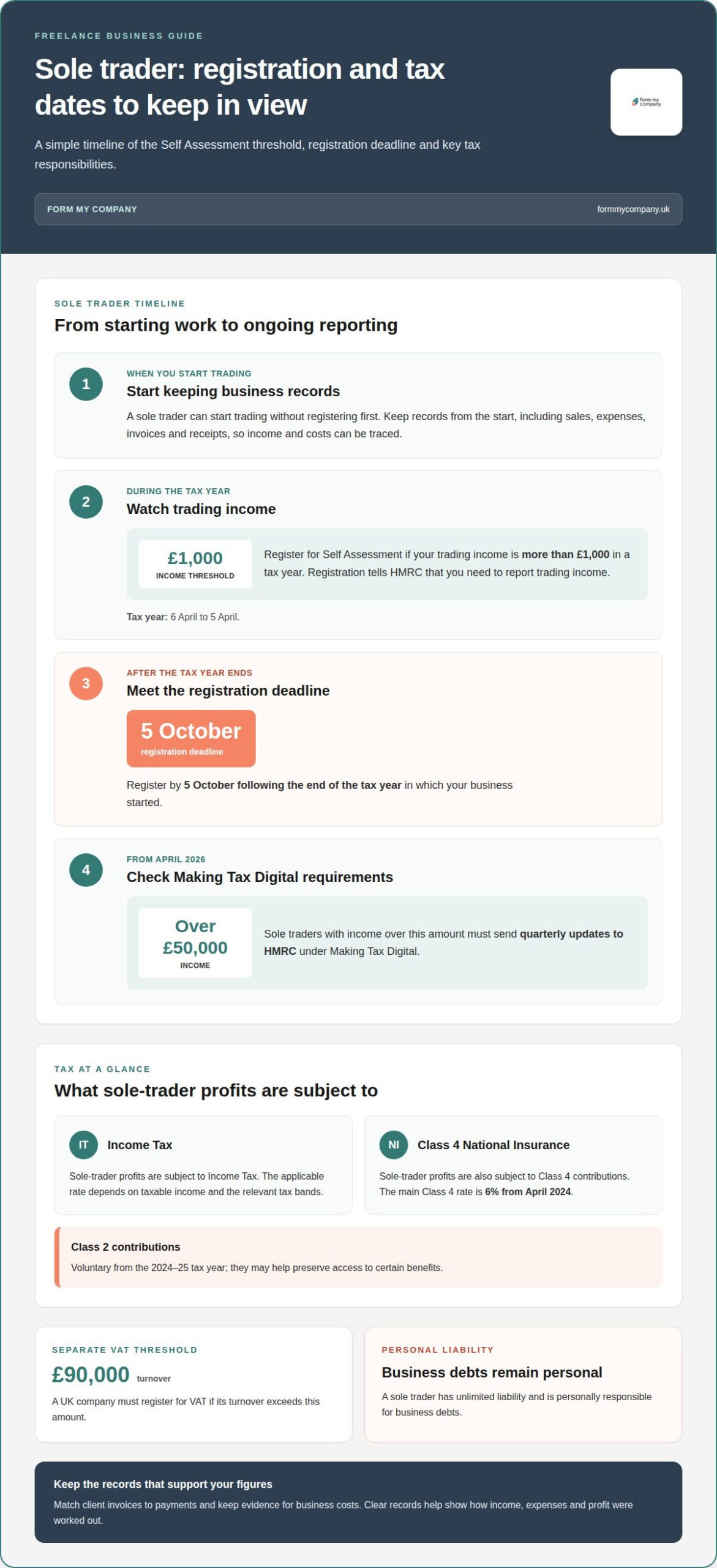
Registering for Self Assessment tells HM Revenue & Customs that you need to report trading income. A sole trader must register if trading income is more than £1,000 in a tax year, which runs from 6 April to 5 April, according to HM Revenue & Customs. Registration is due by 5 October following the end of the tax year in which the business started, according to HM Revenue & Customs.
A tax professional can help organise your income details and identify the relevant registration deadline. This can be useful if you started freelance work part-way through a tax year or earn income from several clients. Keep business records from the start, so the figures on your Self Assessment return can be traced to invoices and expenses.
VAT registration and Making Tax Digital: how a professional can help
VAT registration places a business within the VAT system, while Making Tax Digital sets digital record-keeping and submission requirements. A UK company must register for VAT if its turnover exceeds £90,000, according to HM Revenue & Customs.
From April 2026, sole traders with income over £50,000 must send quarterly updates to HMRC under Making Tax Digital. VAT-registered businesses generally need to keep digital records and submit VAT returns digitally. A tax professional can help assess turnover, organise VAT records and prepare registrations or digital reporting processes. Keep sales records current, so turnover can be monitored against the threshold.
Tax and National Insurance rules
Tax and National Insurance depend on whether freelance work operates as a sole trader or through a limited company. Sole-trader profits are subject to income tax and Class 4 National Insurance contributions. The main Class 4 rate is 6% from April 2024. Class 2 contributions are voluntary from the 2024-25 tax year and may help preserve access to certain benefits.
Companies pay Corporation Tax on profits. For the 2026/27 tax year, UK companies pay Corporation Tax at 19% on profits up to £50,000, according to HM Revenue & Customs. A tax professional can explain how the structure affects reporting and payments; the applicable income tax rate depends on taxable income and the relevant tax bands.
Sole trader personal liability
Unlimited liability means a sole trader is personally responsible for all business debts. If a client doesn’t pay an invoice or business costs exceed available income, the owner remains responsible for settling the debt.
A limited company is legally separate from its owners and must be registered before trading. A formation provider can prepare and submit the incorporation application to Companies House. The company must also register for Corporation Tax within three months of starting to trade. Incorporation and the company’s subsequent tax responsibilities are separate steps.
Choosing between sole trader, limited company and umbrella company structures
Base your decision on your actual contracts, expected workload and business plans. A professional can help identify practical considerations that a headline tax comparison might miss.
Choosing between sole trader, limited company and umbrella company structures with professional guidance
Start by reviewing how each assignment is arranged, including who sets the work and who bears responsibility for delivering it. Off-payroll working rules may be relevant to some engagements. From April 2025, a client is small if it meets two of three tests: turnover up to £15 million, a balance sheet up to £7.5 million, or up to 50 employees.
Assessing the size and nature of your clients is one factor when planning future work. A professional can help organise the details of your engagements and identify questions that need specialist tax or employment-status advice. This makes the decision more specific than choosing a structure from a general checklist, and is a useful step when setting up a company for freelance work in the UK.
Risks and costs of incorporation
Think of incorporation as a business commitment, not just a registration event. Budget for formation and the time needed to manage the company’s responsibilities. Compare those demands with your expected workload and the value of presenting a company identity to clients. The aim is to decide whether the setup supports your plans, not to assume incorporation will automatically improve your take-home pay.
Consider a practical scenario before deciding. For example, would you keep some earnings in the business for future equipment, software or marketing, rather than withdrawing everything as personal income? Also consider whether your client base or project pipeline could change. These factors help you assess the company’s usefulness beyond the initial setup.
Choose a proposed name that works as both a formal company identity and a name you can use in everyday client communications. A formation provider can check it against Companies House registration requirements and use the selected details in the application. Make sure the spelling and punctuation you submit match the name you intend to use on proposals and invoices.
Before committing, write down the main reason for your preferred structure and the trade-off you’re accepting. For instance, you might value a formal company identity but need to plan for more administration. If that reason still makes sense in light of your client pipeline and future plans, you’ll have a clearer basis for moving ahead.
Company administration and director identity checks
A freelance limited company has ongoing filing duties after registration. Directors need to maintain company records, meet tax obligations and complete Companies House identity checks.
A limited company must file annual accounts and confirmation statements with Companies House, as well as annual Company Tax Returns with HM Revenue & Customs. These filings serve different purposes: accounts report the company’s financial position, while the confirmation statement confirms key company information. Add each requirement to the company’s administration calendar.
Accurate financial records and statutory registers are essential. They support the figures reported in accounts and document important details about the company, its directors and ownership. Record transactions clearly, retain invoices and organise documents by accounting period. For example, match a client invoice to its payment and record related business costs for the same period.
Companies House identity verification requirements apply to UK limited companies. Existing company directors must complete identity verification by November 2026. This makes identity checks part of director administration, rather than a one-off task at incorporation. Keep the verification process in view when planning company filings and changes to director details.
Separate filing responsibilities from everyday business tasks. A company might invoice a client, receive payment and pay a business expense, but each transaction still needs to appear correctly in its records. A clear process for storing invoices, bank statements and receipts makes preparing accounts and meeting tax reporting requirements easier.
Set a regular review routine. Compare the company’s transaction records with its bank activity, check that invoices and expense evidence are filed, and note upcoming Companies House and HMRC submissions. This can reveal missing paperwork before accounts or returns are prepared. Record decisions and changes so the statutory registers reflect the company’s current details.
Directors remain responsible for ensuring filings are accurate and submitted. An accountant can help prepare accounts and tax returns, while company administration support can assist with Companies House filings. Agree who handles each task and keep clear records of submissions. This division of responsibilities helps prevent reporting duties from being overlooked as freelance work develops.
Limited company tax, salary and dividends
A limited company pays tax on its profits, while directors must follow rules when taking money out. The key distinction is between company funds and personal income.
Limited company tax
Corporation Tax is charged on company profits, so taxable profit is not the same as total client income. For the 2026/27 tax year, UK companies pay Corporation Tax at 19% on profits up to £50,000, according to HM Revenue & Customs. UK companies pay Corporation Tax at 25% on profits above £250,000, according to HM Revenue & Customs.
Projected profits matter when assessing a company structure. A company must register for Corporation Tax within three months of starting to trade and file Company Tax Returns with HMRC. Record business income and costs accurately so the company’s profit calculation reflects its transactions.
Taking a salary from the company
A salary is a payment the company makes to a director for their work. A director may be an employee of the company or an office holder. Record salary payments as company transactions and distinguish them from dividends and directors’ loans. This makes clear how company money is paid to the director.
Employer National Insurance applies to salaries above £5,000 a year at 15% from April 2025. Include this company cost when considering how much salary to pay. The amount and timing should fit the company’s finances and payroll arrangements, rather than being treated as an informal transfer from its bank account.
Dividends are another way a director may take money from a company, but they are not salary. Directors must follow the rules for dividends and directors’ loans, and keep the relevant transactions documented. From April 2026, dividends are taxed at 10.75% in the basic rate band and 35.75% in the higher rate band. The UK dividend tax-free allowance is £500 from April 2024.
Plan withdrawals by considering company profit, available cash and the director’s personal tax position. A client payment belongs to the company first; it doesn’t automatically become personal income. Salary, dividends and directors’ loans are treated differently, so record each payment under the correct category. For example, don’t label a director’s loan as a dividend simply because money was transferred to a personal account.
Choose a structure with its ongoing tax and payment duties in view. A formation provider can help establish the company, while an accountant can advise on tax calculations and director payments. Review company formation options as you decide whether a limited company suits your freelance work.
Form My Company
Once you’ve chosen a structure, Form My Company can help with company formation. Its Digital Package, Digital & Print Package and Entrepreneurs Choice Package provide formation options for new businesses. Freelancers considering a partnership structure can also use its Limited Liability Partnership (LLP) Formation service.
Use a formation service when you’re ready to establish a company and want support with the registration process. The right option depends on the structure you’ve chosen and the formation support you need. Explore Form My Company’s packages to take the next step.
Choose a setup that can grow with your work
Your freelance business may change as your client base, projects and working arrangements develop. Choose a structure with both your current needs and your next stage in mind. If you’re still weighing up the options, focus on the responsibilities you’re ready to manage and how you expect to work with clients. This gives you a practical basis for moving forward instead of choosing a structure simply because it seems familiar.
Once you’ve decided to form a company, the next step is choosing suitable formation support. Form My Company offers a Digital Package, Digital & Print Package and Entrepreneurs Choice Package for different formation needs. Compare the options to find the support that fits your plans.
Setting up a company for freelance work in the UK is a significant step, but you can take it one decision at a time. Contact Form My Company for help with moving forward. Choose your setup with care, then build your business with confidence.
Frequently Asked Questions
What business structures can freelancers use in the UK: sole trader, limited company or partnership?
UK freelancers can work as sole traders, form a limited company or join a partnership, including a limited liability partnership. An umbrella company is another route: it employs the freelancer and processes pay through PAYE. For example, an independent consultant with several clients might compare sole trading with incorporation, while someone working on an agency assignment might consider an umbrella arrangement. The right fit depends on your preferences for control, administration and liability.
How can a professional help me register as a sole trader with HMRC, and what are the deadlines?
A tax professional can organise the details needed for a Self Assessment registration, including your trading start date and income. HM Revenue & Customs says registration is required when trading income is more than £1,000 in a tax year, running from 6 April to 5 April. Register by 5 October following the end of the tax year in which trading began, according to HM Revenue & Customs. HMRC then issues a 10-digit unique taxpayer reference.
How can a formation provider set up a UK limited company with Companies House, and what does it cost?
A formation provider can prepare and submit the incorporation application to Companies House using the company details and director information you provide. The company name must end with “Limited” or “Ltd.” A provider can help ensure the application is complete, but directors remain responsible for ongoing company duties after incorporation. The formation fee depends on the structure and package inclusions, and is given after a quote request.
How can a professional help with VAT registration for UK freelancers, and what is the current turnover threshold?
A professional can help prepare a VAT registration using details such as business activity, turnover and expected taxable sales. A UK company must register for VAT if its turnover exceeds £90,000, according to HM Revenue & Customs. Form My Company offers a VAT Registration Service for businesses needing support with this process. Once registered, a business must keep digital VAT records and use approved software for VAT submissions.
How should UK freelancers choose between sole trader and limited company status, including tax and take-home pay?
Compare how each structure affects administration, business risk and the route from business income to personal take-home pay. A limited company pays Corporation Tax on profits, while a director may take money through salary, dividends or a director’s loan. Dividends have their own tax treatment, so the amount left personally depends on company profits, withdrawal choices and the director’s tax position. Consider expected work patterns and administrative responsibilities, not tax rates alone.