
Your first company name doesn’t have to be your last. You can change a UK company’s registered name later by passing a special resolution and filing the change with Companies House. Still, choosing a distinctive name from the start can help avoid confusion and reduce the chance of rethinking your branding.
Check more than whether a name appears available on the Companies House register. A clear result doesn’t reserve the name or rule out a trade mark conflict. A memorable choice should also stand apart from names already in use and suit the business you plan to build.
This guide explains how to choose a unique company name in the UK, check it against company and trade mark records, and assess whether it will work as your business grows. You’ll also learn what makes a name distinctive, which naming rules to consider, and what changing it later involves.
Key Takeaways
- Use the Companies House register to spot existing names, but treat an availability result as a starting point rather than a guarantee.
- Compare the full name, not just its spelling: small differences may still leave it too similar to another registered name.
- Choose a name that is easy to remember and say, while leaving room for your business to grow or reach new markets.
- Check trade marks as well as domain names and social media handles to assess whether your preferred identity is usable across different channels.
- You can change a company’s registered name later, but choosing carefully now can help avoid extra administration and disruption.
Checking whether a company name is already registered
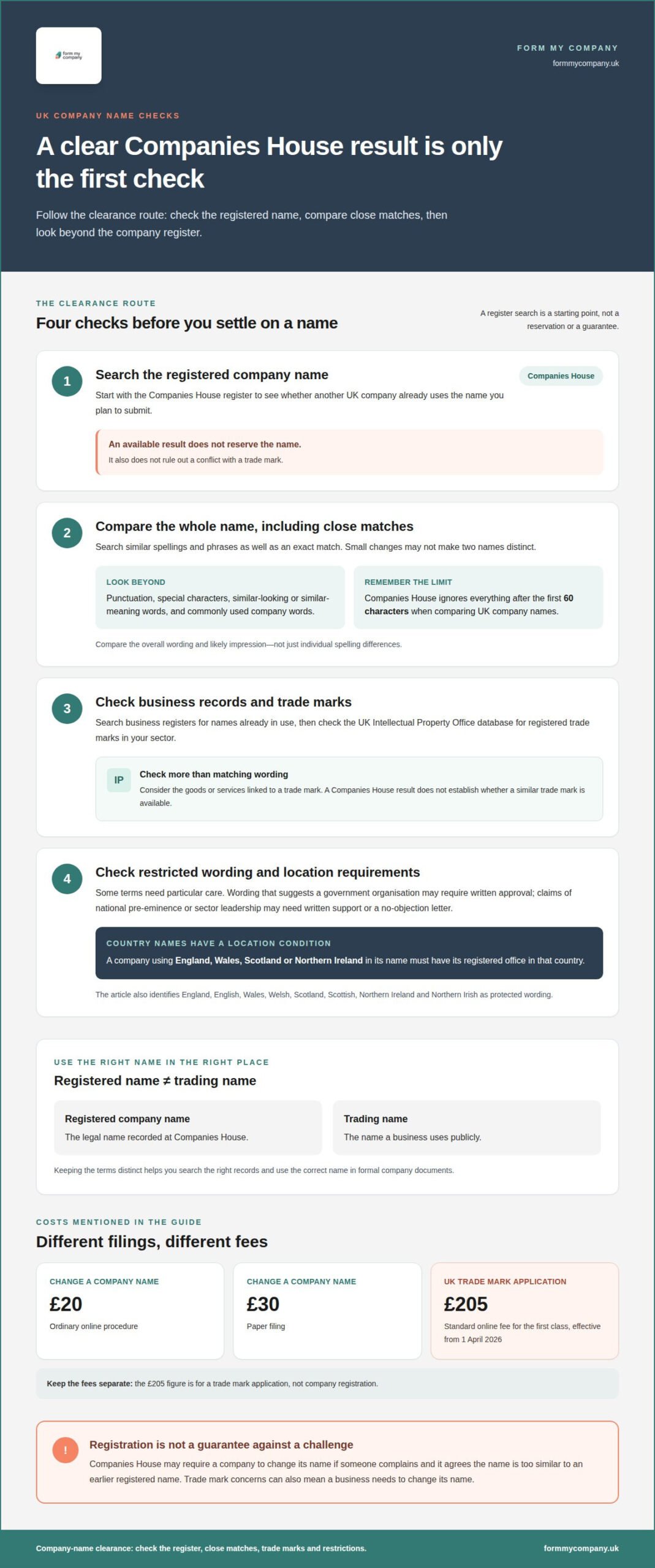
Start by searching the Companies House register to see whether another UK company already uses your preferred name. A clear result is a useful first check, but it doesn’t reserve the name or rule out a trade mark conflict.
Registered Names and Trading Names
A registered company name is the legal name recorded at Companies House; a trading name is the name a business uses publicly. Keeping these terms distinct helps you search the right records and use the correct name in formal company documents.
Search the registered name you plan to submit, then compare similar spellings and phrases rather than relying on an exact-match search. Companies House ignores everything after the first 60 characters when comparing UK company names, according to Companies House. A longer name may therefore be compared using only its opening characters.
Registration costs and processing depend on the filing. Changing a name later costs £20 through the ordinary online procedure or £30 for a paper filing, according to Companies House.
Business and Trademark Registry Checks
Check both company records and trade marks. Search business registers for names already in use, then search the UK Intellectual Property Office database for registered trade marks in your sector. A Companies House result doesn’t establish whether a similar trade mark is available.
Consider the goods or services linked to a trade mark, not just whether its wording matches your proposed company name. The Intellectual Property Office’s standard online UK trade mark application fee for the first class is £205, effective from 1 April 2026. That fee concerns a trade mark application, not company registration.
Check registered-office requirements before choosing a name that refers to a UK nation. A company using England, Wales, Scotland or Northern Ireland in its name must have its registered office in that country. For example, a name containing “Scotland” requires a registered office in Scotland.
Registration doesn’t guarantee that a name will go unchallenged. Companies House may require a company to change its name if someone complains and it agrees that the name is too similar to an earlier registered name. Trade mark concerns can also mean a business needs to change its name.
Use the register search as one part of a broader clearance process: check the full wording, likely variations, business records and relevant trade marks before settling on a name. If you’re choosing a distinctive identity, these checks can help identify potential conflicts before you file the company registration.
What Must You Check Before Choosing a UK Company Name?
The Companies Act 2006 establishes requirements governing UK company names, according to UK legislation. Check that your choice is distinctive, suitable for your plans and clear of naming restrictions before deciding on it.
Avoiding Generic or Trend-Led Names
A generic name describes a broad business category, while an overly specific name ties the business to one product, place or customer group. Either can make it harder to show what makes the company distinctive or leave less room to expand.
Trend-led wording can date quickly. A name built around a current phrase may feel less relevant as customer preferences change, while a highly specific name may no longer fit if the business adds services. Aim for a clear connection to your purpose without describing every activity. For instance, a name focused on one product could become restrictive if you diversify.
Descriptive names tell people what a business does; invented or unusual names can create a more distinctive identity. Neither approach is automatically better. A descriptive name needs enough character to stand apart, while an invented name should be easy to understand, say and remember. Consider whether the name suggests the right qualities to customers rather than relying on novelty alone.
Names That Match or Resemble Existing Names
A name can be treated as the same as an existing company or LLP name even when the wording isn’t identical. Differences limited to punctuation, special characters, similar-looking or similar-meaning words, or commonly used company words may not make it distinct.
Changing punctuation or replacing a word with a close equivalent may leave two names effectively alike. A company may register a name considered the same only if it belongs to the same group or has written confirmation that the existing organisation does not object. Treat close matches as a reason to revise your shortlist, not as a reliable way to stand apart.
Similarity matters beyond exact matches. Companies House may require a company to change its name after a complaint if it agrees that the name is too similar to one registered earlier. Compare the overall wording and likely impression, not just individual spelling differences.
Some wording needs particular care. Names using England, English, Wales, Welsh, Scotland, Scottish, Northern Ireland or Northern Irish are protected. A company using England, Wales, Scotland or Northern Ireland in its name must have its registered office in that country.
A name that could be mistaken for a government organisation may require written approval from the relevant government department. Wording that suggests national pre-eminence or sector leadership may also need written support or a no-objection letter from an independent organisation, governing body or trade association. Check whether your proposed name suggests such a connection before settling on it.
Choosing a descriptive and memorable name
A strong company name helps people understand the business and remember it. Balance a clear description with enough character to distinguish your business from familiar names.
Descriptive and Distinctive Naming
A descriptive name signals what a business does, while a distinctive element gives it an identity of its own. For example, “Bicycle Repairs” tells customers what the service is, but could sound similar to other repair businesses. Adding a relevant, specific word can make the name more recognisable without obscuring its purpose.
Choose words that reflect your work, values or audience, then consider how the complete phrase sounds. Alliteration can make a name more memorable, as in the fictional “Woven Willow” textile business. An invented name can work too: IKEA is formed from initials connected with its founder, family farm and hometown. The right approach depends on the connection you want customers to make.
Keeping a Name Simple and Memorable
A simple name is easy to pronounce, write, dictate and search for. Say each shortlisted option aloud, then imagine giving it over the phone or spelling it in an email. If customers need repeated explanations, the name may create unnecessary friction. A short, clear phrase is often easier to recall than a complicated combination of unfamiliar words.
Test each option in everyday situations. Ask someone unfamiliar with the business to read it aloud, spell it after hearing it, and explain what they think it suggests. A name that sounds clear in conversation may still be hard to type or remember. Check that punctuation, unusual spellings or abbreviations don’t cause confusion.
Consider how the name will look on a website, invoice or sign. “Apple” and “Amazon” show that a company name needn’t describe its products directly, although a less familiar business may benefit from a clearer cue. A private limited company’s registered name also needs to work in formal contexts, not just as branding. Keep the core wording distinctive, then consider how any required legal ending affects its appearance.
Think beyond launch. A name tied closely to one product could become awkward if the business expands; a broad name may offer more flexibility but communicate less. For example, “Handmade Cakes” clearly identifies a product, while a name focused on baking more generally could leave room for new products or services. Choose the balance that suits your plans.
Finally, compare the shortlist as complete names, not isolated words. Say each option aloud, read it in a sentence and consider the impression it creates. A name that feels special to its founders should also be clear to customers, easy to share and suitable for the business you intend to build.
Choosing a unique company name
A unique name should identify your business, fit its plans and work wherever customers encounter it. To think about how to choose a unique company name in the UK, build a shortlist around what makes the business recognisable, rather than choosing a word simply because it sounds unusual.
Start with the qualities you want customers to associate with the business. A name might signal a product, a way of working or a particular customer experience. Write down those ideas, then look for wording that suggests them without describing every service. For example, a firm planning to add services later may prefer a broader name to one tied to a single product.
Distinctiveness comes from the whole name and the associations it creates. Consider combining meaningful words, using initials from significant terms or creating an invented word. Amazon and Apple show that a company name needn’t directly describe its business. For a new venture, though, a clear association can help people understand what the name represents.
Use this short review to compare your shortlist:
- Purpose: Does the name reflect the business’s values or direction?
- Recognition: Can customers remember and distinguish it when they hear it?
- Flexibility: Will it still suit the business if its products, services or customer base change?
- Pronunciation: Can people say, write and search for it without repeated explanation?
Geography needs careful thought. A local business may find a town or region useful in its name, while a company targeting a wider market may prefer wording that doesn’t tie it to one place. A company using England, Wales, Scotland or Northern Ireland in its name must have its registered office in that country. Consider this requirement before adopting a national reference.
Think about international use too. If you plan to sell in different countries, choose wording that is easy to understand across those markets and avoid unintended translations or puns. A phrase that feels clear to UK customers may carry a different association elsewhere. Say the name aloud and consider how someone unfamiliar with the business might interpret it.
Finally, decide who should help choose. Instead of turning naming into a large group exercise, ask a small group familiar with the company’s history and goals to explain their preferences. Their reasons can reveal whether a name feels appropriate, meaningful and memorable, without letting a popularity vote replace a clear business decision.
Remember the legal form when finalising the registered name. A private limited company must usually end its name with “Limited” or “Ltd”, or use the Welsh equivalents if registered in Wales. When considering how to choose a unique company name in the UK, assess how that ending looks alongside the distinctive wording so the complete name works in formal and customer-facing settings.
Checking trademarks, domains and social media handles
A name can be available at Companies House but still conflict with a trade mark or be difficult to use online. Treat trade mark, domain and social media searches as separate checks, because each covers a different part of your public identity.
Search the UK Intellectual Property Office database for registered trade marks in your sector. Compare the wording, sound and relevant goods or services, not just exact spelling. For example, a similar-sounding mark in a related field may warrant closer attention than an identical word used for unrelated goods. Companies House name availability doesn’t confirm that a proposed name is free from trade mark conflicts.
A trade mark protects an identity associated with particular goods or services. That makes your sector relevant: a name used for one type of product may also appear in a different field. Search meaningful variations, including alternative spellings and words that sound alike. If you plan to protect the brand, consider whether trade mark registration is appropriate for the goods or services you expect to offer.
Next, compare the preferred name across domain endings and social platforms. Check the exact wording and sensible variations on platforms such as Instagram, LinkedIn and TikTok. A business name and web address don’t have to match, but keeping them similar can reduce customer confusion.
- .co.uk: Check whether the name is available for a UK-focused web address.
- .uk: Search this shorter UK domain ending separately, even if the .co.uk version is taken.
- .com: Check this option if customers or partners may be based outside the UK.
Availability can differ between domain endings. If the exact name is taken, compare a simple variation, such as adding a relevant product word, rather than choosing a confusing spelling. Keep any alternative consistent with your registered name and easy to tell someone over the phone.
Record your findings beside each shortlisted name. Note trade mark results, available domain endings and matching social handles. This makes it easier to compare a name that works legally and practically with one that only looks appealing on paper. Repeat searches close to your decision, since online availability can change.
Once the name and online identity fit your plans, start your UK company formation with the details you’ve chosen.
Form My Company
Form My Company helps you move from choosing a name to setting up your UK business. Once you’ve completed your checks and selected a suitable legal structure, its company formation packages support the registration process. Options include the Digital Package, Digital & Print Package and Entrepreneurs Choice Package.
If your plans call for a partnership structure rather than a limited company, Form My Company also provides Limited Liability Partnership (LLP) Formation. Choose the route that fits your intended structure, not simply the name you prefer. Keep your proposed registered name and formation details aligned as you prepare to register.
For support with the next step after choosing a name, contact Form My Company.
Take your chosen name into the next stage
A company name becomes part of everyday business, from how customers find you to how you introduce the organisation to potential partners. Before using it across these touchpoints, consider whether it still fits the business you want to build, not just the idea you’re launching today. That wider perspective is central to how to choose a unique company name in the UK: make it distinctive, but leave room for your plans to develop.
Once you’re ready to move from naming to formation, Form My Company can help you take the next administrative step. Its formation options support different preferences for handling company documents, so you can choose a route that fits your needs. If you’d like help progressing from your chosen name to setting up your business, contact Form My Company.
You’ve already done the thinking that gives your business its identity. Use that decision as a confident starting point for what comes next.
Frequently Asked Questions
How Do “Same As” and “Too Like” Rules Differ?
“Same as” describes names treated as effectively identical under Companies House comparison rules; “too like” concerns names similar enough to prompt a complaint. Punctuation changes, similar-looking characters or commonly used company words may not distinguish names under the first test. The second can still matter after registration: if Companies House agrees with a complaint that a name is too similar to an earlier registered name, it may require a change.
What if someone registers a name similar to mine?
If another company registers a name you consider too similar, you can complain to Companies House. It may require the later company to change its name if it agrees that the name is too similar to one registered earlier. A separate concern may arise if the name conflicts with a trade mark. Keep records showing your use of the name and consider which type of conflict applies before deciding what action to take.
What should I avoid when naming a company?
Avoid a name that is too generic to distinguish your business or so specific that it no longer fits if your plans change. Trend-led wording can date quickly too. Check for close matches, protected terms and wording that could suggest a government connection or unsupported market leadership. For instance, a new local business should avoid implying national pre-eminence unless it has the required written support.
When Must a Registered Name End in Limited or Ltd?
A private limited company must usually end its registered name with “Limited” or “Ltd”; a company registered in Wales can use the Welsh equivalents. There are exceptions. A registered charity may omit the ending, as may a company limited by guarantee whose articles meet the relevant conditions. In the latter case, the articles must require members to contribute to company assets if it is wound up during their membership or within a year after it ends.
How do I check if a company name is available on Companies House UK?
Search the Companies House register using the proposed name, then examine close spelling and wording variations. The company-name checker compares names against Companies House’s monthly file of every live UK company. A result showing no match doesn’t reserve the name, so another company could register it before you do. It also doesn’t establish whether the name conflicts with a trade mark or a business name used elsewhere.
What are the UK rules for choosing a limited company name?
UK company names must meet requirements established by the Companies Act 2006, according to UK legislation. The name must not be the same as an existing company name, subject to limited exceptions, and some similar names can be challenged. A private limited company usually needs the appropriate “Limited” or “Ltd” ending. Names containing country references also have registered office requirements, so check that the wording fits the company’s circumstances.
How do I search UK trademarks before choosing a company name?
Search the UK Intellectual Property Office trade mark database for the proposed wording and close variations. Focus on marks covering goods or services connected to your business, and consider similar sounds or spellings as well as exact matches. For example, a name used in a related product sector may deserve closer scrutiny than the same word used in an unrelated field. A Companies House search doesn’t clear trade mark rights.
What company names are prohibited or restricted in the UK?
Names that could be mistaken for a government organisation may need written approval from the relevant government department. Wording that suggests national pre-eminence or sector leadership may require written support or a no-objection letter from an independent organisation, governing body or trade association. Terms such as England, English, Wales, Welsh, Scotland, Scottish, Northern Ireland and Northern Irish are protected in company names. Country references can also carry registered-office requirements.