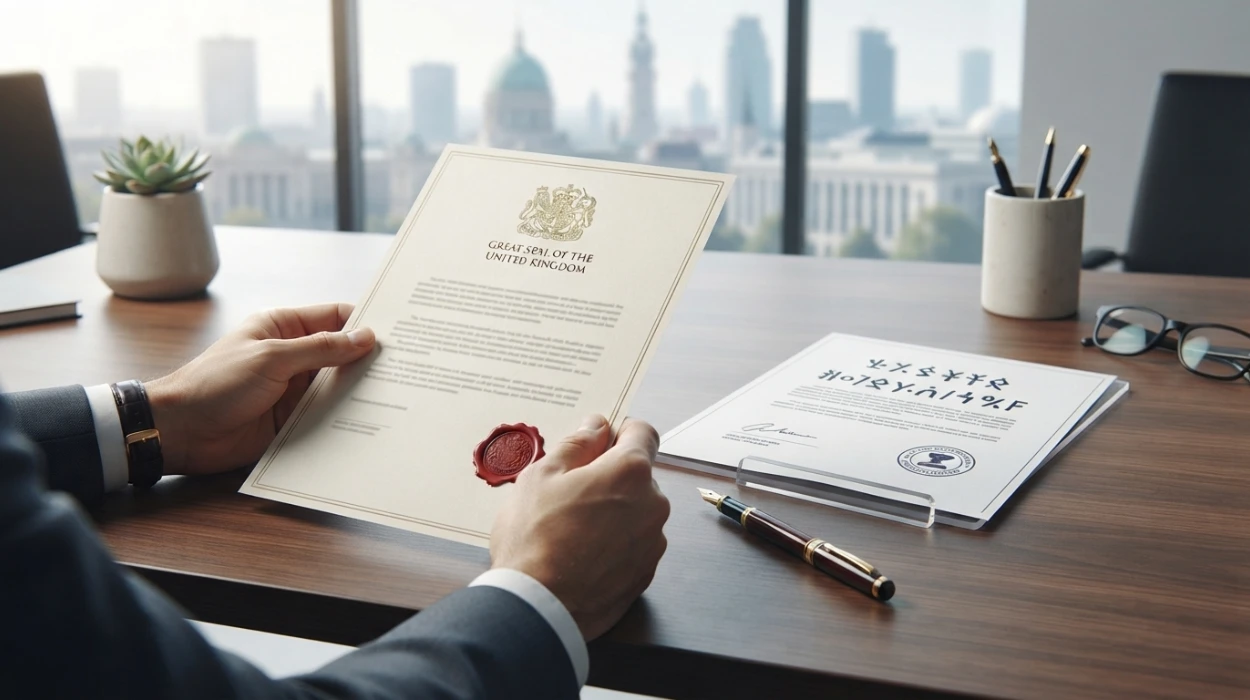
Foreign authorities require certified UK company documents to legally verify corporate identity, authenticate director credentials, and eliminate cross-border fraud risks. Official validation ensures that foreign government agencies, banks, and regulatory bodies receive tamper-proof records originating directly from Companies House.
Global commerce requires absolute trust between domestic institutions and foreign corporate entities. When a UK registered business expands operations, opens an international bank account, or bids on overseas government tenders, host regulators demand proof of legal existence. Foreign courts and overseas tax authorities cannot independently verify raw paper printouts. Certified UK company documents provide undeniable legal proof that a corporation maintains active status and complies with statutory mandates. International regulators rely on these official instruments to establish legal standing across borders.
What Legal Risks Do Unverified Foreign Entities Pose?
Unverified foreign entities introduce severe legal risks, including money laundering vulnerabilities, tax evasion, and regulatory non-compliance across international jurisdictions. Foreign authorities enforce mandatory document certification to prevent illicit actors from establishing shell corporations.
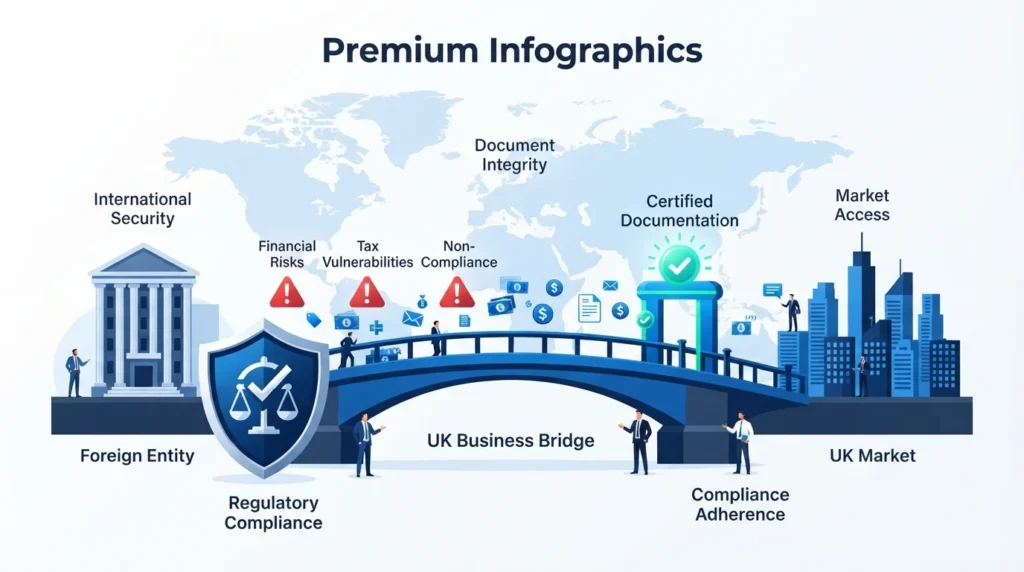
International regulators face sophisticated financial crimes executed through offshore networks and opaque corporate structures. When an unknown business applies for local licensing, regulatory officers audit corporate registries to trace ultimate beneficial ownership. Unverified registrations obscure the true identities of company directors and shareholders.
Cross-border trade relies on strict statutory frameworks to protect domestic markets. Host governments mandate official validation to stop fraudulent enterprises from extracting capital without regulatory oversight. Independent compliance audits reveal that 82% of cross-border financial discrepancies originate from unverified corporate paperwork.
International banking institutions freeze unauthorized accounts immediately when directors fail to provide officially authenticated corporate filings. Foreign tax authorities impose severe financial penalties on businesses operating without certified proof of incorporation. Strict statutory checks safeguard the integrity of domestic economic systems against foreign fraud.
How Does Document Certification Establish Corporate Authenticity?
Document certification establishes corporate authenticity by securing official stamps, wet-ink signatures, and digital authentication tokens from authorized UK public officers. This process proves that submitted records match official government registers.
Official verification transforms standard corporate printouts into legally admissible instruments recognized by foreign courts. When Companies House or practicing UK solicitors validate a certificate of incorporation, they execute a rigorous cross-reference against active government databases. Authorized signatories confirm that registration numbers, registered office addresses, and director names match statutory filings exactly.
Cross-border validation depends on clear administrative chains of custody. Three primary authentication methods secure corporate paperwork: Registrar wet-ink certification, notary public attestation, and official institutional stamping. Each verification tier creates an immutable audit trail for overseas reviewing officers.
International partners inspect these security markers to confirm document integrity before approving commercial contracts. Regulatory bodies reject unsealed transcripts immediately because tampering risks remain unmanaged. Certified records eliminate forgery vectors completely.
Why Do International Banks Demand Certified Incorporation Records?
International banks demand certified incorporation records to satisfy stringent Know Your Customer mandates, anti-money laundering laws, and global compliance regulations. Financial institutions verify legal ownership structures before approving commercial accounts.
Global banking compliance requires rigorous scrutiny of every foreign corporate applicant. Compliance officers evaluate certified certificates of incorporation and memorandum documents to trace ownership hierarchies. Banks reject standard photocopies because financial crime regulations prohibit opening accounts without tamper-evident proof of legal status.
Financial institutions examine three core structural elements: current active status, authorized share capital distribution, and designated corporate officers. Compliance teams verify these details against official registry databases before releasing operational funds.
International wire transfers and credit facilities remain locked until account holders submit fully authenticated corporate records. Foreign monetary authorities penalize banks severely for onboarding unverified corporate clients. Certified documentation protects financial institutions from severe regulatory sanctions and multi-million-dollar compliance fines.
How Do Overseas Regulatory Bodies Validate UK Company Status?
Overseas regulatory bodies validate UK company status by cross-referencing certified registry filings with official government databases and diplomatic channels. Foreign agencies verify active corporate standing to grant local operating licenses.
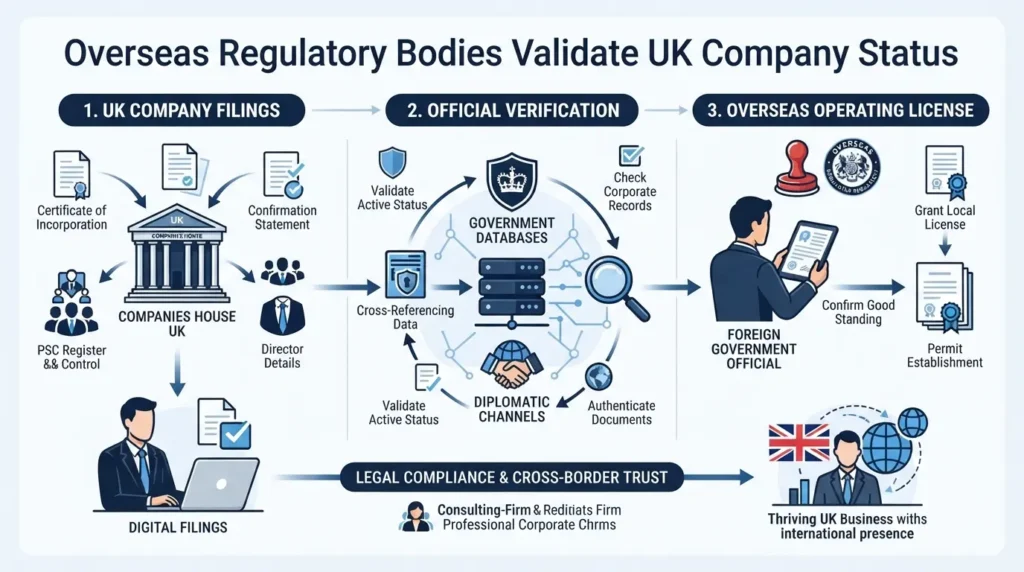
Global regulators operate under strict international transparency agreements that require precise verification of foreign business credentials. When a UK enterprise applies for foreign commercial licensing, local ministries inspect official registry certificates to confirm active trading status. Review boards check filing histories to ensure the enterprise faces no active liquidation or insolvency proceedings.
Cross-border verification involves three distinct administrative phases: registry status confirmation, legal certification, and official diplomatic endorsement. Foreign trade ministries rely on accurate documentation to issue valid operating permits.
Local commercial laws forbid foreign corporations from trading without verified proof of home-country registration. Regulatory compliance teams audit corporate filings annually to maintain active foreign market access. Official certification bridges the gap between different national legal systems effortlessly.
How Do Certified Corporate Documents Streamline Global Expansion?
Certified corporate documents streamline global expansion by eliminating bureaucratic delays, satisfying foreign legal requirements, and accelerating cross-border partnership approvals. Official paperwork ensures seamless corporate integration across international markets.
Entering foreign markets demands rapid administrative clearance to secure competitive commercial advantages. When enterprises prepare comprehensive paperwork packages, overseas legal teams approve corporate structures without administrative friction. Businesses utilizing professional supplementary company documents bypass lengthy bureaucratic investigations entirely.
International expansion strategies succeed when corporate compliance remains flawless across multiple jurisdictions. Three key operational benefits drive this success: accelerated bank onboarding, instant tender qualification, and seamless subsidiary registration.
Companies equipped with properly authenticated records establish foreign offices months ahead of unorganized competitors. Global procurement boards prioritize suppliers who provide transparent, officially certified corporate histories. Brand Name Form My Company delivers complete certification solutions that empower businesses to conquer international markets with absolute confidence and statutory precision.
Foreign authorities require certified UK company documents to eliminate cross-border fraud, satisfy strict anti-money laundering laws, and establish undeniable legal corporate identity. Official validation bridges distinct international legal systems effortlessly. Brand My Company provides comprehensive corporate certification solutions that ensure your business meets every global regulatory standard seamlessly.
Explore More Supplementary Company Documents Guide,
What Is Consular Legalisation for Non-Hague Convention Countries?
When Does a Document Need Embassy Attestation as Well as an Apostille?
Frequently Asked Questions
What are supplementary company documents and why do UK businesses need them?
Supplementary company documents are official corporate records, such as certificates of incorporation, good standing certificates, and memorandum filings, issued beyond standard registration packets. UK businesses require these supplementary company documents when expanding internationally, opening foreign bank accounts, or bidding on overseas tenders to prove legal corporate existence. Form My Company provides these vital supplementary company documents to ensure full compliance with global regulatory authorities.
How can I get my UK company documents certified for international use?
You can obtain certified UK company documents by ordering official copies directly through Companies House or authorized corporate service providers. These records receive physical wet-ink signatures, official stamps, or digital authentication tokens required by foreign legal systems. Form My Company specializes in authenticating supplementary company documents so overseas institutions accept them without administrative delay.
Why do foreign banks require certified UK corporate documents?
Foreign banks enforce strict Know Your Customer (KYC) and anti-money laundering regulations that mandate verified proof of legal ownership and active corporate status. Certified supplementary company documents allow compliance officers to trace ultimate beneficial ownership and verify authorized company directors safely. Providing these officially validated records through Form My Company accelerates international bank account approval significantly.
What is the difference between a standard certificate of incorporation and a certificate of good standing?
A standard certificate of incorporation confirms the initial legal creation and registration date of a UK business entity. A certificate of good standing verifies that the corporation is currently active, compliant with statutory filing requirements, and not facing liquidation. Both records serve as essential supplementary company documents when establishing foreign subsidiaries or registering overseas branches.
How long does it take to obtain certified supplementary company documents?
The processing time for certified supplementary company documents depends on whether you require standard registry turnaround or expedited apostille services. Standard digital and physical certified copies typically process within a few business days through professional providers. Form My Company streamlines this retrieval process to deliver authenticated supplementary company documents quickly for urgent international transactions.