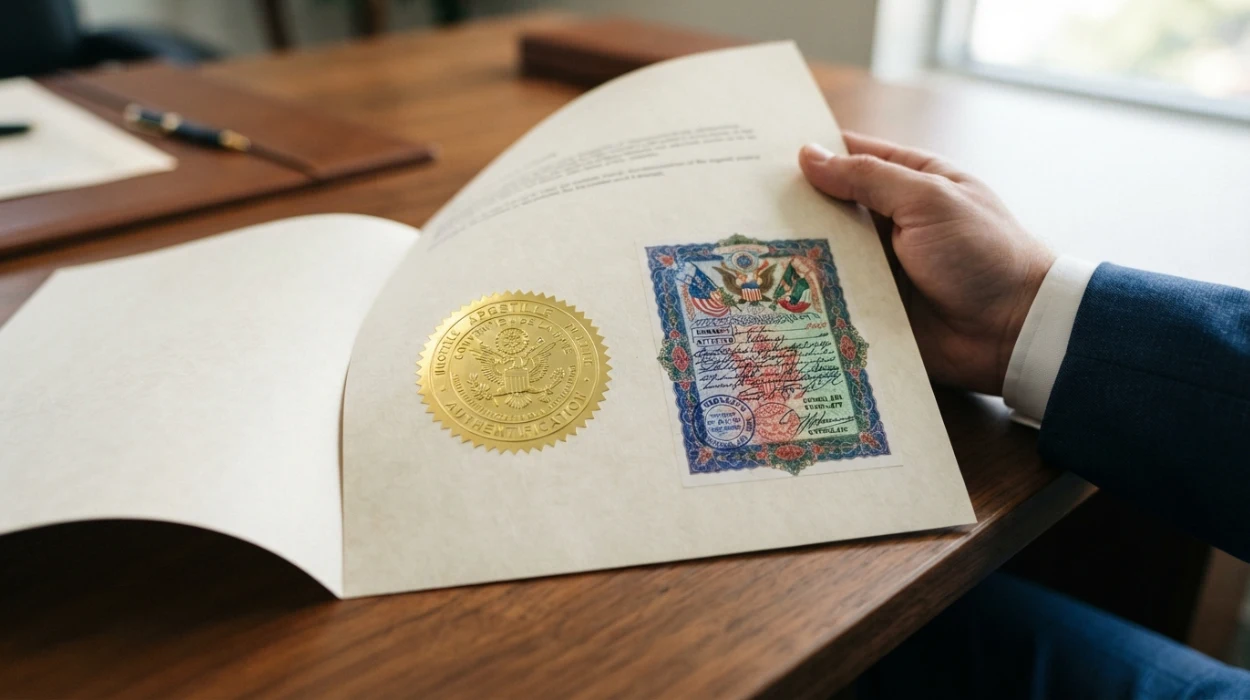
A document requires both an apostille and embassy attestation when it originates in a country party to the Hague Convention and travels to a destination country that is not a signatory, necessitating additional diplomatic legalization by that specific foreign embassy.
What is the fundamental difference between an apostille and embassy attestation?
An apostille simplifies international document recognition among 126 member states through a single certificate, whereas embassy attestation requires multi-step diplomatic verification for nations outside this treaty framework.
An apostille validates the signature and capacity of the official signing a document. It eliminates the need for further consular legalization between participating nations.
Each member state designates competent authorities to issue this standardized certificate. These authorities authenticate public documents such as birth certificates, corporate bylaws, and court orders.
Embassy attestation involves a sequential chain of verifications. This process begins with domestic government certification, moves to the foreign ministry, and ends at the destination country’s embassy.
Non-member countries do not recognize the Hague Convention framework. Consequently, foreign authorities demand consular validation to confirm document legitimacy.
Why do non-Hague Convention countries reject standalone apostilles?
Non-Hague Convention countries reject standalone apostilles because their legal systems require direct diplomatic confirmation from their own sovereign representatives stationed abroad.
Foreign jurisdictions operate under distinct administrative laws. These legal frameworks mandate that domestic authorities verify every foreign paper through their own diplomatic missions.
State sovereignty dictates that foreign governments establish independent verification protocols. Relying on a third-party apostille bypasses national security and legal compliance checks.
Consular officers inspect foreign papers to ensure alignment with local regulations. Embassy staff verify seals and signatures against official diplomatic registers.
Diplomatic verification bridges the gap between different legal systems. Without this consular seal, foreign courts and ministries deem foreign paperwork invalid.
Which types of documents frequently demand dual legalization?
Corporate papers, academic degrees, and vital statistics records frequently demand dual legalization when submitted to foreign government ministries or commercial registries.
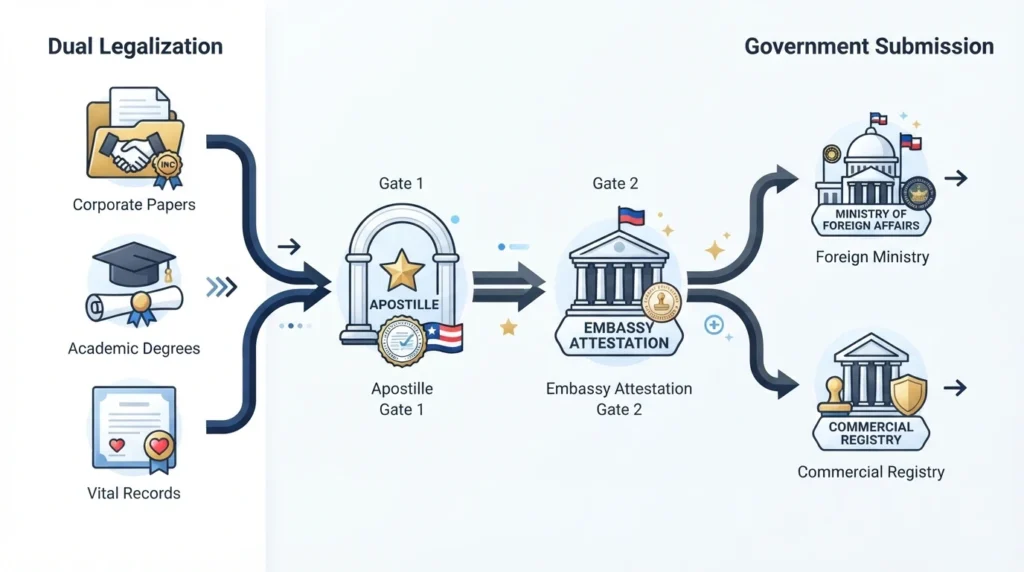
Business expansion into non-member states triggers complex compliance requirements. Corporate entities must authenticate articles of incorporation, board resolutions, and certificates of good standing.
Educational institutions verify academic credentials to protect against fraudulent degrees. Universities and ministries demand notarized transcripts bearing both apostille stamps and consular seals.
Personal identification documents require similar scrutiny for residency and employment visas. Civil status certificates undergo rigorous inspection before foreign immigration offices grant legal status.
Commercial invoices and shipping manifests require dual processing for international trade clearance. Customs authorities inspect these certified papers to assess tariffs and enforce trade regulations.
How does the step-by-step legalization workflow operate?
The legalization workflow operates through sequential verification stages, beginning with local notarization, advancing to government apostille issuance, and concluding with consular endorsement.
Domestic solicitors or notaries public certify the authenticity of the original paperwork. This initial step establishes the foundational legal standing of the document.
The Foreign, Commonwealth & Development Office attaches the apostille certificate. This government body confirms that the notary holds valid authorization to execute the verification.
Foreign ministry officials review the apostilled paperwork for diplomatic clearance. This intermediate agency ensures the document meets international transit standards.
The destination embassy or consulate applies the final attestation stamp. Consular officials confirm the paperwork satisfies all statutory requirements for use abroad.
What operational risks arise from incorrect document legalisation?
Incorrect document legalization triggers severe operational risks, including costly regulatory delays, rejected visa applications, and complete commercial transaction failures.
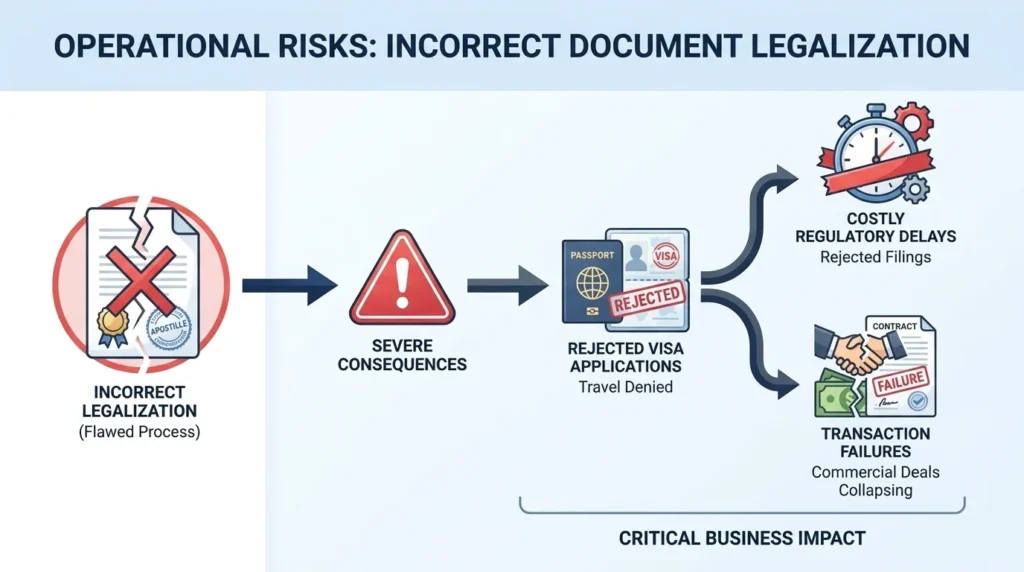
Foreign ministries reject non-compliant paperwork instantly. This rejection halts corporate expansion plans and freezes foreign direct investment projects.
Delays in document authentication cost businesses thousands of pounds in missed commercial deadlines. Operational teams must restart the entire verification sequence from inception.
Immigration authorities deny visa renewals when applicants submit improperly certified personal records. This administrative failure disrupts international assignments and expatriate relocations.
Financial institutions freeze corporate accounts when supporting constitutional papers lack proper diplomatic seals. Regulatory compliance audits penalise firms operating with unverified legal documentation.
Businesses mitigate these operational risks by utilizing professional Apostilled Documents services to ensure precise compliance across international borders.
How do businesses streamline complex consular processing?
Businesses streamline complex consular processing by partnering with specialized compliance agencies that manage multi-step governmental authentication pipelines.
Corporate compliance officers delegate document legalization to dedicated service providers. These specialists navigate intricate bureaucratic requirements across 195 global jurisdictions.
Expert coordinators monitor changing diplomatic regulations in target destination countries. This proactive oversight prevents unexpected rejections at foreign embassy counters.
Centralized management reduces administrative overhead for growing enterprise organizations. Staff members avoid spending valuable hours visiting government offices and foreign missions.
Secure courier channels protect sensitive corporate and personal records throughout transit. Specialized handlers track every phase of the verification workflow from collection to delivery.
Organizations seeking comprehensive cross-border solutions often choose to Get Translation, Apostille and Attestation Handled by Form My Company to eliminate administrative burdens.
Navigating international paperwork verification requires precise adherence to bilateral treaties and consular laws. Understanding when an apostille suffices versus when embassy attestation is mandatory prevents costly administrative delays. Businesses expanding into non-Hague Convention territories must execute multi-stage diplomatic legalization carefully. Form My Company delivers structured solutions to secure full regulatory compliance across international jurisdictions.
Explore More Apostilled Documents Guide,
Want to Get Your Articles of Association Apostilled Through Form My Company?
How Can You Suppress a PSC Home Address With Form My Company?
Frequently Asked Questions
How long does it take to get documents apostilled in the UK?
Standard UK apostille processing through Form My Company typically takes 3 to 5 working days once physical documents arrive at the processing center. Urgent expedited services can reduce this turnaround time to 24 hours depending on government office availability. Proper document preparation ensures your Apostilled Documents meet all statutory deadlines for international business transactions.
What types of documents can receive an apostille certificate?
Public documents such as birth certificates, corporate bylaws, academic degrees, and court orders qualify for official apostille authentication. These papers require notarization by a practicing UK notary public or solicitor before government legalization can proceed. Form My Company verifies every paper to ensure seamless acceptance by foreign authorities.
Do my foreign language documents need translation before apostille?
Foreign language papers destined for international use often require certified translation alongside the apostille certificate to satisfy local regulatory bodies. Destination ministries mandate that translations bear official certification to prove linguistic accuracy and legal fidelity. Form My Company coordinates comprehensive translation workflows alongside your Apostilled Documents service package.
What is the difference between a notary certification and an apostille?
Notary certification authenticates a signature and confirms the identity of the signer within domestic jurisdiction. An apostille is a higher-level government certificate that validates the notary’s credentials for international recognition across Hague Convention member states. Form My Company manages both domestic notarization and government authentication stages seamlessly.
Can digital or electronic documents receive an apostille in the UK?
Certain UK government documents issued electronically can receive an e-Apostille, whereas paper-based certificates require physical submission to the Foreign, Commonwealth & Development Office. Verification officers inspect digital signatures against official government registers before issuing electronic authentication certificates. Form My Company assesses your paperwork format to determine the correct processing pathway for your Apostilled Documents.