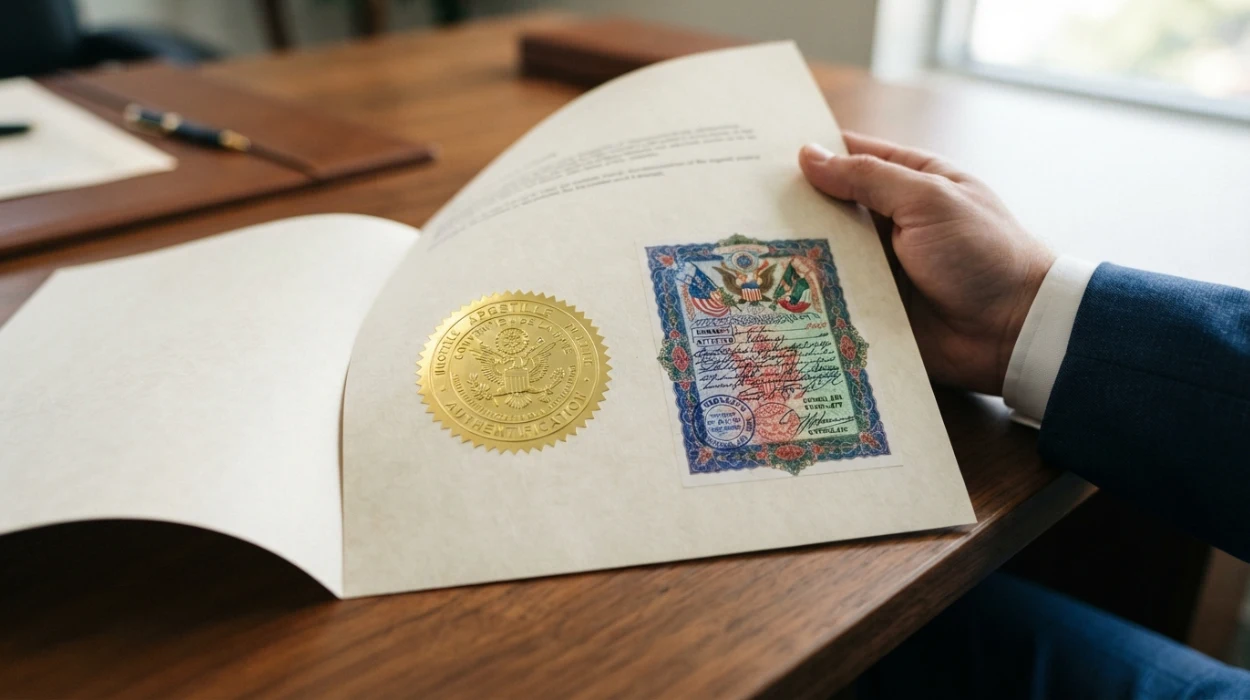
You order full consular legalisation for non-Hague countries by submitting your corporate or personal documents for UK Foreign, Commonwealth & Development Office certification, embassy attestation, and final verification by the destination state’s foreign mission.
Consular legalisation establishes document authenticity for international jurisdictions that are not signatories to the 1961 Hague Apostille Convention. Navigating multi-step diplomatic protocols requires precise adherence to foreign state requirements. Each embassy demands specific verification tiers before commercial contracts, certificates of incorporation, or power of attorney instruments receive legal validity abroad.
Form My Company simplifies this complex bureaucratic pathway through dedicated processing channels. Global trade expansion demands absolute document compliance across international borders.
What Is Full Consular Legalisation and Why Do Non-Hague Countries Require It?
Full consular legalisation is a multi-tier diplomatic verification process required by non-Hague nations to authenticate foreign documents for domestic legal use.
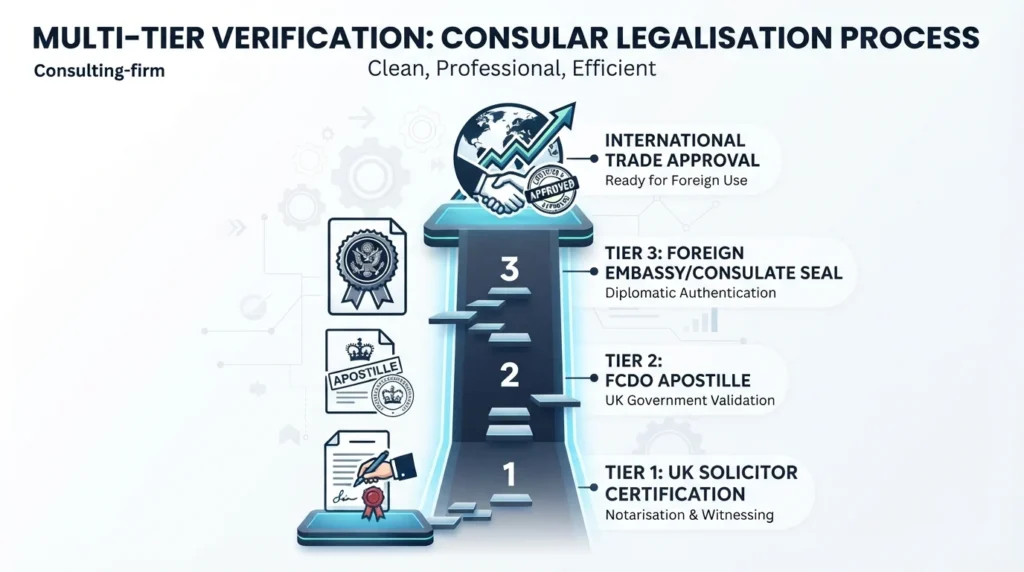
Non-Hague Convention countries reject standard apostille stamps because they do not participate in the simplified Hague treaty framework. These nations mandate independent verification by their own diplomatic representatives stationed in the UK. Two verification tiers govern this process: UK government certification followed by foreign embassy attestation. Official bodies verify corporate seals, notary signatures, and registrar credentials before foreign diplomats endorse the paperwork. Foreign ministries in destination countries inspect these completed stamps to ensure total legal compliance.
Businesses expanding into regions like the United Arab Emirates, China, or Qatar must complete this sequence to protect commercial interests. Form My Company manages these intricate multi-stage verifications with strict accuracy.
Which Documents Require Consular Legalisation Before Overseas Use?
Commercial instruments, legal agreements, and corporate registration certificates require consular legalisation before foreign authorities accept them.
Corporate expansion relies on authenticated documentation to establish foreign branch legitimacy. Three document categories dominate international business filings: corporate constitutional documents, commercial agreements, and personal statutory declarations. Certificates of incorporation, memoranda of association, and board resolutions require solicitor notarisation before government submission. Export invoices, certificates of origin, and distribution contracts undergo Chamber of Commerce certification prior to diplomatic processing.
Each document type triggers specific verification rules dictated by foreign embassy regulations. Executing these filings correctly prevents costly trade delays and regulatory rejections overseas. You can explore our detailed guidance on Apostille vs Consular Legalisation: Which Route Does Your Country Need? to determine your exact diplomatic pathway.
How Does the Multi-Step Consular Legalisation Process Work?
The consular legalisation process requires sequential verification through UK notaries, the Foreign Office, and the destination country embassy.
Execution follows a strict chronological order to satisfy international diplomatic law. Four operational steps define the standard fulfillment workflow: solicitor notarisation, UK government apostille, Arab-British Chamber of Commerce stamping where applicable, and final embassy attestation. Notaries public verify signer identity and witness corporate signatures on all legal instruments. The Foreign, Commonwealth & Development Office attaches an official certificate verifying the notary public signature. Foreign embassy officials review the preceding stamps and apply a consular seal, which finalizes the document for overseas deployment.
Processing times vary across different diplomatic missions based on staff capacity and regional protocols. Managing this sequence independently increases the risk of administrative rejection.
How Can Businesses Order Consular Legalisation Efficiently Through Form My Company?
Businesses order consular legalisation efficiently by submitting documents through specialized corporate service providers that coordinate government and embassy channels.
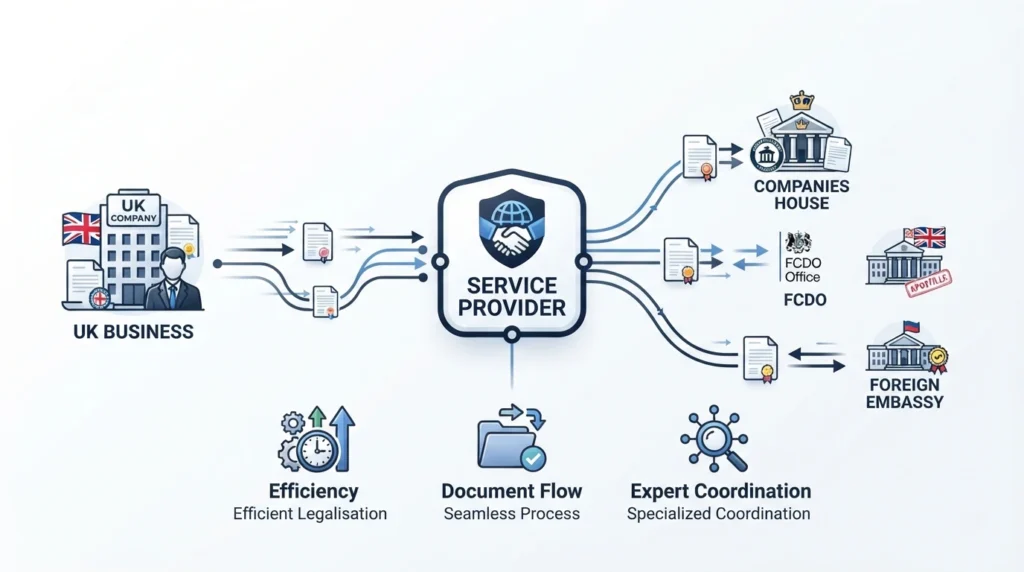
Professional oversight eliminates administrative bottlenecks during international document authentication. Three operational benefits drive outsourcing value: secure document transit, direct embassy liaison, and compliance monitoring. Dedicated account managers review document formatting against specific foreign state legal mandates before submission. Courier tracking systems safeguard sensitive corporate papers during transit between London notaries, government offices, and foreign embassies.
Companies seeking a comprehensive solution can Order Full Consular Legalisation for Non-Hague Countries directly through our dedicated portal. Form My Company delivers structured documentation workflows that accelerate international market entry for ambitious UK enterprises.
Full consular legalisation secures official document recognition across non-Hague jurisdictions through rigorous multi-tier diplomatic verification. Structuring corporate filings correctly prevents legal disputes and regulatory blocks in foreign markets. Form My Company delivers reliable document authentication services that streamline international trade compliance. Professional coordination ensures every corporate certificate, contract, and statutory declaration meets strict foreign embassy standards.
Explore More Apostilled Documents Guide,
Want to Get Your Articles of Association Apostilled Through Form My Company?
How Can You Suppress a PSC Home Address With Form My Company?
Frequently Asked Questions
How long does consular legalisation take for non-Hague countries?
Consular legalisation typically takes between 10 and 25 working days depending on the specific foreign embassy workload and government processing times. Form My Company manages this multi-step verification sequence efficiently to minimize administrative delays for your business.
What is the difference between an apostille and consular legalisation?
An apostille is a simplified single-tier certification used exclusively for countries belonging to the 1961 Hague Convention. Consular legalisation requires additional embassy attestation for non-Hague nations because those destination states do not recognize standard apostille stamps.
Which countries require full consular legalisation instead of an apostille?
Nations that are not signatories to the Hague Convention, such as the United Arab Emirates, China, and Qatar, require full consular legalisation. Form My Company processes corporate and personal documents to meet the exact regulatory mandates of these non-Hague jurisdictions.
Can business contracts be notarised and legalised for overseas use?
Commercial agreements, board resolutions, and certificates of incorporation require solicitor notarisation before undergoing government and embassy legalisation. Form My Company coordinates solicitor verification, UK government certification, and diplomatic stamps for international trade compliance.
Do personal documents need consular legalisation for foreign employment?
Personal documents such as educational degrees, marriage certificates, and criminal record checks require consular legalisation for use in non-Hague countries. Form My Company authenticates these vital records to ensure they receive full legal recognition from foreign authorities abroad.