
Could a share certificate prove company ownership on its own? It is useful evidence, but the company’s register of members is the primary record of who owns its shares. If you’re researching How to Prove Company Ownership With the Right Certificates, start by understanding what each document records and how they work together.
Shareholders, beneficial owners, directors and the company itself have different roles. A document confirming one detail may not prove another. Out-of-date or inconsistent records can also raise questions when you need to show who owns a business.
This guide explains what UK company documents show and how to assemble evidence that matches the request. Learn when to use a share certificate, the register of members, Companies House information or PSC details, and when other company records may help. The aim is a clear, consistent account of ownership that is easy to review.
Key Takeaways
- Identify whether you need to evidence share ownership, control or the company’s existence. The right documents depend on what the request asks you to prove.
- Check what each record supports and what it cannot establish, rather than relying on one certificate to answer every ownership question.
- Use How to Prove Company Ownership With the Right Certificates as a practical guide to selecting relevant evidence and checking that details are consistent.
- Before sending documents, match them to the requested format and check whether certified copies or other authentication are required.
- Use company records to build an organised bundle, and make sure each document is relevant to the question being asked.
How to Prove Company Ownership: Start by Identifying What Must Be Proven
Ownership evidence should match the interest being checked. A request to confirm that a company exists calls for different documents from one asking who holds its shares, who manages it or who exercises control. Read the request carefully, then choose records that address it directly.
A bank might need to verify the company’s identity and the people who control it. An investor may ask for evidence of shareholdings, while a counterparty may only need confirmation that the business is registered. The documents can overlap, but they do not all prove the same thing. A director may run a company without owning shares, and a shareholder may hold shares without being a director.
For How to Prove Company Ownership With the Right Certificates, keep the purpose of each record in view. A share certificate records a member’s shares and can support evidence of title, but it should not be treated as universal proof of current ownership. Read it alongside the company’s current records, particularly its register of members.
Does a company incorporation certificate prove who owns the company?
No. Incorporation evidence confirms that the company was formed and identifies it, but it does not provide a complete picture of current share ownership. Company identity details are different from records showing who holds shares now. Match the document to the request: formation evidence may answer a request for proof of incorporation, while a request about shareholders calls for ownership records.
Legal ownership and beneficial ownership are not always identical
A registered shareholder is the person or organisation recorded as holding shares in the company’s register of members. A beneficial owner is the person who ultimately benefits from or exercises control over an interest. These may be different people where shares are held through another person or organisation.
A shareholder is recorded as holding shares; a beneficial owner is the person who ultimately benefits from or controls an interest in them.
Companies House PSC information can help identify people with significant control, but it is not a complete list of every shareholding or a substitute for the company’s register of members. PSC status may arise through share or voting rights, or other forms of control. Where ownership passes through a company or another arrangement, supporting records may be needed to explain the links between the registered holder and the person exercising control.
Keep this distinction clear when assembling evidence. The Share certificate offers an overview of the document, but the evidence you need depends on the question being asked and the company’s current records.
Which UK Company Records and Certificates Show Share Ownership?
Each document answers a different question. A share certificate records a member’s shares and is evidence of title, while the company’s register of members is its key record of membership. Neither gives a complete explanation of every person’s beneficial interest or control. Use this comparison to see what each record can support.
| Document | What it supports | What it doesn’t establish | When it may help |
|---|---|---|---|
| Share certificate | The named holder and share details stated on that certificate | Every beneficial interest, control arrangement or later change not reflected in the document | When evidence of a member’s shares is requested |
| Register of members | The company’s record of its members and relevant shareholding details | By itself, the full chain of indirect ownership or every aspect of control | When checking who is recorded as a shareholder |
| PSC register | People identified as having significant control under the applicable rules | A complete list of share certificates, shareholders or share transfers | When a request concerns significant control |
| Companies House filings | Information filed with the registrar, which can include ownership-related details | A substitute for the company’s own current membership records | For a public-record cross-check or due diligence |
| Certificate of incorporation | The company’s formation and identity | Its current shareholders or ownership structure | When proof that the company was incorporated is requested |
What does a share certificate show?
Depending on the certificate, it may state the shareholder’s name, the number or class of shares, and identifying company details. Compare those particulars with the company’s register of members and the date of the record. A certificate can be important evidence, but it does not automatically show who ultimately benefits from the shares or exercises control. Whether it is accepted also depends on the organisation making the request and its stated requirements.
How do the register of members and PSC register differ?
The register of members records the company’s membership and relevant shareholding information. The PSC register concerns people who meet the applicable significant-control conditions. It is not a transaction-by-transaction record of share transfers or a replacement for the register of members. Companies House makes filed company information publicly available as the UK’s registrar, but public filings and internal company records serve different purposes. For more detail, see Companies House records.
If a certificate and the register appear inconsistent, compare both with the company’s share issue or transfer records and check which record is current. The PSC register support information relates to organising PSC information. The key is to match the evidence to the question, then check that the documents present a consistent account.
Share Certificate vs Companies House Records: Avoid These Ownership-Proof Mistakes
A common mistake is assuming one official-looking document proves every aspect of company ownership. A share certificate, the company’s register of members, PSC information and incorporation evidence each serve a different purpose. The strongest bundle is the one that answers the request and presents a consistent, current account of the relevant details.
Use each record for what it can show:
- Share certificate: supports evidence of the shares recorded for its named holder. It may not reflect a later transfer or explain who ultimately benefits from or controls those shares.
- Register of members: shows who the company records as its members and relevant shareholding details. It is a company record, so compare it with supporting documents if there is a discrepancy.
- Companies House information: provides filed information for public reference. It can help with a cross-check, but it should not be assumed to capture every detail held in the company’s own records.
- PSC information: relates to people identified as having significant control. It is not a complete record of all shareholders or share transactions.
- Certificate of incorporation: confirms the company’s formation, not its current share ownership.
For How to Prove Company Ownership With the Right Certificates, focus on the question being asked. Evidence that a company exists will not answer a request for a shareholder’s current shareholding, just as a share certificate may not explain a wider control arrangement.
Why an incorporation certificate is not a share certificate
These certificates relate to different facts. Incorporation evidence identifies a company formed through UK company registration, while a share certificate relates to shares recorded for a holder. Sending an incorporation certificate in response to a request for shareholder evidence may leave the request unanswered. Read the wording carefully and provide documents that address the stated purpose, rather than relying on a document simply because it is official.
What if ownership details do not match across documents?
Do not ignore a mismatch. Compare the company name, shareholder’s name, share numbers or quantities, share class where stated, and the dates on each record. A change of name may explain different wording, while a share transfer or allotment may mean older paperwork no longer reflects the company’s current records.
Check the sequence of events against available company documents, including records of the relevant issue or transfer and the updated register of members. A Companies House filing may have a different date or purpose from an internal record, so note what each document represents rather than assuming that different dates automatically indicate an error.
Before submitting your evidence, resolve apparent inconsistencies where possible and obtain appropriately updated records. If the discrepancy remains unclear, explain it plainly and avoid presenting an outdated certificate as proof of the current position. This review can make the evidence easier to assess and help prevent unnecessary follow-up.
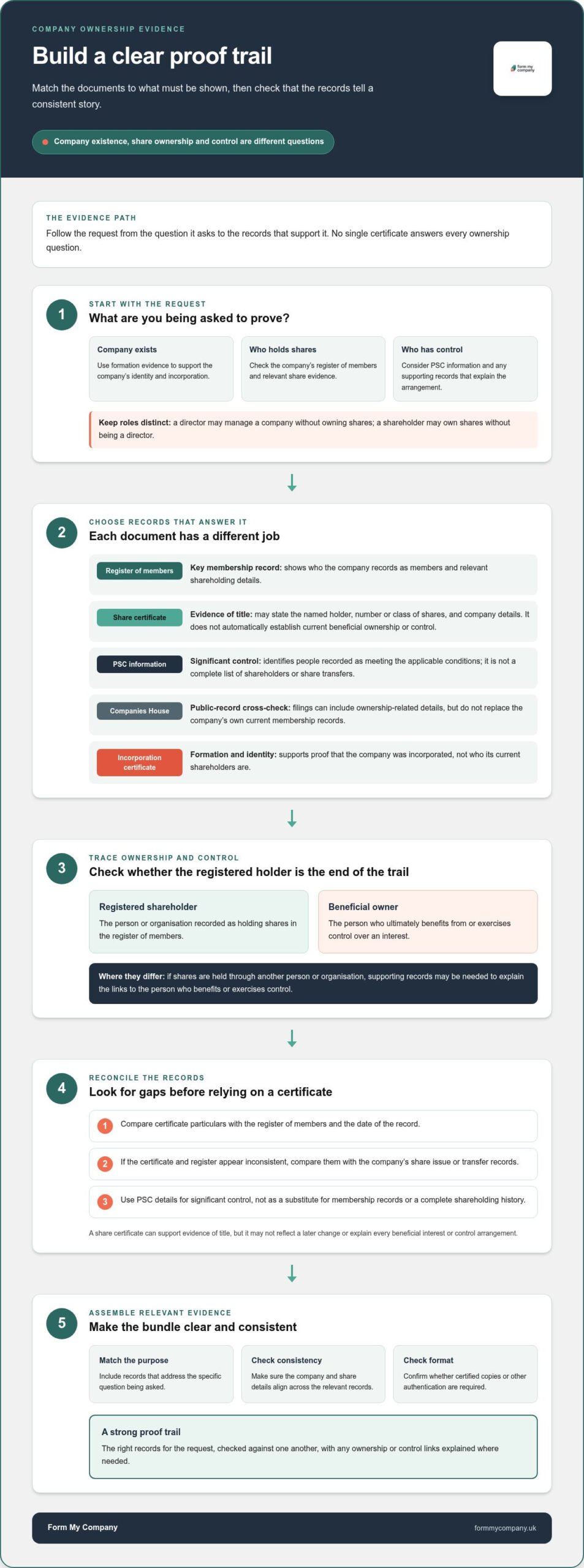
How to Assemble Company Ownership Proof Step by Step
A clear document bundle starts with the request, not with a stack of certificates. Use this workflow to select relevant evidence, check that details align and present the records in an easy-to-follow order.
- 1. Identify what must be proved. Does the request concern a person’s shares, who exercises significant control or whether the company exists? These are separate checks and may call for different evidence.
- 2. Read the instructions carefully. Note the exact documents requested, the period they should cover and any requirements for certified copies, translations, file types or authentication. If the wording is unclear, clarify it with the organisation making the request.
- 3. Select evidence for the purpose. For share ownership, gather the relevant share certificate and supporting company records, such as the current register of members. For significant control, check whether PSC information is requested and whether records explaining an ownership chain are needed. For company existence, use formation evidence rather than treating it as proof of share ownership.
- 4. Compare the details. Check names, share details and dates across the documents. Look for changes such as a share transfer or a change of name, and make sure the records reflect the position relevant to the request.
- 5. Arrange and protect the bundle. Put the main evidence first, followed by supporting records in date order. Label each document by purpose and source, include only relevant information, and handle personal details securely.
Match the evidence to the request
Prepare a clear, consistent document bundle
Make it easy for the recipient to compare names, dates and share details. If a record appears out of date or conflicts with another, resolve the discrepancy or explain it before submission. Avoid adding unrelated paperwork, which can obscure the relevant evidence. Checklist: clarify the request, select matching records, compare current details, follow format instructions and arrange the documents in a clear order.
For information about documents prepared for overseas use, see Form My Company’s apostilled document information.
Get the Right Company Documents Together With Form My Company
Once you know what the request asks you to prove, bring the relevant company records together in a clear, organised set. A well-prepared bundle makes it easier to compare details and see how each document supports the ownership information you are providing.
For information about company records, see the Company Pack page and the linked information about PSC registers. Use the requesting organisation’s instructions to decide which records are relevant. Do not assume that a particular document will answer every ownership question or meet every recipient’s requirements.
For How to Prove Company Ownership With the Right Certificates, the goal is not to collect the most paperwork. Assemble the records that answer the question, with details that can be checked against one another.
When a Company Pack or supplementary documents may help
Company records are most useful when they are relevant to the request and easy to compare. Before submitting anything, check that the documents match the request’s purpose, required date range and format. The requesting organisation decides what evidence it accepts, so use its instructions to guide your selection.
When the ownership question needs specialist advice
Routine document gathering is different from resolving a dispute about who owns shares. Trusts, layered ownership and disagreements over a transfer can raise questions that a document bundle alone will not settle. Form My Company provides company formation and administrative services, not legal representation. If ownership is disputed or the structure is complex, seek advice from a suitably qualified legal professional. For a routine request, use the recipient’s instructions to guide which records you prepare and how they should be presented.
Keep the final bundle focused: include the relevant records, make dates and names easy to compare, and leave out unrelated paperwork. If you’re setting up a UK company, explore Form My Company’s Digital Package to get started with company formation.
Build a Clearer Company Ownership Record
Strong ownership evidence starts with the question being asked. A share certificate, the register of members, PSC information and incorporation documents each support different checks, so do not rely on one record to prove everything. Compare names, share details and dates, then follow the requesting organisation’s instructions for format or certification.
Knowing How to Prove Company Ownership With the Right Certificates means matching documents to the specific interest being checked and organising them into a consistent, easy-to-review bundle. Form My Company provides UK company formation packages and administrative services for businesses at different stages.
Explore Form My Company’s Digital Package if you’re ready to form a UK company. Choose the company formation option that suits your plans and start with a clear administrative foundation.
Frequently Asked Questions
Does a share certificate prove company ownership?
A share certificate can provide evidence of the shares recorded for its named holder, but it may not show the complete current ownership or control position. Compare its details with the company’s register of members and relevant records of later changes, such as a transfer. If a bank, investor or other organisation has asked for specific evidence, follow its instructions rather than assuming a certificate alone will meet its requirements.
Is a Certificate of Incorporation proof of company ownership?
No. A Certificate of Incorporation is evidence that the company was incorporated, not a record of every shareholder or their current shareholding. To show who holds shares, check relevant shareholder documents and the company’s current records. If the request concerns control rather than share ownership, find out whether PSC information or other supporting records are needed. Match each document to the specific point the recipient wants verified.
What is the difference between a shareholder and a PSC?
A shareholder holds shares in a company, while a person with significant control, or PSC, is identified because they meet applicable control criteria. The same person may be both, but the terms are not interchangeable: someone may exercise control through rights or arrangements without being recorded as a direct shareholder. Check whether the request asks about shares, significant control or both, and refer to current Companies House guidance for PSC criteria.
Can the PSC register prove who owns all the company shares?
No. The PSC register concerns people with significant control; it is not a complete record of every shareholder, share certificate or share transfer. To evidence share ownership, compare relevant certificates with the company’s register of members and other current records. PSC information may help explain control, but the evidence needed depends on the recipient’s question. Follow its instructions and avoid treating a PSC entry as a full shareholding statement.
How do I prove beneficial ownership of a UK company?
Start by identifying the ownership chain and the specific benefit or control the recipient wants to verify. Share certificates and company records can help show direct share ownership, while PSC information may indicate significant control. If another company or person sits between the individual and the shares, supporting records may be needed to explain that link. For How to Prove Company Ownership With the Right Certificates, match each document to the request and use current records.
What should I do if my share certificate and company records do not match?
Compare the names, dates and share details, then check whether a recorded change, such as a transfer, explains the difference. Do not submit conflicting documents without explaining the mismatch. Gather relevant updated records and follow the recipient’s instructions about acceptable evidence. If the discrepancy involves a disputed transfer or a complex ownership arrangement, seek appropriate professional advice before relying on either document to establish the position.