
A Certificate of Good Standing is required in tenders and contracts because it provides verifiable, official proof from Companies House that a company is legally active, compliant with statutory filing requirements, and free from liquidation proceedings or administrative dissolution.
Procuring entities demand this validation to eliminate financial risk, verify legal existence, and ensure corporate continuity before committing to multi-party agreements. When large commercial enterprises or public sector authorities evaluate vendor bids, verifying corporate legitimacy protects them from contracting with dissolved or non-compliant entities.
What is a Certificate of Good Standing and what does it prove?
A Certificate of Good Standing is an official UK government document issued by Companies House that confirms a registered company has existed continuously since incorporation and has no pending strike-off actions.
This document validates that the registered enterprise has filed its required annual accounts and confirmation statements on schedule. When procurement teams evaluate supplier eligibility, they rely on this official confirmation to verify that corporate directors hold active authority and that the enterprise maintains an active operational status. Public sector tenders enforce strict compliance protocols because regulatory standards require verifiable proof of corporate health before contract award. Three essential items appear on the certificate: the company registration number, the official corporate name, and a confirmation of active legal status.
How does corporate compliance impact tender eligibility?
Corporate compliance directly determines tender eligibility because procurement frameworks disqualify bidders who fail to submit up-to-date statutory filings or face active winding-up petitions.
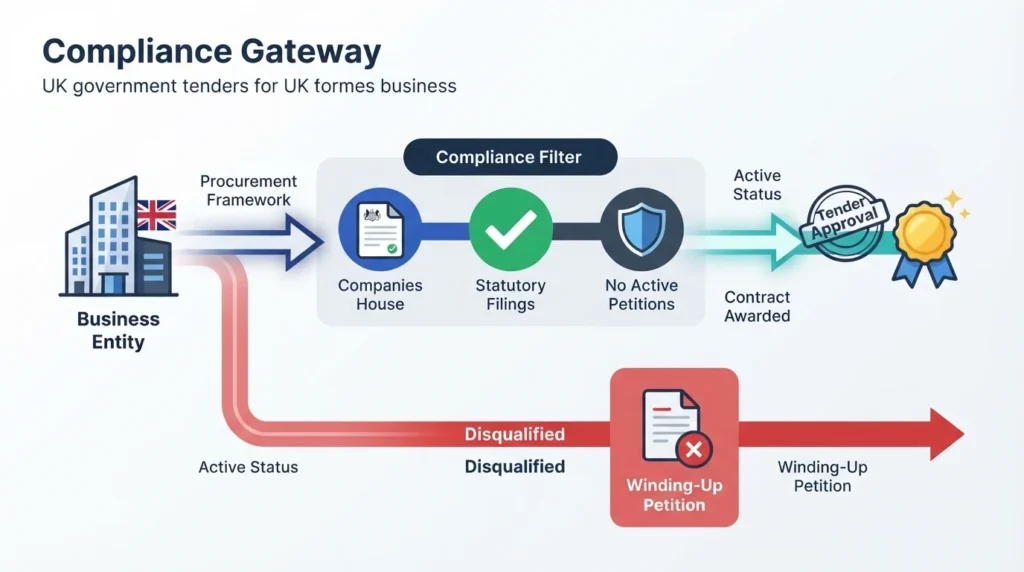
Public procurement regulations mandate rigorous background checks to prevent financial default and contractual failure. When statutory filings lapse, Companies House flags the entity, which immediately jeopardizes its standing and halts successful tender submissions. Commercial buyers examine compliance histories to safeguard supply chain continuity against sudden operational disruptions. Two critical regulatory checks govern this process: checking annual account submission dates and reviewing confirmation statement filing deadlines. Maintaining a pristine compliance record ensures that your enterprise passes initial administrative screening stages without delay.
Why do public sector procurement frameworks demand active status verification?
Public sector procurement frameworks demand active status verification to comply with statutory transparency mandates and protect taxpayers from fraudulent or insolvent contractors.
Government bodies operate under strict legal guidelines that mandate due diligence on every recipient of public funds. When an agency issues a high-value tender, legal accountability requires absolute certainty regarding the financial and legal viability of the winning bidder. Independent verification prevents shell companies and dormant entities from securing public contracts fraudulently. Three standard risk-mitigation measures include inspecting corporate registries, validating director identities, and confirming active tax clearance. Procurement officers review a Certificate of Good Standing to authenticate that the bidding enterprise operates within full legal compliance.
How do international trade contracts utilize corporate status validation?
International trade contracts utilize corporate status validation to establish legal certainty across borders and satisfy foreign regulatory authorities during cross-border transactions.
Foreign buyers and overseas regulatory bodies cannot easily inspect local company registers without official certification. When expanding operations into international markets, businesses must prove their domestic legal validity to secure commercial leases, banking facilities, and import licenses. Certified corporate documents bridge the information gap between jurisdictions by providing universally recognized proof of legal existence. Two primary requirements for international contracts include obtaining an apostille stamp and translating the documentation into the destination country’s official language. Foreign partners rely on these authenticated records to establish secure, legally binding partnerships.
What financial and legal risks do buyers mitigate using these certificates?
Buyers mitigate severe financial and legal risks by using these certificates to prevent unexpected corporate dissolution, contract frustration, and protracted litigation.
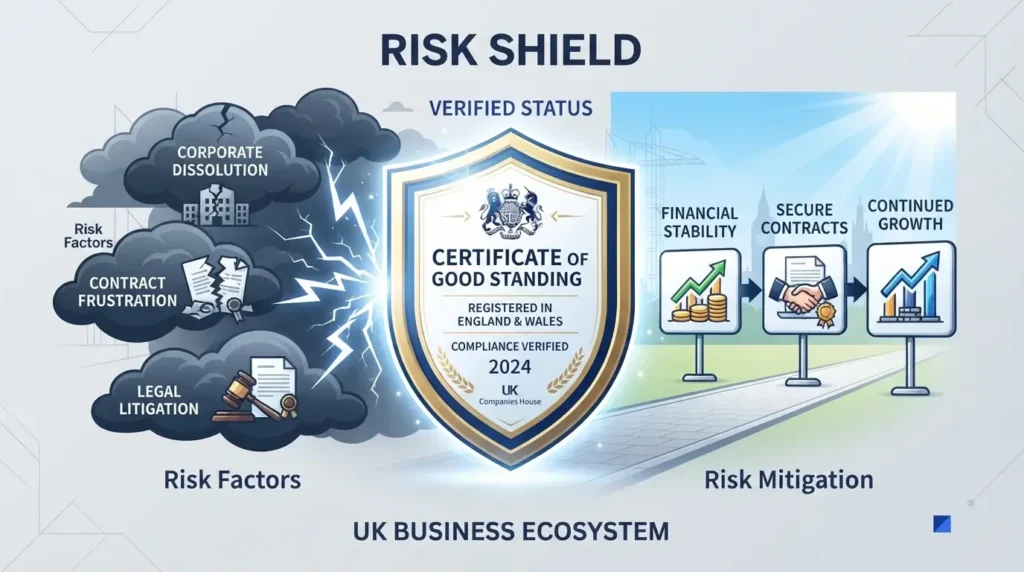
Entering a multi-year commercial agreement with an unstable or non-compliant entity exposes the buyer to sudden project abandonment if the supplier faces compulsory strike-off. Commercial enterprises mitigate these vulnerabilities by enforcing strict pre-qualification criteria that mandate official proof of corporate longevity. When an enterprise secures a Certificate of Good Standing, it demonstrates financial stability and administrative discipline. Businesses often evaluate whether ordering a single document or multiple copies is more cost-effective; you can review guidelines on How to Choose Between Ordering One Certificate or a Bundle for Multiple Uses to optimize your document management strategy. Three major risks avoided through this verification include supply chain collapse, regulatory penalties, and unrecoverable financial advances.
How can businesses expedite document procurement for urgent tender deadlines?
Businesses can expedite document procurement for urgent tender deadlines by utilizing specialized corporate secretarial services that interface directly with official government registries.
Tight submission windows require rapid turnaround times to ensure compliance documentation arrives before procurement portals close. When filing manually, administrative delays or rejected applications can cause an enterprise to miss lucrative tender deadlines entirely. Professional business services streamline this workflow by verifying company data and submitting expedited requests directly to Companies House. To secure an expedited, investor-ready document, you can Request an Investor-Ready Certificate of Good Standing With Form My Company to guarantee compliance before your deadline. Two primary methods for fast-tracking applications include electronic authentication and priority dispatch services.
Tenders and contracts require a Certificate of Good Standing to protect buyers from legal liability, financial insolvency, and corporate non-compliance. Procuring entities rely on these official documents to verify that a business maintains active status and meets all statutory filing obligations. Form My Company delivers efficient, reliable solutions for securing official compliance documentation, ensuring that your enterprise remains fully prepared for every commercial tender and contract negotiation.
Explore More Certificate of Good Standing Guide,
When Do You Actually Need a Certificate of Good Standing for Your Company?
Why Do Banks Ask for a Certificate of Good Standing When Opening an Account?
Frequently Asked Questions
How long is a Certificate of Good Standing valid for UK companies?
A Certificate of Good Standing is typically valid for 3 months from the date of issue because commercial banks, regulatory bodies, and international authorities require current verification of a company’s active status. When organisations need to prove ongoing compliance during tenders or foreign expansions, they must obtain a newly issued document through providers like Form My Company.
Can a company with filing arrears obtain a Certificate of Good Standing?
A company cannot obtain a Certificate of Good Standing if it has overdue annual accounts or late confirmation statements with Companies House. To qualify for this document, businesses must first resolve all filing arrears and clear any outstanding administrative penalties to restore compliance.
What information is included on a Certificate of Good Standing?
A Certificate of Good Standing displays the official company name, company registration number, incorporation date, and a legal confirmation that the enterprise is active and not subject to dissolution. This official document also lists the names of current company directors and the registered office address as recorded by Companies House.
How quickly can Form My Company deliver a Certificate of Good Standing?
Form My Company offers expedited processing options that allow businesses to secure a digital or paper Certificate of Good Standing within 24 to 48 hours. This rapid turnaround time ensures that corporations can meet urgent tender submission deadlines or sudden banking compliance requirements without delay.
Do overseas authorities require an apostille on a UK Certificate of Good Standing?
Overseas authorities frequently require an apostille stamp on a UK Certificate of Good Standing to authenticate the document for international legal and commercial use. Form My Company assists businesses in obtaining both the certificate and the necessary foreign office legalization to ensure cross-border validity.