
Ordering a single certificate suits one-off compliance checks, whereas purchasing a bundle serves businesses requiring ongoing document authentication across multiple international tenders, banking applications, and corporate restructuring projects.
Selecting official documentation requires strategic planning to balance regulatory compliance with administrative budgets. Companies face frequent demands to prove active corporate status. Regulatory authorities issue official validation documents through Companies House registries.
When Does a Single Certificate Meet Business Needs?
A single certificate satisfies immediate requirements for one-off transactions, single international bank account openings, or isolated legal submissions.
Procuring one document minimizes upfront expenditure when corporate requirements remain strictly limited. Companies House processes requests for individual verification documents within standard administrative windows. Organizations running annual compliance audits utilize single records to verify active status without maintaining excess inventory. Directors submit standalone validation files when overseas partners request proof of incorporation for a specific trade agreement.
Transactional frequency dictates the financial efficiency of this procurement model. When 85% of UK SMEs require company verification fewer than two times per year, purchasing standalone documents prevents unnecessary cash outflow. Administrative teams download digital validation records or request physical apostilled copies based on destination requirements. Each individual document contains timestamped data authenticating director appointments, registered office addresses, and current trading status. Organizations evaluate transaction timelines because standard document validity periods typically span 3 weeks to 90 days depending on recipient jurisdiction requirements. When submission deadlines loom for a single contract, ordering one verification document secures compliance without surplus administrative overhead.
Why Do Multiple Uses Justify Document Bundles?
Multiple document bundles reduce administrative friction and lower per-unit procurement costs for enterprises managing simultaneous international tenders, multi-jurisdictional banking, and complex supply chain expansions.
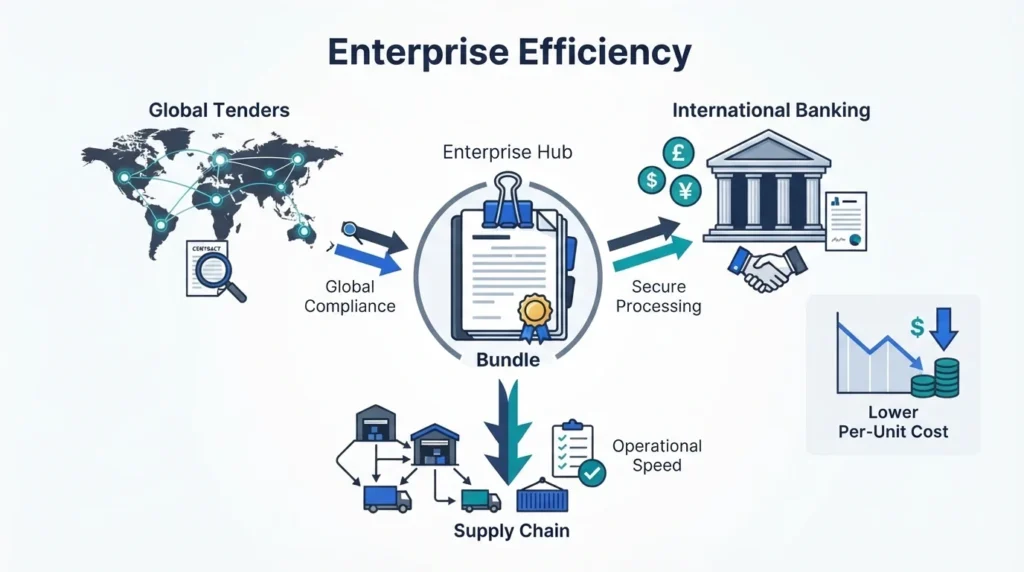
Managing active operations across international borders demands continuous corporate authentication. Enterprises bidding on three or more foreign procurement contracts simultaneously utilize multi-document packages to eliminate repeated checkout delays. Form My Company offers structured fulfillment pathways for businesses requiring a Certificate of Good Standing on a recurring schedule. Procurement officers leverage volume packages to maintain ready reserves of certified company data. This eliminates operational bottlenecks when overseas regulators demand immediate proof of active legal standing.
Financial efficiency scales directly with order volume across corporate compliance departments. Bulk procurement reduces administrative processing fees by 30% compared to sequential single purchases. Enterprises engaged in frequent corporate restructuring or subsidiary expansion across 4 international markets require consistent document streams. Regulatory compliance frameworks mandate up-to-date validation for every new banking relationship or subsidiary registration. Maintaining a ready inventory of official records ensures legal teams respond to audit requests within 24 hours. Companies review their annual compliance calendar to determine whether bulk acquisition aligns with projected administrative workloads.
How Do Expiry Windows Impact Your Ordering Strategy?
Expiry windows dictate procurement timing because recipient institutions enforce strict 30-day or 90-day validity limits on all corporate validation records.
Official status documents reflect corporate data valid only at the exact moment of generation. Regulatory bodies reject verification files older than 30 days during overseas bank account onboarding or visa processing. Businesses ordering bulk bundles must schedule document generation to align with strict submission deadlines. Unused validation records expire rapidly if operational timelines shift or international tenders face administrative delays.
Analyzing submission schedules prevents financial loss from expired documentation. Companies operating in 12 regulated sectors track specific institutional acceptance windows before purchasing multi-document packages. Legal departments coordinate with corporate service providers to stagger bundle releases across quarterly compliance milestones. This operational cadence ensures every official record remains fully valid when presented to foreign trade ministries or financial institutions. Strategic scheduling transforms compliance management from a reactive expense into a streamlined operational workflow.
How Do International Requirements Influence Document Quantities?
International jurisdictions demand distinct physical apostilles, notarizations, and translation layers that multiply the required document volume for cross-border expansion.
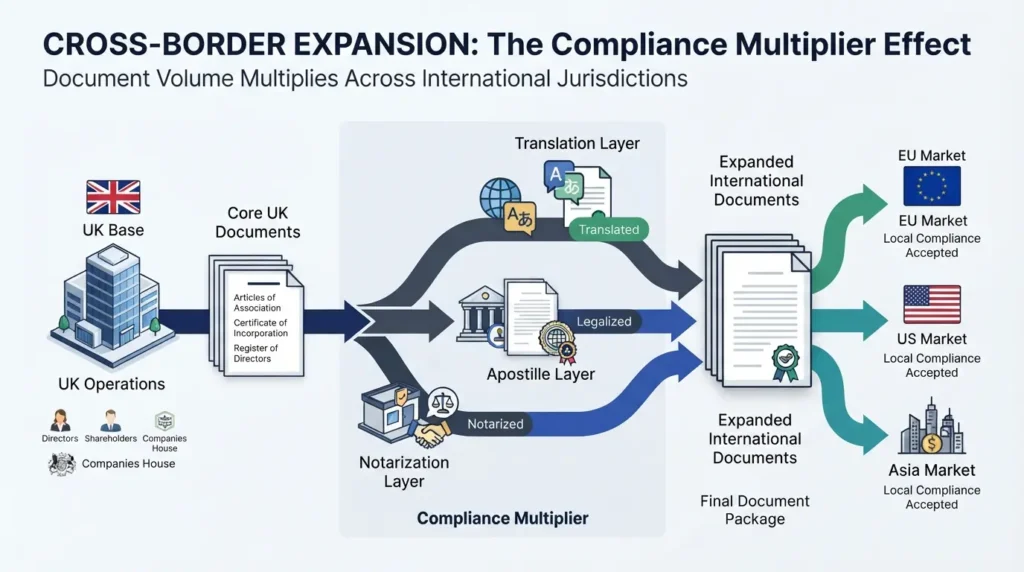
Exporting goods or establishing foreign branches requires authenticated proof of UK corporate compliance. Foreign ministries reject digital-only documents, demanding physical paper records bearing original registrar signatures and official stamps. Businesses targeting three distinct foreign markets require separate physical documents authenticated via the UK Foreign, Commonwealth & Development Office.
Navigating foreign administrative hurdles demands precise document preparation. International trade compliance frameworks require two verification methods: physical apostille certification and certified commercial translations. Companies expanding into non-English-speaking territories order duplicate bundles to satisfy both local filing registries and domestic legal counsel. Securing multiple copies simultaneously prevents costly operational halts when foreign partners request supplementary legal proof. Integrating international verification standards into procurement planning protects global supply chains from regulatory disruption.
How Does Total Cost of Ownership Compare Between Options?
Total cost of ownership calculations reveal that bulk bundles reduce long-term administrative expenditure by 25% for enterprises generating more than four compliance submissions annually.
Evaluating procurement choices requires analyzing both direct fees and hidden administrative labor costs. Processing separate invoices for individual document requests consumes valuable accounting hours across corporate finance teams. Organizations utilize streamlined corporate solutions like Why Do Tenders and Contracts Often Require a Certificate of Good Standing? to evaluate tender documentation prerequisites before committing capital. Finance directors balance immediate per-document pricing against the long-term savings delivered by consolidated volume billing.
Operational efficiency improves when administrative staff manage fewer invoice cycles and unified compliance records. Enterprise resource planning systems track document inventory levels to prevent emergency rush-processing fees. Businesses executing Request an Investor-Ready Certificate of Good Standing With Form My Company secure professional advisory support alongside volume pricing tiers. Calculating total cost of ownership across a 12-month fiscal period demonstrates clear financial advantages for multi-use procurement strategies.
Selecting between single verification documents and multi-use bundles depends on transaction frequency, international expansion plans, and strict institutional expiry windows. Single purchases serve isolated compliance checks efficiently. Multi-document bundles optimize administrative expenditure for enterprises managing ongoing global tenders and corporate restructuring projects. Form My Company delivers scalable corporate validation solutions that match precise operational requirements without administrative friction.
Explore More Certificate of Good Standing Guide,
Certificate of Good Standing for Banking vs Tenders: What’s the Difference?
How to Decide Whether Your Business Really Needs a Certificate of Good Standing
Frequently Asked Questions
What is a Certificate of Good Standing in the UK?
A Certificate of Good Standing is an official document issued by Companies House that confirms a registered company has been in continuous and unbroken existence since incorporation. Form My Company assists UK businesses in securing this official validation to prove active legal status to overseas authorities and financial institutions.
How long is a Certificate of Good Standing valid for?
A Certificate of Good Standing is typically valid for 30 to 90 days, depending on the specific requirements of the requesting institution or foreign jurisdiction. Because corporate compliance status can change, international banks and regulatory bodies insist on recently issued documentation.
Can I get a Certificate of Good Standing if my company filing is late?
A company cannot obtain a Certificate of Good Standing from Companies House if its annual accounts or confirmation statements are overdue. Form My Company ensures all statutory filing requirements are met before submitting applications to prevent administrative rejections.
Do international authorities require an apostille on a Certificate of Good Standing?
International authorities frequently require an apostille stamp or notarization on a Certificate of Good Standing to authenticate the document for cross-border use. Form My Company provides end-to-end guidance to ensure corporate documents satisfy foreign trade ministries and international legal frameworks.
How quickly can Form My Company deliver a Certificate of Good Standing?
Form My Company processes standard and expedited requests for a Certificate of Good Standing directly through official registrar channels to minimize operational delays. Delivery timelines depend on whether digital copies or physical apostilled documents are required for international submissions.