
International partners request a UK Certificate of Good Standing to authenticate active corporate registration, verify active director appointments, and confirm regulatory compliance with Companies House. Overseas entities require this official documentation before executing cross-border joint ventures, opening foreign bank accounts, or establishing local subsidiaries.
Cross-border trade requires absolute certainty regarding corporate legitimacy. Overseas entities face significant financial risks when dealing with UK companies. Foreign compliance officers, legal teams, and regulatory bodies demand verifiable proof that a UK limited company exists in active status. This legal instrument acts as a government-backed seal of trust across global jurisdictions.
What is a UK Certificate of Good Standing and how does it function?
A UK Certificate of Good Standing is an official government document issued by Companies House that verifies a company has been in continuous, unbroken existence since incorporation and has filed all mandatory statutory returns.
Companies House issues this official document under the signature of the Registrar of Companies. The instrument displays the company registration number, official corporate name, and confirmation that no strike-off or liquidation proceedings exist. International organizations rely on this certification because government validation eliminates fraudulent corporate representations. Legal departments examine the issuance date to ensure current corporate health before drafting binding international agreements.
Why do overseas regulatory bodies demand corporate compliance proof?
Overseas regulatory bodies demand corporate compliance proof to mitigate financial crime risks, enforce local anti-money laundering laws, and validate beneficial ownership structures during foreign market entry.
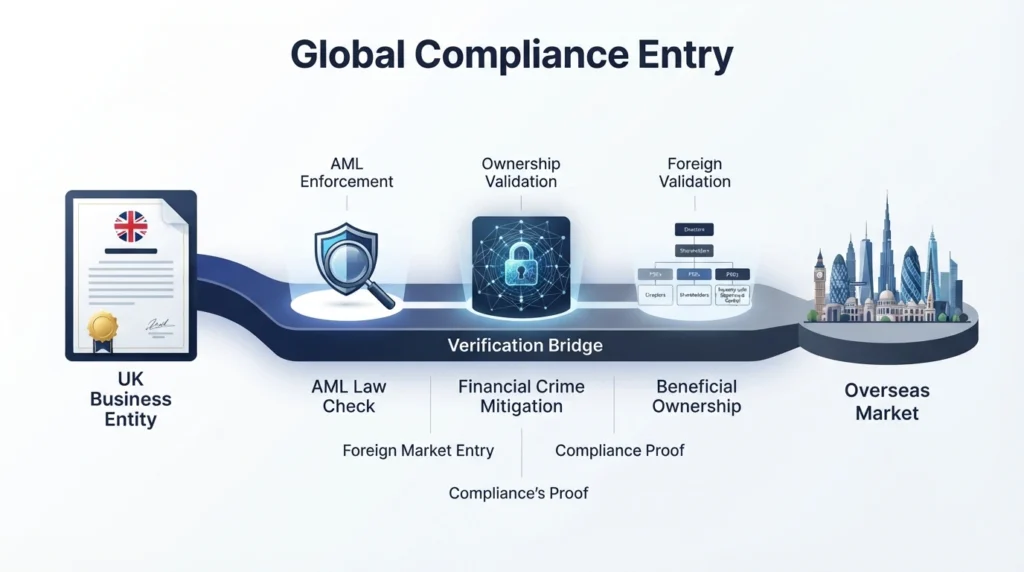
Global financial regulators enforce stringent compliance checks on incoming foreign corporate entities. Foreign authorities require verification that a UK company maintains active legal status and clear filing records. Compliance officers utilize this document to cross-reference corporate data against international sanctions lists and trade registries. When foreign banks review foreign direct investment applications, they mandate official validation to satisfy international banking compliance standards.
How do foreign banks utilize this document for account onboarding?
Foreign banks utilize this document during corporate account onboarding to authenticate legal entity status, verify authorized signatories, and fulfill mandatory international know-your-customer regulations.
International financial institutions enforce rigorous due diligence protocols before opening corporate bank accounts for non-resident companies. Bank compliance teams require certified proof that the applicant entity holds active legal standing in its home jurisdiction. This document confirms that the company has not entered administration or administrative receivership. Financial institutions examine these records to ensure seamless cross-border fund transfers and lawful commercial operations. You can explore various pathways for evaluating corporate requirements by reading Comparing Reasons Companies Request a Certificate of Good Standing.
What specific corporate details does this official document display?
This official document displays the current company name, incorporation date, registered office address, confirmation of active filing status, and a formal seal from the Registrar of Companies.
The layout presents critical corporate data points extracted directly from the central UK registry. Each certificate outlines whether the company operates as a private limited company or a public limited company. Overseas trading partners inspect these specific details to match contract terms with official government records. Legal professionals rely on these exact parameters to draft enforceable cross-border commercial contracts and licensing agreements.
Why do foreign legal teams require government validation for contracts?
Foreign legal teams require government validation for contracts to eliminate fraudulent representation risks, ensure legal enforceability across borders, and verify director signing authority.
International contract law requires absolute proof of corporate capacity before parties execute high-value commercial agreements. Legal advisors verify that the counterparty maintains active legal standing and possesses the statutory authority to enter binding commitments. When disputes arise in foreign courts, possessing a government-certified status document protects local partners from unenforceable contracts signed by dissolved entities. Businesses streamline this verification process when they order a UK Certificate of Good Standing prior to negotiations.
How does active filing status impact international tender submissions?
Active filing status impacts international tender submissions by proving corporate solvency, meeting mandatory government procurement criteria, and passing preliminary administrative compliance screening.
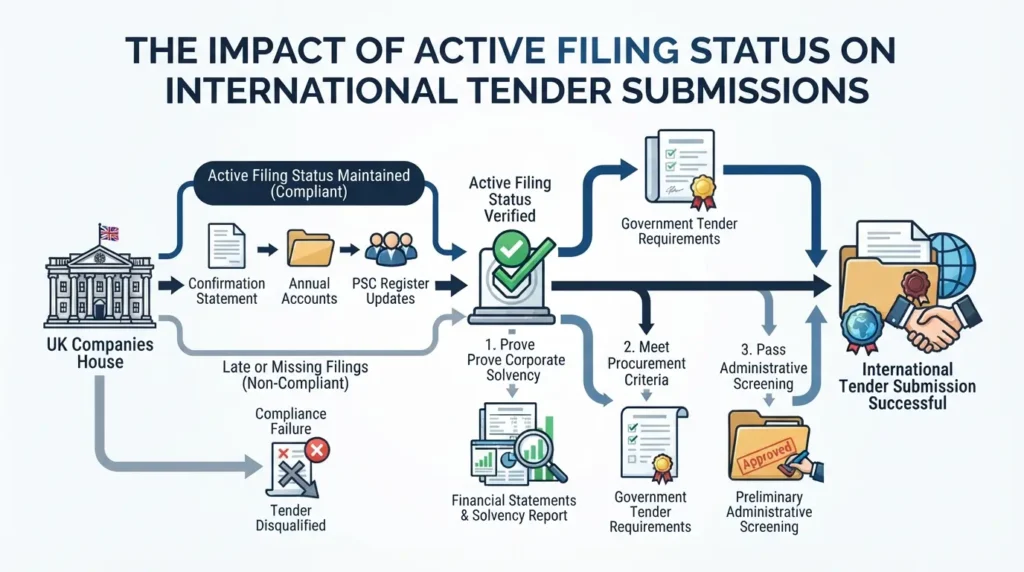
Global procurement boards evaluate hundreds of supplier bids for major infrastructure and technology contracts. Tender committees automatically disqualify any foreign bidder that fails to provide official proof of active regulatory standing. Public sector buyers require evidence that the bidding entity maintains up-to-date filing compliance with Companies House. This certification guarantees that the supplier operates as a financially stable enterprise capable of delivering long-term project requirements.
When do foreign subsidiaries require verification for local licensing?
Foreign subsidiaries require verification for local licensing when registering branch offices, applying for import-export permits, and satisfying host-country commercial ministry regulations.
Expanding operations into foreign jurisdictions necessitates local business registration and regulatory licensing. Host governments mandate that parent companies prove their legitimate existence within their home jurisdiction before granting local operating permits. Commercial ministries examine UK registry status to ensure the parent entity remains in good standing. This regulatory requirement prevents shell companies from establishing foreign operations without proper oversight. Organizations ready to proceed with international expansion can Buy a Certificate of Good Standing for International Partners at Form My Company. Form My Company delivers secure, expedited document procurement services to satisfy global compliance standards efficiently.
International partners request a UK Certificate of Good Standing to eliminate cross-border risk and verify corporate legitimacy. Government-backed validation protects global entities during contract execution, banking compliance reviews, and tender submissions. Form My Company provides reliable document procurement services, ensuring businesses secure official verification swiftly and accurately.
Explore More Certificate of Good Standing Guide,
Why Do Tenders and Contracts Often Require a Certificate of Good Standing?
Why Do Banks Ask for a Certificate of Good Standing When Opening an Account?
Frequently Asked Questions
What information does a UK Certificate of Good Standing contain?
A UK Certificate of Good Standing issued by Companies House displays the official company name, registration number, and incorporation date. It officially confirms that the company has been in continuous existence and has filed all mandatory statutory returns. Form My Company provides this essential document to verify corporate legitimacy for international partners.
How long does it take to obtain a Certificate of Good Standing?
Standard processing through Companies House typically takes between 3 to 5 working days, while expedited digital or same-day options are often available. Business owners can request this document through Form My Company to streamline urgent international trade and banking compliance requirements.
Can a company with overdue filing accounts get a Certificate of Good Standing?
Companies House will not issue a Certificate of Good Standing if a company has overdue confirmation statements or late annual accounts. The entity must bring all statutory filings completely up to date before Form My Company or any provider can successfully generate the active status document.
Do foreign banks require an apostille on a UK Certificate of Good Standing?
Foreign banks and international regulatory authorities frequently require an apostille or consular legalization to ensure the document is legally recognized abroad. Form My Company assists businesses in securing both the Certificate of Good Standing and the necessary authentication for overseas transactions.
How long is a Certificate of Good Standing valid for international use?
International partners and foreign financial institutions typically require a Certificate of Good Standing issued within the last 3 months to ensure accurate, up-to-date corporate data. Because company compliance status can change rapidly, foreign authorities rarely accept older certificates for ongoing cross-border agreements.