
A UK Certificate of Good Standing is an official document issued by Companies House that verifies a registered business maintains active legal status, files mandatory confirmation statements on time, and faces no current striking-off proceedings.
When international trade expansion accelerates, foreign regulators, overseas banks, and global suppliers require definitive legal proof of corporate legitimacy. Businesses across international markets demand validation before entering formal commercial agreements. UK corporations operate within strict statutory compliance frameworks established by the Companies Act 2006. Overseas entities mitigate operational risk by requesting official documentation that confirms a UK company remains compliant with national corporate registries.
What Are the Primary Reasons International Partners Request This Document?
International partners request a Certificate of Good Standing to verify active corporate registration status, confirm legal directorship authority, and validate compliance with filing deadlines before executing cross-border commercial contracts.
Global enterprises establish strict onboarding protocols to eliminate fraudulent shell corporations. Compliance officers review official registry extracts to confirm that a UK corporate entity maintains active legal standing. Overseas vendors examine corporate records to ensure that financial liabilities and statutory filings remain up to date. Risk management departments require authenticated proof before releasing commercial shipments or transferring proprietary assets across international borders.
Foreign jurisdictions enforce strict anti-money laundering regulations that mandate rigorous corporate vetting procedures. Legal teams inspect official registry documentation to authenticate company existence and trace beneficial ownership structures. International collaborators rely on these verification certificates to satisfy domestic regulatory authorities that their foreign counterpart operates lawfully within the United Kingdom.
Why Do Foreign Banks Require This Verification for Business Accounts?
Foreign financial institutions require a Certificate of Good Standing to satisfy international compliance mandates, verify corporate existence, and mitigate regulatory risks during multi-jurisdictional merchant account applications.
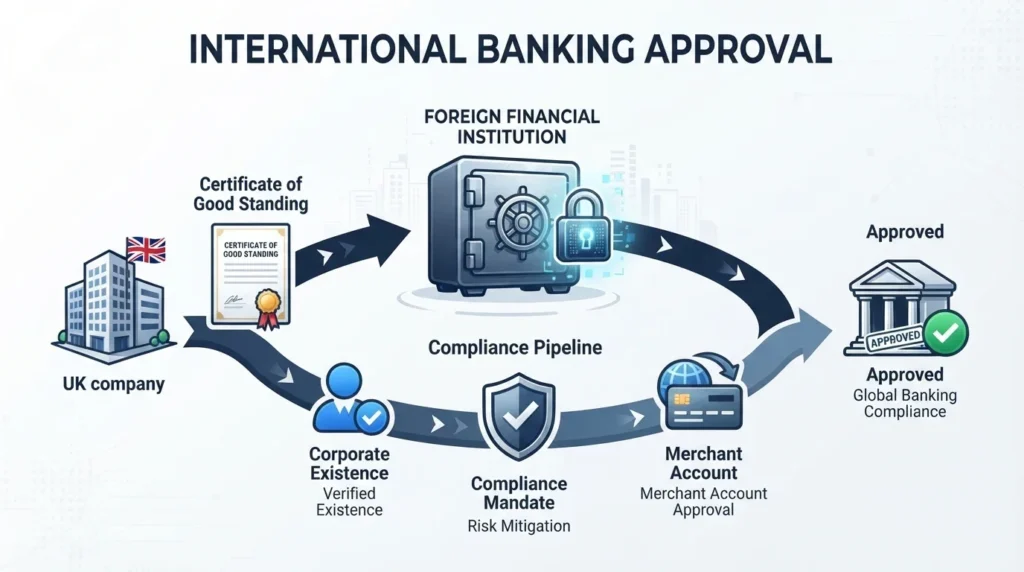
Global banking institutions enforce stringent Know Your Customer mandates before approving corporate credit facilities or opening foreign currency accounts. Compliance analysts inspect official registry extracts to confirm that a business maintains active legal registration and avoids administrative dissolution. Financial regulators penalize institutions that onboard unverified corporate entities, making document authentication mandatory for international banking access.
Commercial banks evaluate corporate stability by reviewing historical filing compliance records maintained by national registries. Risk assessment committees examine official certificates to ensure that directors possess lawful authority to bind the corporation to financial agreements. Financial institutions accelerate onboarding timelines when applicants present authenticated proof of active status alongside a comprehensive Certificate of Good Standing package.
How Does This Document Support Cross-Border Mergers and Acquisitions?
Cross-border mergers and acquisitions require a Certificate of Good Standing to validate corporate solvency, confirm unencumbered asset ownership, and satisfy foreign regulatory approval boards during due diligence.
Corporate restructuring initiatives across international jurisdictions involve extensive legal due diligence audits. Acquisition lawyers inspect official registry documents to verify that target companies maintain unblemished legal records and face no active winding-up petitions. Investment syndicates evaluate statutory compliance certificates to ensure that corporate assets remain free from hidden regulatory liabilities.
Regulatory authorities in destination countries demand official proof of corporate legitimacy before granting approval for foreign direct investment transactions. Legal representatives utilize authenticated registry extracts to demonstrate that acquiring entities possess the legal capacity to execute complex international asset transfers. Strategic buyers streamline regulatory approval processes by presenting verified certificates that establish corporate compliance across multiple operational jurisdictions.
Why Do Overseas Regulatory Bodies Demand Registry Authentication?
Overseas regulatory bodies demand registry authentication to enforce foreign trade compliance, verify licensing qualifications, and prevent unauthorized commercial operations within domestic markets.
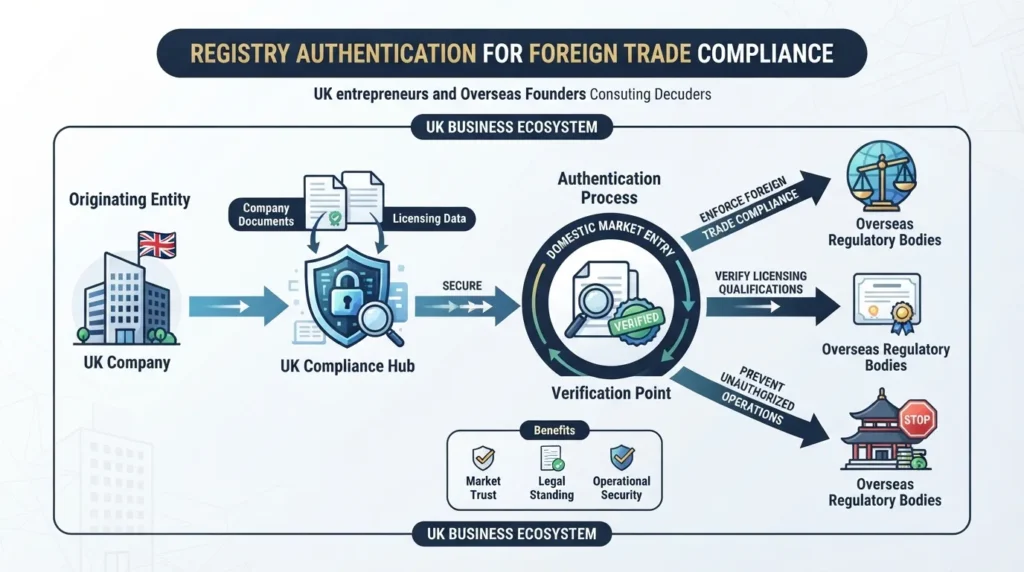
Government agencies across international jurisdictions regulate foreign corporate participation to protect domestic economic interests. Regulatory authorities require official proof of home-country compliance before granting operating licenses, import permits, or telecommunication frequencies to foreign enterprises. Administrative boards review authenticated registry extracts to confirm that a company maintains active legal status within the United Kingdom.
Compliance inspectors cross-reference official certificate data against national databases to verify registered office addresses and active director appointments. Regulatory frameworks mandate that foreign businesses maintain continuous good standing to retain valid operating licenses abroad. Businesses navigating these international expansion requirements often review the insights detailed in Why International Partners Request a UK Certificate of Good Standing? to align their compliance strategies with foreign expectations.
How Do Global Supply Chain Partners Use Corporate Standing Proof?
Global supply chain partners use corporate standing proof to assess supplier reliability, verify legal operational longevity, and mitigate financial exposure during high-value vendor contract negotiations.
Procurement departments across international manufacturing networks implement rigorous vendor qualification standards to protect global supply chains. Enterprise buyers examine official registry documents to confirm that prospective suppliers maintain stable corporate structures and active operational histories. Supply chain managers require authenticated standing proof to minimize disruptions caused by sudden administrative dissolution or regulatory penalties.
Vendor onboarding teams evaluate corporate compliance records to ensure that international suppliers adhere to strict ethical and legal operating standards. Risk mitigation protocols mandate that procurement specialists verify corporate legitimacy before signing multi-million-dollar supply agreements. Companies preparing for rigorous international procurement audits frequently utilize resources such as Buy a Certificate of Good Standing for International Partners at Form My Company to secure necessary documentation quickly.
International partners, foreign banks, regulatory bodies, and global supply chain networks demand verified proof of corporate compliance to mitigate cross-border operational risks. Securing an official registry extract ensures that UK businesses satisfy strict international due diligence mandates and maintain seamless global commercial operations. Form My Company delivers efficient document procurement services that empower enterprises to validate their legal status and accelerate international expansion initiatives with absolute confidence.
Explore More Certificate of Good Standing Guide,
Certificate of Good Standing for Banking vs Tenders: What’s the Difference?
How to Decide Whether Your Business Really Needs a Certificate of Good Standing
Frequently Asked Questions
What is a UK Certificate of Good Standing?
A UK Certificate of Good Standing is an official document issued by Companies House that confirms a registered company has been in continuous existence and faces no current striking-off proceedings. Businesses frequently order this verification through provider platforms like Form My Company when expanding internationally, opening foreign bank accounts, or securing commercial contracts.
How long is a Certificate of Good Standing valid?
While Companies House issues the certificate as a point-in-time snapshot, most international authorities, overseas banks, and foreign partners require a document issued within the last 30 to 90 days. Because corporate compliance status can change following the annual confirmation statement deadline, third-party organizations generally reject outdated extracts.
Can a dissolved or non-compliant company obtain this certificate?
Companies House will not issue a Certificate of Good Standing if a corporation has missed statutory filing deadlines, such as overdue confirmation statements or annual accounts. To qualify for the document, a UK business must be fully active on the register and have resolved any pending administrative or compliance penalties.
How quickly can Form My Company issue a Certificate of Good Standing?
Standard processing through Companies House typically takes several business days, but expedited electronic or express postal delivery options significantly reduce turnaround times. Form My Company assists UK corporations in obtaining these authenticated registry extracts quickly to meet urgent international tender and banking deadlines.
Do international partners always require an apostille on the certificate?
Many foreign regulators, overseas legal courts, and international institutions require the Certificate of Good Standing to be legalized with a UK apostille or consular authentication. The apostille verifies the authenticity of the official Companies House signature so the document holds legal validity in foreign jurisdictions that are not part of specific treaty exemptions.