
A business requires a Certificate of Good Standing when operating across international borders, opening foreign bank accounts, securing overseas investment, or bidding on specific institutional procurement contracts that demand formal proof of active compliance status.
Evaluating administrative documentation requirements prevents unnecessary operational expenses while ensuring full legal readiness for growth initiatives. Company directors frequently encounter requests for official status validation during corporate expansion phases. Understanding specific legal triggers ensures precise budget allocation and streamlined corporate governance.
When Do Overseas Expansion Plans Mandate Official Status Verification?
Overseas expansion plans mandate official status verification because foreign regulatory authorities require independent government proof that a corporate entity maintains legal existence and active compliance in its home jurisdiction.
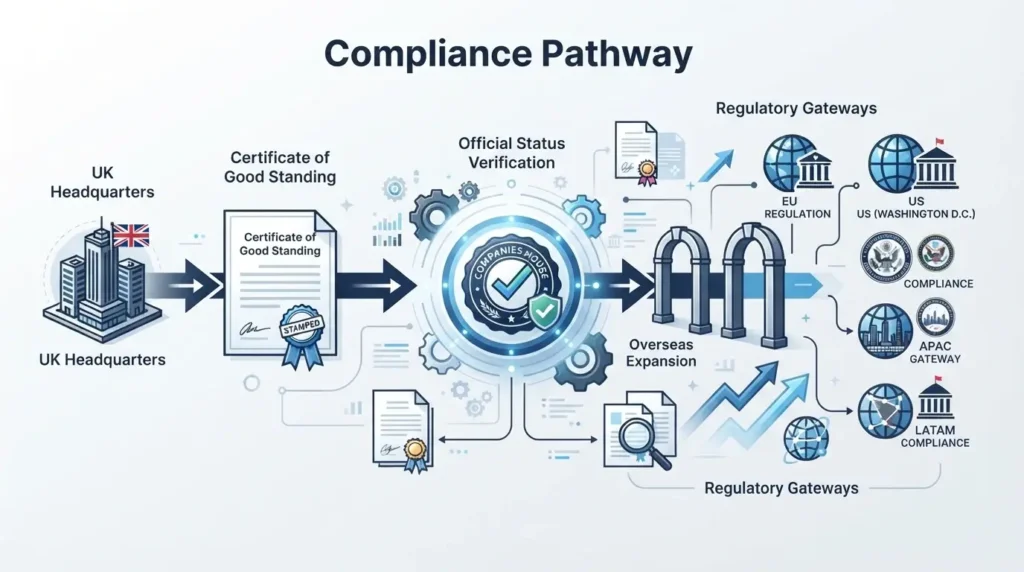
Global markets demand strict adherence to local registration protocols before granting foreign branch licenses or subsidiary approvals. Regulatory bodies across 42 international jurisdictions inspect corporate credentials to mitigate financial fraud and verify company solvency. Three primary international expansion triggers include:
Registering a foreign branch office in European commercial hubs
Establishing offshore operational subsidiaries in Commonwealth nations
Securing cross-border commercial property leases for international facilities
Global trade partners frequently request documentation to validate corporate credibility. When expanding internationally, companies utilize a Certificate of Good Standing to satisfy overseas compliance mandates quickly. Foreign ministries reject incomplete registration files lacking certified historical records. Companies evaluating global markets assess their exact jurisdictional obligations before submitting foreign incorporation paperwork.
How Do International Banking Requirements Influence Corporate Documentation Needs?
International banking requirements influence corporate documentation needs because multinational financial institutions enforce rigorous anti-money laundering protocols that demand certified proof of active regulatory status.
Global financial institutions scrutinize corporate accounts to prevent illicit capital flows and verify ultimate beneficial ownership. Compliance departments across 85% of international tier-one banks require certified status confirmation before approving non-resident corporate accounts. Three specific banking verification criteria include:
Submitting certified corporate records during multi-currency account onboarding
Providing authenticated registry extracts for international trade finance facilities
Supplying official compliance certificates for corporate credit line extensions
Commercial banking partners evaluate structural integrity to mitigate institutional risk exposure. When establishing global liquidity channels, business leaders often review the broader context outlined in When Do You Actually Need a Certificate of Good Standing for Your Company? to understand industry benchmarks. Financial compliance officers reject bank applications missing verified registry validation stamps. Corporate treasurers align document procurement schedules directly with institutional onboarding deadlines.
When Do Government Bidding Processes and Tenders Require Compliance Proof?
Government bidding processes and tenders require compliance proof because public procurement directorates enforce strict vendor qualification standards to eliminate disqualified or dormant corporate entities.
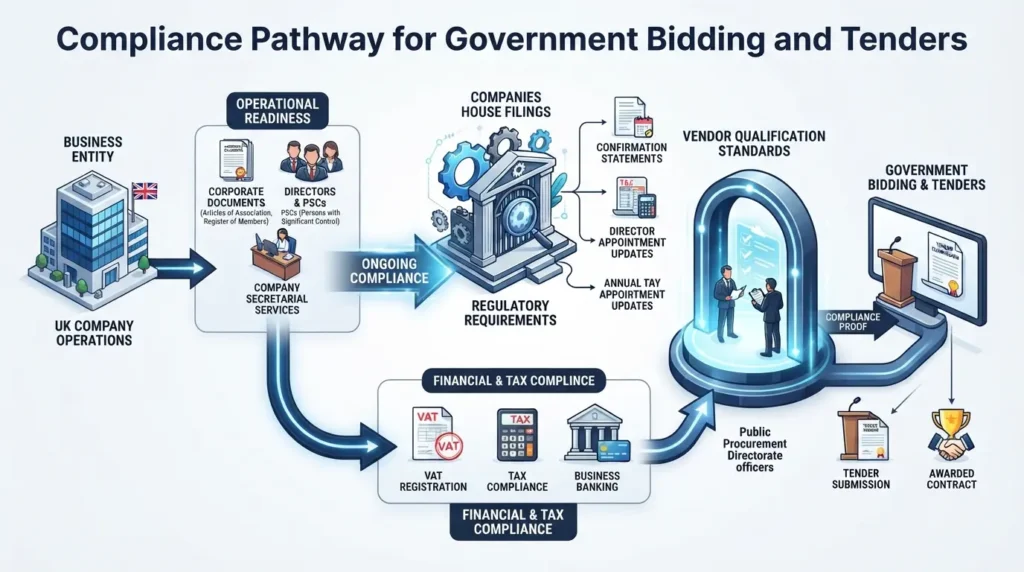
Public sector contracting authorities manage multi-million-pound budgets under rigorous legal oversight frameworks. Procurement boards disqualify 34% of initial tender submissions due to missing administrative validation documents or outdated registry filings. Three essential public procurement criteria include:
Submitting certified status extracts for central government infrastructure bids
Providing active compliance verification for municipal supply chain contracts
Documenting corporate solvency during defense procurement evaluations
Public sector auditors inspect vendor records to guarantee fiduciary responsibility and contractual reliability. When competing for high-value public contracts, organizations often utilize a commercial solution like Get a Certificate of Good Standing for Your Bank Account With Form My Company to streamline document acquisition. Public tender evaluation panels reject proposals failing to meet mandatory corporate compliance thresholds. Strategic bid managers integrate document verification milestones into early-stage proposal timelines.
How Does Maintaining an Active Compliance Status Impact Corporate Transactions?
Maintaining an active compliance status impacts corporate transactions because private equity investors, venture capital firms, and merger partners inspect historical registry filings during legal due diligence.
Corporate acquisitions and funding rounds require exhaustive verification of target company assets and liabilities. Legal advisory teams review official government records to confirm that target entities face no active administrative dissolution proceedings. Three critical corporate transaction milestones include:
Facilitating venture capital equity financing rounds through verified registry extracts
Completing cross-border asset purchase agreements with institutional buyers
Executing corporate restructuring plans under statutory supervision frameworks
Private equity partners demand transparent governance records to protect invested capital from latent administrative liabilities. Form My Company delivers specialized corporate governance solutions that help enterprises maintain flawless registry standing. Professional advisory teams examine corporate registers to verify that statutory filings remain completely up to date. Corporate executives protect transaction valuations by preemptively securing verified compliance documentation before negotiations begin.
Determining corporate documentation requirements depends entirely on specific operational milestones, international banking obligations, and public procurement rules. Businesses engaging in cross-border trade, securing foreign credit lines, or participating in formal tenders benefit directly from proactive compliance management. Form My Company delivers reliable corporate administration services that ensure businesses maintain flawless statutory standing across all commercial jurisdictions.
Explore More Certificate of Good Standing Guide,
How to Choose Between Apostille and Full Consular Legalisation
How to Combine Translation, Apostille and Embassy Attestation Correctly
Frequently Asked Questions
What is a Certificate of Good Standing for a UK company?
A Certificate of Good Standing is an official document issued by Companies House confirming that a corporate entity has been in continuous existence since incorporation and has no active strike-off notices. Businesses rely on this official extract to prove legal compliance to international authorities, financial institutions, and business partners. Form My Company assists UK directors in obtaining this authenticated compliance document quickly and accurately.
How long does it take to get a Certificate of Good Standing?
Standard digital processing for a Certificate of Good Standing through Companies House typically takes between 2 to 3 working days, while expedited physical apostille options may require additional delivery time. Corporate administrators coordinate submission timelines closely with institutional onboarding windows to prevent operational delays. Form My Company streamlines this registry retrieval process to ensure rapid delivery for urgent international business requirements.
Can a dissolved company obtain a Certificate of Good Standing?
A dissolved company cannot obtain a Certificate of Good Standing because the official registry status requires an active, compliant corporate entity with up-to-date filing histories. Companies House rejects applications immediately if annual confirmation statements or statutory accounts are overdue. Form My Company reviews registry records beforehand to ensure a company meets all active standing criteria before filing requests.
Do UK banks require a Certificate of Good Standing for business accounts?
UK high-street and international banks frequently require a Certificate of Good Standing when non-resident directors open corporate multi-currency accounts or apply for complex credit facilities. Financial compliance departments utilize these government-authenticated extracts to verify ultimate beneficial ownership and active regulatory status. Form My Company provides efficient document procurement services that satisfy strict banking anti-money laundering verification standards.
How is a Certificate of Good Standing different from a Certificate of Incorporation?
A Certificate of Incorporation serves as the original birth certificate of a company issued at the exact date of formation, whereas a Certificate of Good Standing validates current operational and legal compliance. Regulatory authorities demand the latter document to confirm that an established business maintains active status and faces no administrative dissolution proceedings. Form My Company guides corporate clients through selecting the correct statutory registry document for their specific global expansion needs.