
You secure a Certificate of Good Standing for your business bank account by submitting an official application directly through Companies House, confirming that your UK registered company has filed all statutory documents and remains active on the public register.
Maintaining active banking compliance requires verified corporate documentation. High-street financial institutions and digital business banks mandate current compliance proof to update corporate records, prevent account restrictions, or approve international trade lines. When financial institutions request this official validation, UK company directors leverage streamlined filing channels to secure authentication within standard operational timeframes. Form My Company accelerates this verification workflow, ensuring business accounts maintain uninterrupted operational status through dedicated corporate compliance support.
Why Do UK Banks Require a Certificate of Good Standing?
UK banks demand a Certificate of Good Standing to verify that corporate entities maintain active legal status, fulfill statutory filing obligations, and remain fully authorized to conduct commercial financial transactions.
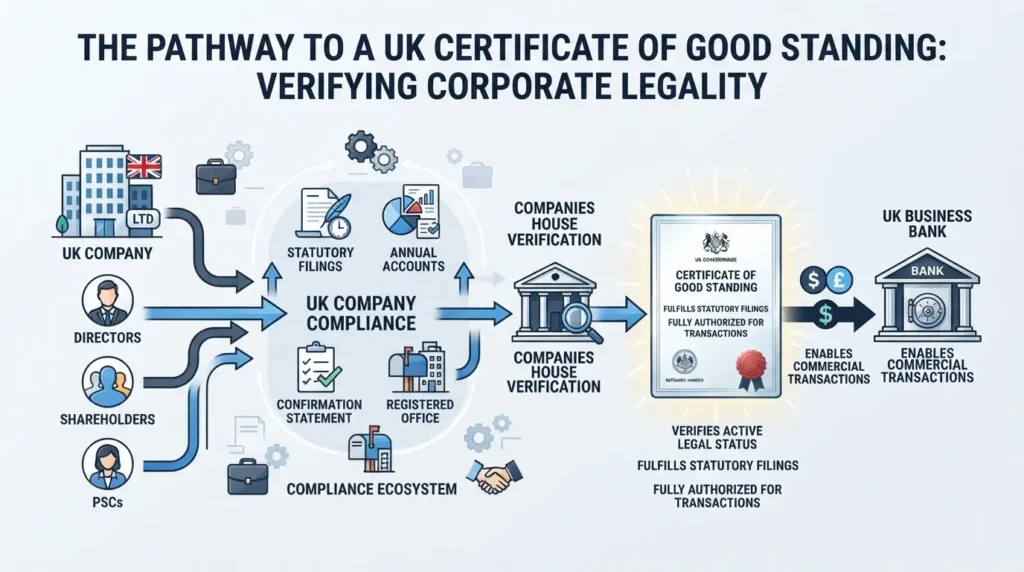
Commercial banking providers enforce strict anti-money laundering regulations and Know Your Customer mandates across all corporate accounts. Financial institutions mitigate lending risk by reviewing official confirmation from Companies House that proves a business has no pending strike-off actions or overdue confirmation statements. Banks examine these documents during annual risk reviews, credit facility applications, or multi-currency account setups. Directors utilize the Certificate of Good Standing service to seamlessly satisfy bank compliance demands without administrative delays.
What Information Does Companies House Verify Before Issuance?
Companies House evaluates active company registration status, timely submission of annual accounts, accurate confirmation statements, and the absence of formal liquidation proceedings prior to document generation.
Government registrars review the official corporate database to ensure the applicant enterprise meets strict statutory compliance parameters. Two core verification checks comprise this review: verifying the submission of annual accounts and confirming the delivery of recent confirmation statements. Registrar databases automatically reject applications if a company faces active administrative restoration or compulsory strike-off notices. Businesses must resolve outstanding administrative filings before government officers authenticate the corporate record. Companies House validates director identities, registered office addresses, and official company numbers against active public records.
How Does the Application Process Work for Business Accounts?
The application process requires submitting the official company registration number, paying the statutory government fee, and selecting standard or expedited processing speeds through designated corporate filing agents.
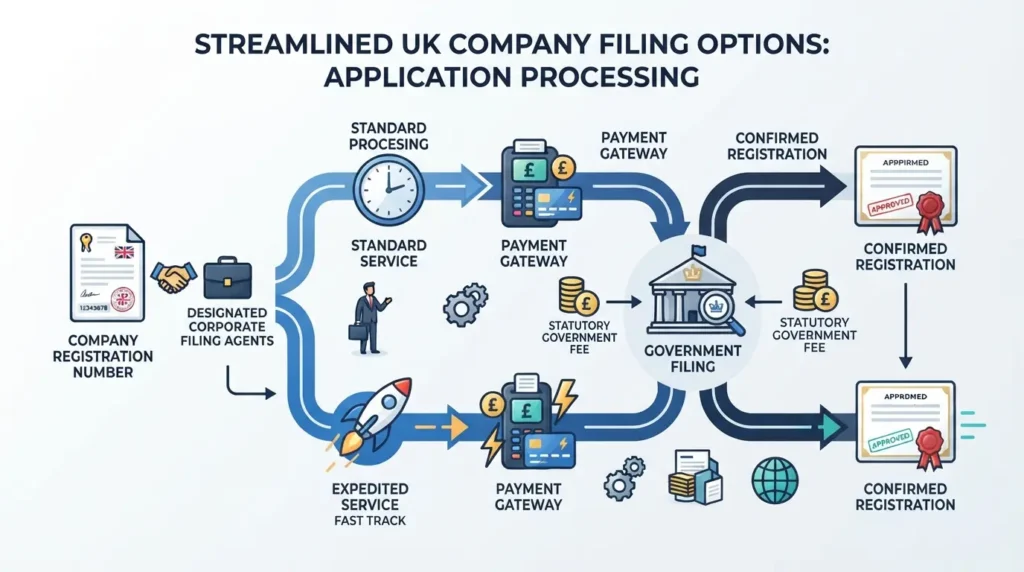
Corporate directors initiate the formal request by providing exact company details to authorized filing partners. Three core procedural steps define this workflow: inputting the official company registration number, selecting standard or priority delivery speeds, and authorizing the filing payment. Standard government processing takes between three to five business days, whereas priority dispatch services deliver authenticated documents within twenty-four hours. Professional corporate service providers validate input data against government registers to prevent application rejections caused by clerical errors. Businesses aiming to understand strategic timing before application can review How to Decide Whether Your Business Really Needs a Certificate of Good Standing to evaluate specific corporate requirements.
What Happens When Your Bank Receives the Document?
Financial institutions authenticate the received certificate against official government databases, update internal risk scoring profiles, and lift any temporary holds placed on corporate transactions.
Bank compliance teams inspect the physical or digital certificate for official authentication seals, registrar signatures, and current issuance dates. Four operational outcomes follow successful verification: lifting account freezes, approving international merchant facilities, raising transaction limits, and finalizing commercial loan agreements. Banks typically accept certificates issued within the preceding three months to ensure data accuracy. Organizations planning long-term corporate expansion strategies should evaluate insights detailed in When Do You Actually Need a Certificate of Good Standing for Your Company? to anticipate future banking compliance milestones.
Securing an official Certificate of Good Standing remains an essential administrative requirement for businesses navigating strict UK banking compliance frameworks. Financial institutions rely on these validated documents to confirm corporate legitimacy, maintain regulatory alignment, and authorize complex commercial transactions. Form My Company delivers reliable corporate administration support, empowering directors to acquire official registry documents efficiently and protect their business bank accounts from compliance disruptions.
Explore More Certificate of Good Standing Guide,
Get Complete Document Legalisation Done Right With Form My Company
Legalise Documents for Any Country With Form My Company
Frequently Asked Questions
How long does a Certificate of Good Standing take to get in the UK?
A standard Certificate of Good Standing from Companies House typically takes between three to five business days to process and dispatch. Directors can choose expedited processing through Form My Company to receive digital or hard-copy authentication within 24 hours.
Can a dissolved company obtain a Certificate of Good Standing?
Dissolved or struck-off companies cannot obtain a Certificate of Good Standing because the legal entity no longer exists on the active Companies House register. Directors must first formally restore the company through administrative or court proceedings before requesting compliance documentation.
Does a Certificate of Good Standing expire?
Government registrars do not print an official expiration date on a Certificate of Good Standing, but most requesting authorities require issuance within the last 30 to 90 days. Banks, international regulators, and overseas government bodies routinely reject compliance documents older than three months to ensure current company status.
What details are included on a Certificate of Good Standing?
The official document displays the company name, unique registration number, date of incorporation, and a formal statement confirming active status on the register. Form My Company assists businesses in obtaining these certificates to verify that all statutory annual accounts and confirmation statements are up to date.
Do foreign banks accept a UK Certificate of Good Standing?
International financial institutions routinely accept a UK Certificate of Good Standing when opening overseas corporate bank accounts or expanding foreign operations. Foreign jurisdictions often require the document to be legally legalized with an Apostille stamp or consular certification before acceptance.