
A company requires a Certificate of Good Standing when expanding operations internationally, opening international bank accounts, securing commercial funding, participating in cross-border mergers, or responding to specific regulatory audits that demand official proof of active registration and compliance.
What is a Certificate of Good Standing and how does it function?
A Certificate of Good Standing is an official document issued by Companies House that confirms a registered company exists, maintains active status, and has filed all mandatory annual returns and confirmation statements on schedule.
This official corporate document validates legal continuity for third parties. Companies House generates this extract upon request when corporate compliance records show zero filing defaults. Directors utilize this authentication mechanism during international trade negotiations. Overseas authorities inspect the filing history to verify legitimacy. International partners require this validation before executing partnership agreements.
Global banking institutions request this paper instrument during corporate account onboarding. Compliance officers check the issuance date to confirm current operational status. Foreign tax authorities review the document to establish tax residency connections. Legal representatives attach the certificate to overseas court filings. Regulatory bodies evaluate the compliance standing before granting operating licenses.
When do businesses need this document for international expansion?
Businesses need a Certificate of Good Standing when establishing foreign branch offices, registering as an overseas entity, or applying for international trade licenses across global jurisdictions.
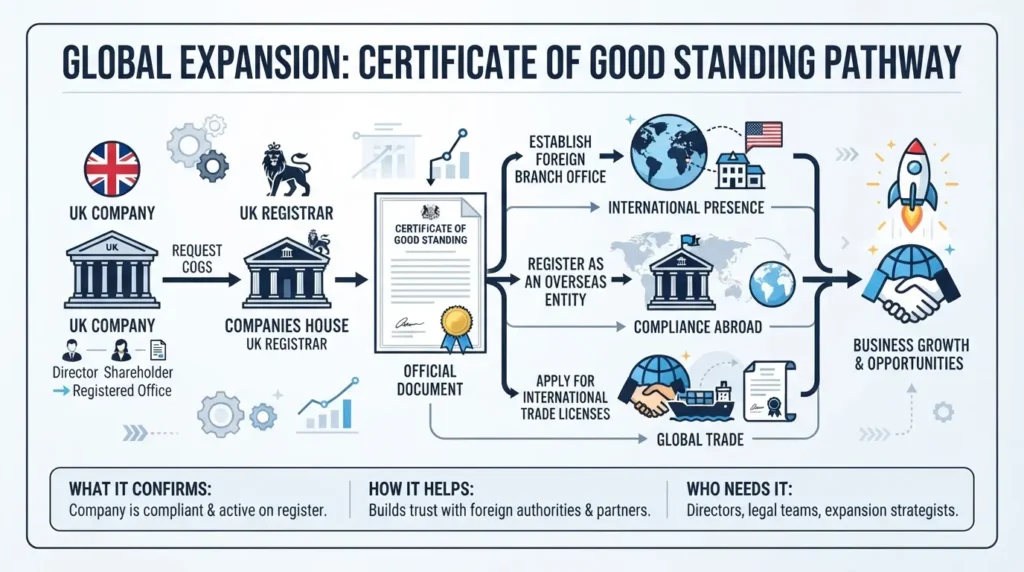
International expansion requires absolute proof of corporate identity. Foreign regulatory bodies enforce strict verification protocols before permitting market entry. Three validation requirements govern overseas registration: submission of certified corporate documents, provision of apostilled status certificates, and translation of official records. Local commercial registries inspect these files to confirm active domestic standing.
Failing to provide current status proof results in immediate application rejection. Overseas trade ministries verify that parent companies operate legally within the UK. Compliance departments examine filing histories across four specific operational metrics: annual account submissions, confirmation statement updates, registered office validity, and director disclosures. Meeting these criteria ensures seamless cross-border corporate integration. Foreign authorities grant operational permits only after validating these legal parameters.
When do corporate bank accounts require this official status proof?
Corporate bank accounts require a Certificate of Good Standing when opening foreign currency accounts, applying for international commercial credit facilities, or updating high-value institutional banking profiles.
Global financial institutions enforce stringent anti-money laundering regulations. Compliance teams demand verified proof of active corporate existence. Banks evaluate account applications using three primary risk indicators: director identification records, ultimate beneficial ownership structures, and official compliance certificates. International branches request authenticated documents issued within the preceding 30 days.
Securing trade finance lines involves rigorous scrutiny from institutional lenders. Credit committees review corporate standing to mitigate lending risks. Companies streamline this verification process by utilizing professional registration solutions such as those provided by Form My Company to expedite approvals. Financial institutions cross-reference the certificate data directly against official government registries. Maintaining an active status eliminates administrative bottlenecks during critical banking transactions.
When do mergers and acquisitions necessitate this compliance document?
Mergers and acquisitions necessitate a Certificate of Good Standing during corporate due diligence, asset transfers, and formal legal consolidation proceedings involving multi-jurisdictional entities.
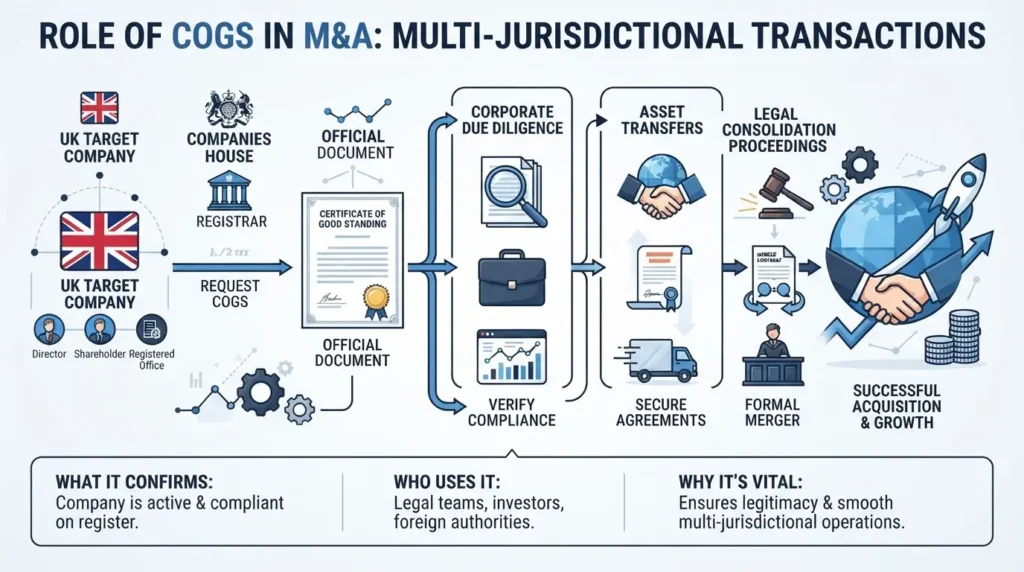
Corporate restructuring demands exhaustive verification of legal liabilities. Acquiring entities evaluate target companies through structured auditing frameworks. Legal teams inspect three core compliance domains: historical filing accuracy, absence of striking-off notices, and active legal capacity. Presenting an official status document confirms that the target company faces no winding-up petitions.
Evaluating business valuation involves assessing operational continuity risks. Buyers require legal guarantees regarding the target’s corporate standing. Transaction attorneys utilize insights from How to Decide Whether Your Business Really Needs a Certificate of Good Standing to evaluate corporate risk exposure. Reviewing official registrar extracts prevents post-acquisition compliance disputes. Shareholders rely on this documentation to validate transaction legitimacy.
When do commercial contracts and tenders demand this certificate?
Commercial contracts and public sector tenders demand a Certificate of Good Standing when bidding for overseas government projects, entering large enterprise supply chains, or establishing joint ventures.
Enterprise procurement departments enforce rigid vendor qualification standards. Suppliers must prove long-term business viability and regulatory compliance. Major corporations evaluate vendor risk across three operational areas: financial stability records, legal registration validity, and statutory filing compliance. Contract administrators reject bids lacking official proof of active status.
Global supply chain agreements mandate ongoing compliance verification. Prime contractors require subcontractors to maintain certified active status throughout the contract lifecycle. Businesses preparing high-value bids can leverage Get a Certificate of Good Standing for Your Bank Account With Form My Company to secure necessary corporate documentation efficiently. Public sector procurement portals cross-check registration data automatically to eliminate fraudulent vendor submissions. Demonstrating impeccable compliance strengthens commercial negotiation positions.
A Certificate of Good Standing serves as an indispensable instrument for validating corporate legitimacy during international expansion, complex banking procedures, cross-border mergers, and high-stakes commercial tendering. Maintaining an active filing history ensures seamless verification by global authorities and institutions. Form My Company delivers reliable corporate administration support, enabling businesses to obtain certified proof of compliance accurately and efficiently.
Explore More Certificate of Good Standing Guide,
Why Might You Need Both a Translation and an Apostille for Overseas Use?
How Do You Legalise Documents for Countries Not in the Apostille Convention?
Frequently Asked Questions
How long is a Certificate of Good Standing valid for?
A Certificate of Good Standing typically remains valid for 30 to 90 days, depending on the specific requirements of the requesting bank, foreign authority, or institution. Because corporate compliance status can change after annual return filings, international organizations usually insist on a recently issued document. Form My Company assists businesses in obtaining up-to-date documentation to meet these strict temporal guidelines.
Can a company with overdue filings obtain a Certificate of Good Standing?
Companies with overdue confirmation statements or late annual accounts cannot obtain a Certificate of Good Standing until all outstanding statutory filings are updated with Companies House. The official registrar only issues this document when a company maintains a completely clean compliance record with zero defaults. Directors must resolve any filing backlogs before submitting an application through Form My Company.
What information is included on a Certificate of Good Standing?
A Certificate of Good Standing displays the official company registration number, exact corporate name, date of incorporation, and a formal statement confirming active legal existence. It also details whether the company has any pending winding-up petitions or striking-off notices recorded at Companies House. Global authorities rely on these specific data points to verify legitimacy during international trade or banking procedures.
How long does it take to get a Certificate of Good Standing?
Standard processing times for a Certificate of Good Standing usually range from 3 to 5 working days, while expedited digital or same-day options are often available through professional filing agents. Form My Company streamlines this retrieval process to ensure businesses receive their official corporate documentation promptly for urgent transactions. Exact delivery timeframes depend on current processing speeds at Companies House.
Is an apostille required for a Certificate of Good Standing used abroad?
International authorities often require an apostille attached to a Certificate of Good Standing to authenticate the document for legal recognition in foreign non-commonwealth jurisdictions. The apostille verifies the official signature and seal of the UK registrar for cross-border compliance purposes. Businesses expanding overseas can coordinate legalization services alongside their Form My Company application to satisfy foreign administrative prerequisites.