
Banks ask for a Certificate of Good Standing to verify that a corporate entity exists legally, maintains active compliance status with regulatory authorities, and has no pending dissolution orders or filing discrepancies.
Global financial institutions operate under strict anti-money laundering regulations and Know Your Business mandates. When corporate founders apply for a commercial bank account, financial compliance officers demand proof of legal existence. This official document validates that the registered company satisfies all statutory filing requirements with the state or national registrar. Without this verification, corporate banks face severe regulatory penalties and compliance audits.
What Information Does a Certificate of Good Standing Contain?
A Certificate of Good Standing contains the exact legal name of the entity, the official registration number, the date of incorporation, a confirmation of active status, and an official authentication stamp from the governing registrar.
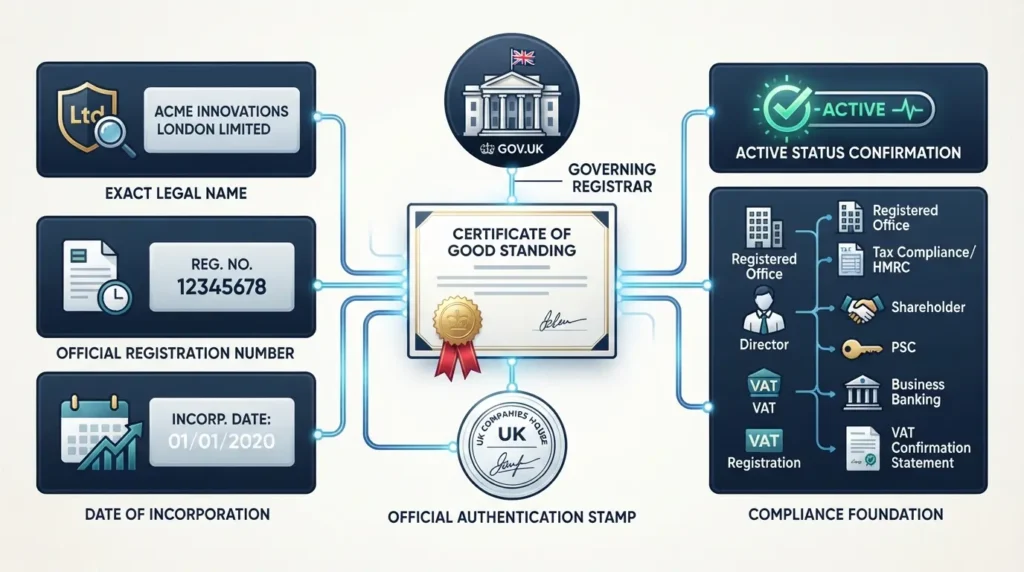
Corporate verification officers examine specific data points to confirm corporate legitimacy before approving business bank accounts. The document explicitly states whether the entity faces any active administrative suspension or involuntary dissolution proceedings. Registrar officials authenticate the certificate using a secure holographic seal or a digital cryptographic signature. Financial compliance systems cross-reference these details against national company registers to eliminate shell company risks.
How Do Banks Use This Document for Risk Mitigation?
Banks use the certificate to mitigate legal liability, ensure adherence to international compliance frameworks, and verify that directors possess the legal authority to bind the corporate entity.
Commercial lending and deposit departments require absolute certainty regarding the legal standing of corporate applicants. When a company experiences administrative dissolution due to missed annual filings, its directors lose their legal authority to execute contracts. Financial institutions prevent unauthorized account openings by mandating recent proof of active status issued within the last 30 to 90 days. Regulatory frameworks such as the Financial Action Force recommendations compel institutions to authenticate corporate ownership structures and operational legitimacy continuously.
Why Do Foreign Banks Require Consular Authentication?
Foreign banks require consular authentication or apostille certification to verify that the certificate issued in the home jurisdiction satisfies local evidentiary standards for cross-border transactions.
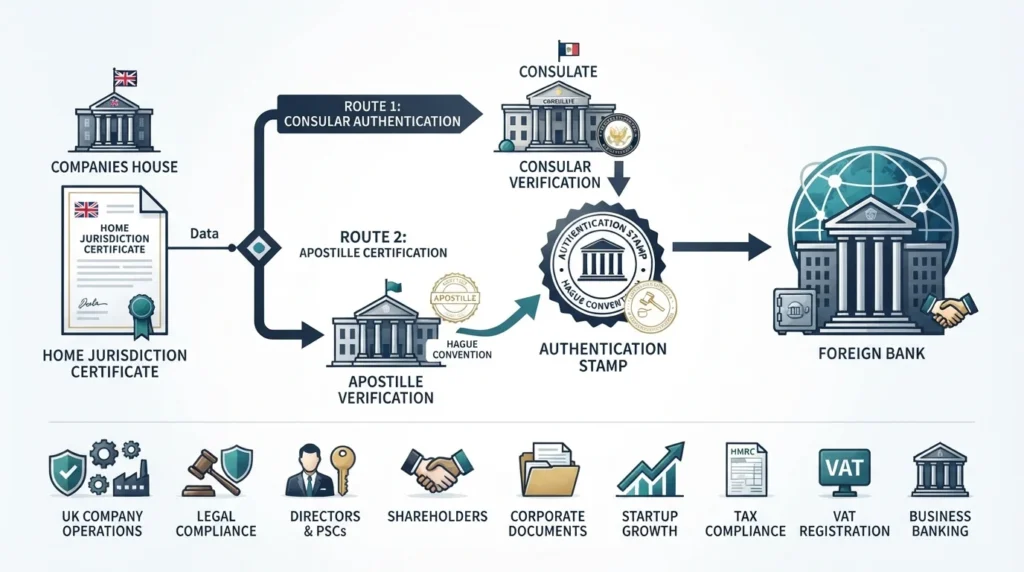
International expansion introduces complex regulatory hurdles when opening overseas corporate bank accounts. Local regulatory authorities cannot independently verify foreign registry databases without official diplomatic validation. An apostille stamp authenticates the signature of the public official who issued the corporate document. Multi-jurisdictional compliance teams rely on this certified chain of custody to prevent financial fraud and illicit capital flows across international borders.
How Can Businesses Prevent Account Opening Delays?
Businesses prevent account opening delays by maintaining active statutory filings, requesting recent corporate documentation well in advance, and utilizing specialized administrative filing services.
Corporate account rejections frequently stem from outdated registry filings or unsubmitted annual accounts. Directors must ensure that all mandatory corporate returns remain fully updated before submitting financial applications. When companies require immediate documentation for time-sensitive commercial opportunities, obtaining an official Certificate of Good Standing through Form My Company streamlines the banking verification workflow. Maintaining pristine corporate records accelerates account activation and ensures seamless navigation of institutional compliance protocols.
Explore More Certificate of Good Standing Guide,
Why Might You Need Both a Translation and an Apostille for Overseas Use?
How Do You Legalise Documents for Countries Not in the Apostille Convention?
Frequently Asked Questions
How long is a Certificate of Good Standing valid for UK banks?
A Certificate of Good Standing issued by Companies House is typically valid for 30 to 90 days, depending on the specific compliance policies of the financial institution. Form My Company ensures businesses receive freshly authenticated documents so they meet strict banking acceptance windows without administrative delays.
Can I open a UK business bank account without a Certificate of Good Standing?
While some digital challengers may not demand it initially, traditional clearing banks usually require a Certificate of Good Standing if your company has been incorporated for over a year. This official proof validates that your active corporate status and statutory filings remain fully compliant with UK regulations.
What is the difference between a Certificate of Incorporation and a Certificate of Good Standing?
A Certificate of Incorporation simply confirms the date your company was originally formed, whereas a Certificate of Good Standing proves your business is currently active and up to date with its filings. Banks and international regulators require the latter to verify that an entity has not been dissolved or struck off the register.
How can I expedite getting a Certificate of Good Standing for urgent banking requirements?
You can expedite the retrieval process by settling any pending Companies House confirmation statements and ordering through professional corporate filing providers. Form My Company streamlines this request workflow to deliver official registrar-stamped documentation directly to your compliance team.
Do foreign banks require an apostille on a UK Certificate of Good Standing?
Foreign financial institutions frequently require an apostille stamp attached to your UK Certificate of Good Standing to authenticate the document for cross-border legal use. This additional diplomatic certification ensures that international compliance officers accept your company records without jurisdiction disputes.