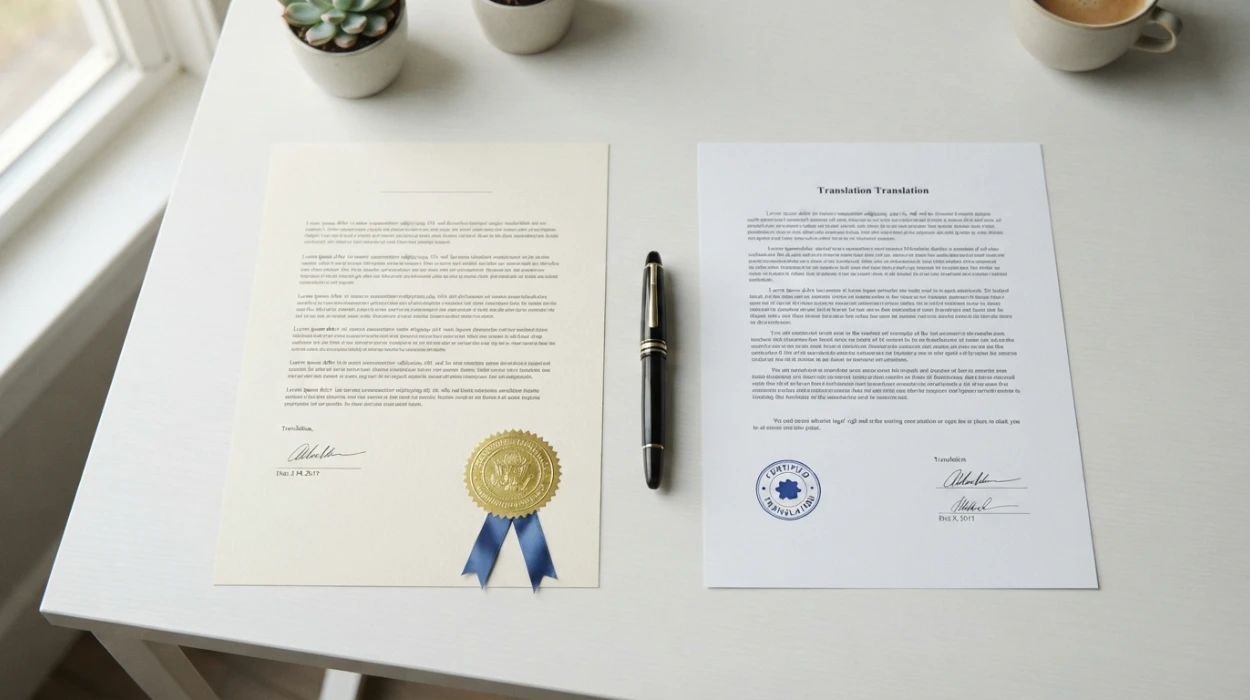
Choosing between an apostille and full consular legalisation depends entirely on your destination country’s membership in the 1961 Hague Convention. If the destination country participates in the treaty, an apostille certificate provides sufficient international legal validation. When the destination country remains outside the convention, you must complete full consular legalisation.
Navigating international documentation requires absolute precision. Global business expansion, cross-border corporate registration, and foreign employment depend on proper paperwork authentication. Jurisdictions maintain distinct legal frameworks for verifying foreign public documents. Government bodies, courts, and corporate registries reject invalid certificates immediately. Understanding the legal distinctions prevents costly transactional delays.
What Is the Core Difference Between an Apostille and Consular Legalisation?
An apostille is a standardized certificate issued under the 1961 Hague Convention that validates public documents for use in member states. Consular legalisation involves multi-stage verification through both the UK Foreign Office and the specific foreign embassy when a destination country is not a treaty member.
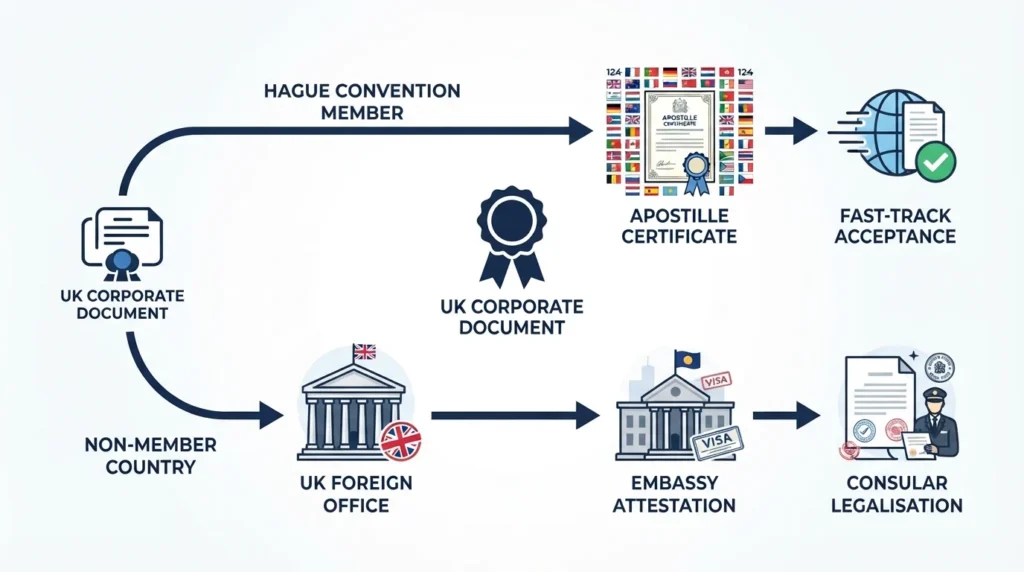
International document recognition relies on two distinct administrative paths. The Hague Apostille Convention streamlined verification across 125 participating nations. A single stamp from the Foreign, Commonwealth & Development Office removes the need for embassy intervention. Non-member states refuse apostille stamps. These jurisdictions require a sequence of approvals involving domestic government departments and foreign diplomatic missions.
Foreign authorities inspect corporate papers, educational degrees, and vital records for authenticity. State institutions verify signatures, official seals, and issuing officer credentials. When a country signs the Hague Convention, reciprocal trust agreements eliminate redundant embassy checks. When a country abstains from the treaty, sovereign security protocols demand exhaustive verification chains.
Business executives must identify destination requirements before submitting documents for processing. Submitting an apostille to a non-member embassy results in immediate rejection and wasted fees. Requesting consular legalisation for a Hague member state wastes weeks of operational time. Strategic document preparation protects international timelines and corporate budgets.
When Does a Document Require an Apostille Instead of Consular Legalisation?
A document requires an apostille when the destination country is a contracting party to the 1961 Hague Apostille Convention. This single-step authentication verifies UK public documents for legal use across all 125 participating international jurisdictions.
Global commerce operates efficiently when administrative burdens decrease. The Hague Convention replaces complex diplomatic certifications with a unified digital or physical stamp. Businesses expanding operations across borders use Apostilled Documents to validate corporate standing certificates, Articles of Association, and board resolutions.
Three primary verification elements define the apostille process:
Inspect document signatures against official government registries
Validate issuing authority credentials using secure databases
Attach the standardized certificate securely to the original public document
UK corporations establish foreign bank accounts and subsidiary branches rapidly using this streamlined method. European, North American, and numerous Asian jurisdictions accept Hague-compliant paperwork without hesitation. Legal professionals rely on this framework to accelerate cross-border litigation and asset transfers.
Efficiency dictates that compliance officers check current convention member lists prior to submission. National accession updates occur periodically as new governments adopt the treaty. Verifying treaty status avoids administrative rejections by foreign corporate registries.
When Is Full Consular Legalisation Mandatory for Foreign Documents?
Full consular legalisation is mandatory when the destination country has not signed the 1961 Hague Apostille Convention. This rigorous procedure requires certification from the UK government followed by authentication at the specific foreign embassy representing the destination nation.
Non-Hague jurisdictions enforce stringent document verification protocols. Countries across the Middle East, North Africa, and parts of Asia require exhaustive diplomatic oversight. Commercial invoices, certificates of incorporation, and power of attorney instruments must pass through multiple bureaucratic checkpoints.
Four sequential stages comprise the consular legalisation workflow:
Certify documents through a registered UK solicitor or notary public
Authenticate the certification via the UK Foreign, Commonwealth & Development Office
Submit files to the target nation embassy or consulate in London
Complete final clearance by the foreign ministry within the destination country
Embassies examine every detail of submitted corporate records. Consular officials cross-reference company registration numbers with domestic databases. Diplomatic fees vary significantly depending on the destination country and document type.
Corporate legal teams factor extended processing timelines into project schedules. Consular verification frequently spans four to six weeks. Strategic planning ensures that international expansion milestones account for these mandatory diplomatic intervals.
How Do Document Types Influence the Legalisation Pathway?
Document types influence the legalisation pathway based on whether they originate from public authorities or private commercial entities. Public records require direct government authentication, whereas commercial documents need preliminary solicitor certification before entering the state or consular pipeline.
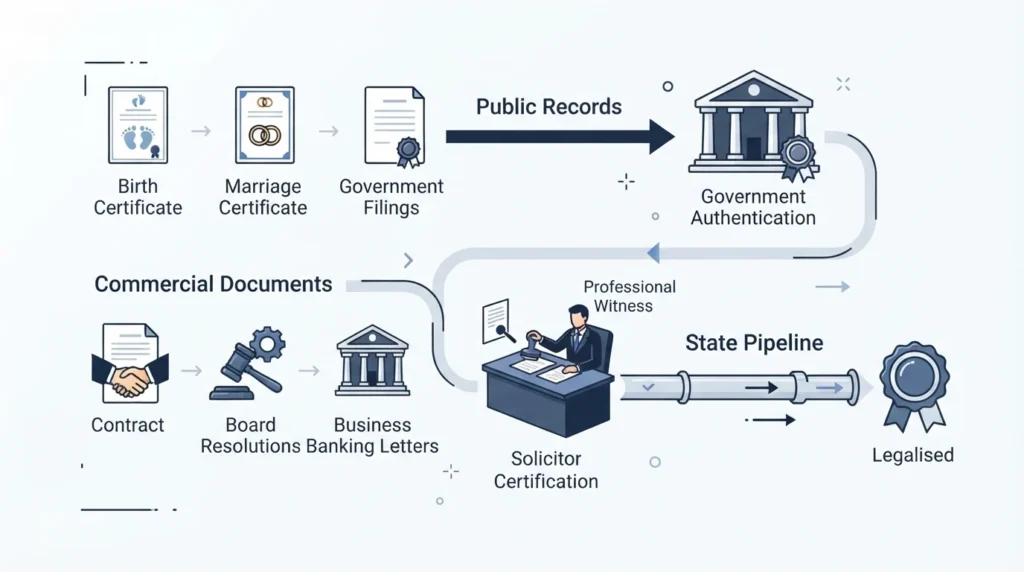
Administrative classifications determine how authorities handle international paperwork. Birth certificates, court orders, and government-issued tax documents qualify as public acts. These records move directly to state-level authentication bodies. Corporate contracts, commercial agreements, and board minutes qualify as private instruments.
Three essential steps prepare commercial documents for international deployment:
Draft formal statements on official company letterhead
Execute notarisation before a practicing UK notary public
Process the notarised instrument through the appropriate legalisation channel
Foreign authorities scrutinize commercial contracts for compliance with local contract law. Translating corporate filings into the official language of the destination state often accompanies legalisation. Precision in drafting prevents foreign regulators from flagging discrepancies during corporate audits.
Businesses streamline this phase by auditing document portfolios early. Separating public vital records from private commercial agreements prevents procedural bottlenecks. Expert guidance ensures that every file meets the exact evidentiary standards of foreign courts.
What Financial and Operational Factors Determine Your Final Choice?
Financial and operational factors determine your final choice by weighing processing speed against destination compliance rules. Apostilles offer rapid, cost-effective validation for member states, whereas consular legalisation demands higher diplomatic fees and extended turnaround times.
Budget allocation and project deadlines dictate administrative workflows. An apostille typically incurs a single government fee and processes within days. Consular legalisation multiplies administrative costs through solicitor fees, foreign embassy charges, and courier expenses.
Four critical metrics guide cost-benefit analysis for international filings:
Calculate total government and diplomatic processing fees
Measure elapsed time from document submission to foreign acceptance
Assess risk exposure tied to potential administrative rejection
Evaluate internal labor hours required for multi-stage management
Operational foresight prevents costly shipment delays during international expansion. Corporations balance the urgency of market entry against strict legal mandates. Compliance officers document every verification stage to maintain corporate transparency.
Form My Company simplifies complex administrative requirements through structured execution. Strategic document handling ensures every international filing satisfies regulatory thresholds without unnecessary delay. Professional oversight transforms bureaucratic friction into seamless global operations.
Navigating international document verification requires strict adherence to destination country regulations. The 1961 Hague Convention separates global jurisdictions into two distinct compliance categories. Member nations accept streamlined apostille certificates, while non-member states demand exhaustive consular legalisation. Evaluating destination treaties, document classifications, and project timelines ensures absolute legal compliance. Form My Company delivers complete document legalisation done right, protecting your international business ventures from costly regulatory setbacks.
Explore More Apostilled Documents Guide,
How to Combine Translation, Apostille and Embassy Attestation Correctly
How to Set Up an Overseas Branch With the Right Documents
Frequently Asked Questions
How long does it take to get an apostille for UK documents?
Standard apostille processing through Form My Company typically takes between 3 to 5 working days from the date of submission. Expedited same-day services are available for urgent international business filings and time-sensitive cross-border transactions involving Apostilled Documents.
Which documents can be authenticated with an apostille?
Public documents such as birth certificates, court orders, corporate Articles of Association, and HMRC tax certificates qualify for apostille authentication. Form My Company validates these essential records so that overseas authorities and foreign corporate registries accept them legally.
Do I need an apostille or full consular legalisation for my documents?
The requirement depends entirely on whether the destination country has signed the 1961 Hague Convention. Member states accept standard apostille certificates, whereas non-member nations require full consular legalisation through both the UK Foreign Office and the relevant foreign embassy.
Can commercial and corporate documents receive an apostille?
Commercial documents like power of attorney instruments and board resolutions require preliminary certification by a UK notary public before receiving an apostille. Form My Company coordinates the complete notarisation and authentication workflow to ensure full compliance with international standards.
Are digital apostilles accepted by foreign authorities?
E-apostilles issued via electronic registers are increasingly accepted by participating Hague Convention member states for digital verification. Form My Company assists clients in determining whether destination jurisdictions accept electronic stamps or require physical paper documentation.