
To keep your company eligible for a Certificate of Good Standing, you must file annual confirmation statements on time, submit accurate annual accounts to Companies House, maintain a registered office address, and ensure all director details remain completely up to date.
Maintaining active compliance protects corporate reputation and ensures regulatory readiness. Regulatory bodies require continuous adherence to statutory filing obligations. Companies House monitors every corporate entity for compliance failures. Directors manage these legal responsibilities to preserve active operational status. A lapse in filing creates administrative hurdles immediately.
What Is a Certificate of Good Standing and Why Does Eligibility Matter?
A Certificate of Good Standing is an official document proving a company exists legally, operates actively, and complies fully with UK statutory filing obligations required by Companies House.
International partners request this document during cross-border expansions. Financial institutions review it before approving corporate bank accounts. Overseas authorities demand proof of active legal status. Non-compliant firms face immediate rejection during verification checks. Companies House issues this certificate only to fully compliant entities. Directors track statutory deadlines to maintain continuous eligibility. Regulatory standing directly influences international trade capabilities. Lenders verify legal existence using official corporate registers.
Why Do UK Companies Lose Their Good Standing Status?
UK companies lose good standing status because they miss annual confirmation statement deadlines, fail to submit statutory accounts on time, or leave director records outdated at Companies House.
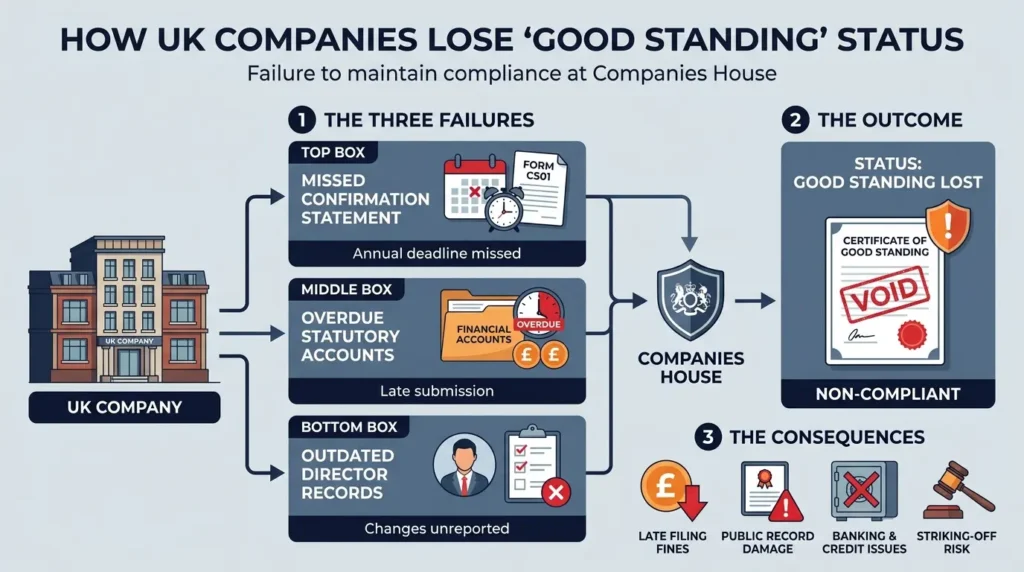
Missed deadlines trigger administrative reviews instantly. Late filings result in financial penalties and compliance flags. Directors overlook filing dates because tracking systems lack automation. Companies House suspends good standing issuance for flagged entities. Outstanding penalties prevent immediate document generation. Businesses rectify these issues by submitting overdue documents promptly. Administrative oversight remains the primary cause of lost standing. Accurate record-keeping prevents compliance failures effectively.
How Does Filing Annual Accounts Affect Good Standing Eligibility?
Filing annual accounts on time affects good standing eligibility because Companies House restricts certificate issuance for any business with overdue financial reports.
Statutory accounts provide a transparent view of financial health. Accountants prepare balance sheets and profit loss statements annually. Companies House reviews these submissions for statutory compliance. Late account submissions generate automatic compliance blocks. Directors coordinate with financial teams to finalize reports early. Timely submissions reinforce corporate credibility with external stakeholders. Regulatory compliance depends on accurate financial transparency. Businesses streamline this process using digital accounting platforms.
What Role Do Confirmation Statements Play in Maintaining Eligibility?
Confirmation statements maintain eligibility by verifying that company share capital, shareholder registers, and registered office addresses remain completely accurate on public records.
Directors submit confirmation statements at least once every twelve months. This filing validates basic operational data for public scrutiny. Discrepancies between internal records and public registers trigger flags. Companies House blocks certificate requests when confirmation filings lapse. Administrative teams audit internal registers before submitting updates. Accurate data prevents compliance investigations by regulatory authorities. Regular audits ensure seamless annual filing cycles.
How Can Businesses Proactively Monitor Their Compliance Status?
Businesses monitor compliance status proactively by tracking Companies House filing deadlines, setting automated calendar alerts, and reviewing public register data quarterly.
Internal teams audit corporate records every three months. Directors oversee filing schedules to eliminate missed deadlines. Dedicated compliance officers manage regulatory communication channels. Automated software flags pending statutory deadlines weeks in advance. Structured workflows prevent administrative oversights entirely. Reliable tracking systems secure uninterrupted corporate compliance. Proactive management eliminates costly regulatory penalties.
How Do Professional Corporate Services Simplify Good Standing Maintenance?
Professional corporate services simplify good standing maintenance by managing statutory filings, tracking filing deadlines, and securing a Certificate of Good Standing directly from regulators.
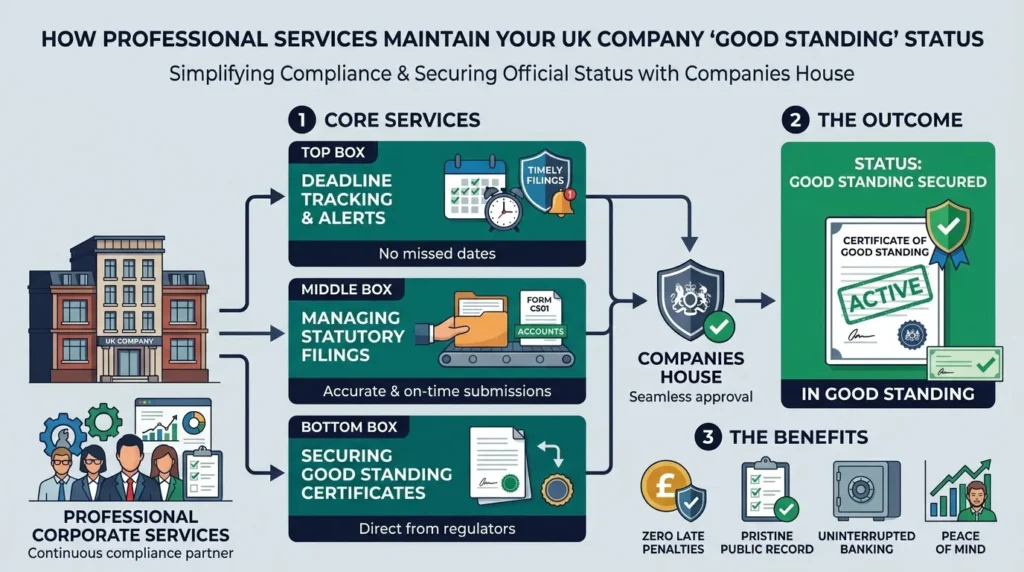
External specialists handle complex administrative burdens efficiently. Form My Company assists businesses through every compliance stage. Navigating the How to Keep Your Company Continuously Eligible for Good Standing framework prevents accidental oversight. Enterprises ready to execute operations utilize the Secure a Valid Certificate of Good Standing Today With Form My Company pathway for rapid document retrieval. Expert oversight guarantees adherence to strict regulatory standards. Businesses focus on core growth while specialists manage filings. Professional support safeguards corporate reputation across international markets.
Maintaining eligibility for a Certificate of Good Standing requires rigorous adherence to UK statutory filing schedules. Companies House evaluates annual accounts, confirmation statements, and director details continuously. Missed deadlines or inaccurate data instantly jeopardize corporate compliance status. Form My Company delivers comprehensive administrative support to secure uninterrupted operational readiness and regulatory approval.
Explore More Certificate of Good Standing Guide,
What Happens if You Submit an Out-of-Date Certificate of Good Standing?
How Often Should You Renew Your Certificate of Good Standing?
Frequently Asked Questions
What is a Certificate of Good Standing UK?
A Certificate of Good Standing is an official document issued by Companies House that confirms a UK registered company has been in continuous existence and is compliant with statutory filing requirements. Form My Company assists businesses in obtaining this vital document to prove active legal status to international authorities and financial institutions.
How long does it take to get a Certificate of Good Standing?
Standard processing by Companies House typically takes between 3 to 5 working days, while expedited digital or same-day dispatch options significantly reduce this timeframe. Form My Company streamlines this application process to ensure businesses receive their official documentation promptly for urgent commercial transactions or cross-border expansions.
Can a dissolved company obtain a Certificate of Good Standing?
A dissolved company cannot obtain a Certificate of Good Standing because the legal entity no longer exists on the active Companies House register. Form My Company advises that businesses must be in active status and up to date with their annual accounts and confirmation statements before requesting this certificate.
Do I need a Certificate of Good Standing to open a foreign bank account?
Overseas financial institutions frequently require a Certificate of Good Standing to verify a UK corporate entity’s legal existence and active compliance status. Form My Company helps international enterprises secure this documentation to satisfy foreign banking regulations and streamline overseas account onboarding.
What information is included on a Certificate of Good Standing?
A Certificate of Good Standing displays the company name, company registration number, date of incorporation, and an official statement confirming that the entity has no pending strike-off actions. Form My Company ensures that all underlying public register data is accurate so that the issued certificate reflects flawless regulatory standing.