
Keeping a company continuously eligible for good standing requires filing annual confirmation statements on time, submitting accurate annual accounts to Companies House, paying all corporation tax liabilities promptly, and updating registered office addresses immediately whenever business locations change.
Maintaining active compliance status protects corporate reputation, secures business contracts, and satisfies international trade requirements. UK registered companies must navigate specific statutory obligations to preserve their official status. Regulatory authorities review filing histories and financial submissions constantly to determine operational validity.
Why Does Continuous Good Standing Matter for UK Companies?
Continuous good standing matters because international partners, corporate lenders, and procurement platforms require verified compliance status before signing commercial contracts or approving multi-million-pound business loans.
Corporate compliance directly influences commercial growth and international expansion. Global suppliers check official registries before establishing credit lines or signing trade agreements. When businesses maintain flawless filing histories, risk assessment scores improve significantly. Financial institutions examine active status reports before releasing capital for expansion projects. Regulatory bodies penalize delinquent corporations with severe financial fines and compulsory dissolution proceedings. Operating with active compliance eliminates unexpected legal disruptions. Form My Company assists directors in maintaining accurate compliance records throughout every financial year.
What Are the Core Filing Deadlines to Prevent Compliance Lapses?
Core filing deadlines to prevent compliance lapses include submitting annual accounts within nine months of the accounting reference date and filing the confirmation statement within 14 days of the review period.
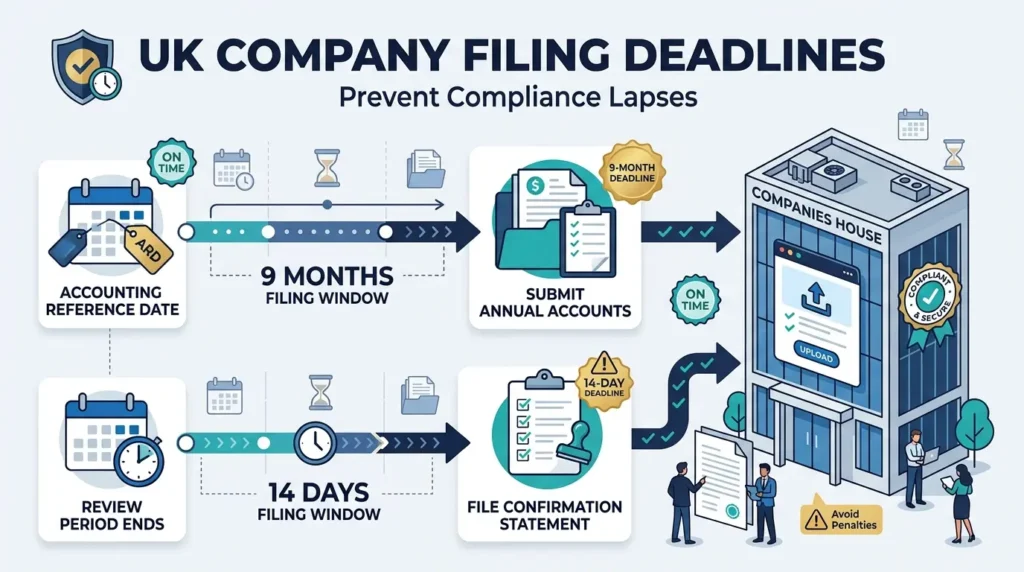
Companies House enforces strict statutory deadlines for all mandatory corporate submissions. Directors must track two distinct filing schedules annually. Annual accounts detail financial performance, asset values, and liability metrics. Confirmation statements verify fundamental corporate data such as shareholder registers, director appointments, and control structures. Missing these critical windows triggers automatic system penalties and flags the entity as non-compliant. Automated tracking systems help administrative teams monitor submission dates effectively. Accurate forecasting prevents last-minute filing errors that jeopardize official status.
How Do Financial Obligations Impact Your Standing Status?
Financial obligations impact your standing status because unpaid corporation tax liabilities, outstanding penalties, and unfiled tax returns prompt HM Revenue and Customs to report compliance failures directly to official registries.
Tax compliance forms the foundation of corporate legitimacy in the United Kingdom. HM Revenue and Customs audits corporate tax returns to ensure accurate revenue reporting. When businesses fail to settle corporation tax liabilities within 12 months of the accounting period, financial penalties accumulate rapidly. Outstanding tax debts prevent the issuance of clean compliance certificates. Accountants must reconcile ledger accounts and submit tax computations well before statutory deadlines. Maintaining transparent financial records satisfies strict auditing standards.
Why Is Immediate Maintenance of Statutory Registers Essential?
Immediate maintenance of statutory registers is essential because failing to update Companies House regarding changes to directors, significant controllers, or registered office addresses breaches statutory legislation.
Corporate transparency regulations require real-time updates for all fundamental business changes. Companies must notify regulatory bodies within 14 days of appointing or resigning directors. Changes to persons with significant control demand immediate electronic filing. Operating from an outdated registered office address results in missed statutory notices and administrative restoration failures. Three essential data points require continuous monitoring: director residential addresses, share capital allocations, and PSC register entries. Maintaining these records prevents administrative penalties. Companies aiming to secure a valid Certificate of Good Standing must audit their internal registers quarterly.
How Can Businesses Proactively Monitor Their Compliance Health?
Businesses can proactively monitor their compliance health by conducting quarterly internal audits, utilizing digital filing software reminders, and reviewing public register profiles for unexpected data discrepancies.
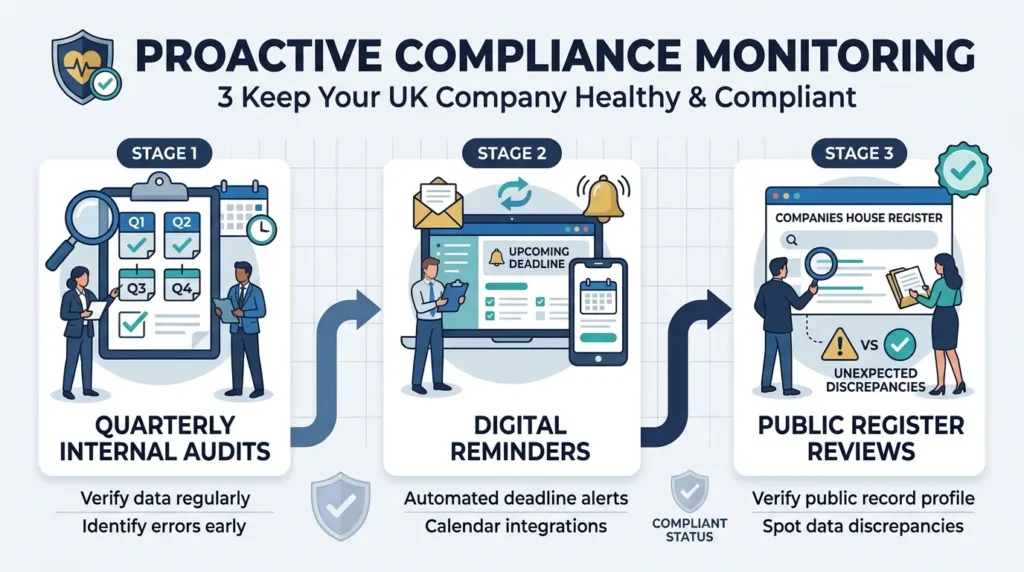
Proactive oversight eliminates the risk of accidental administrative defaults. Compliance managers should review official filing portals regularly to verify data accuracy. Internal audits should examine three core areas: tax filing receipts, confirmation statement accuracy, and statutory register completeness. When administrative teams identify filing discrepancies early, corrective actions occur without regulatory intervention. Establishing structured internal protocols ensures long-term operational stability. Organizations seeking deeper insights can review the How Do You Keep Your Company Eligible for a Certificate of Good Standing? guide. Business leaders ready to finalize their official credentials can explore Secure a Valid Certificate of Good Standing Today With Form My Company for streamlined assistance.
Sustaining continuous eligibility for good standing requires strict adherence to statutory filing deadlines, transparent financial reporting, and meticulous corporate governance. Form My Company supports corporate entities by streamlining document preparation and submission workflows. Maintaining proactive compliance safeguards your commercial reputation and ensures uninterrupted business operations across all regulated markets.
Explore More Certificate of Good Standing Guide,
How to Avoid Rejection From Submitting an Expired Certificate of Good Standing
How to Choose a Renewal Schedule for Your Certificate of Good Standing
Frequently Asked Questions
What is a Certificate of Good Standing and when does a company need one?
Answer: A Certificate of Good Standing is an official document issued by Companies House confirming that a UK company has been in continuous existence and meets all statutory filing requirements. Businesses typically need this document when expanding operations internationally, opening overseas corporate bank accounts, securing business loans, or bidding on major procurement contracts. Through the Certificate of Good Standing service, Form My Company helps directors obtain this verification quickly and efficiently.
Why is my company ineligible for a Certificate of Good Standing?
Answer: Companies House will reject a certificate request if a business has overdue annual accounts, an unfiled confirmation statement, or outstanding tax liabilities with HM Revenue and Customs. Additionally, entities undergoing voluntary strike-off or liquidation proceedings fail to meet basic eligibility criteria. Form My Company assists businesses in identifying and resolving these filing backlogs to restore full compliance status.
What specific information does a Certificate of Good Standing display?
Answer: A standard Certificate of Good Standing displays the company registration number, incorporation date, registered office address, and current active status. It also lists current director names and confirms that all statutory annual filings are fully up to date. Clients can request specialized variations through Form My Company to include specific historical governance data required by overseas authorities.
How long is a UK Certificate of Good Standing valid after issuance?
Answer: A UK Certificate of Good Standing is generally valid for three months from the date of issue because corporate compliance statuses change frequently. Financial institutions, international regulators, and overseas commercial partners routinely demand fresh documents issued within this 90-day window. Form My Company streamlines renewal processes so active enterprises maintain continuous proof of regulatory compliance.
Can Form My Company expedite my Certificate of Good Standing request?
Answer: Form My Company manages the entire application lifecycle through direct digital integration with official UK regulatory filing channels. Professional corporate agents review company registers beforehand to prevent administrative rejections and secure rapid turnaround times. Business leaders can leverage the Certificate of Good Standing service to obtain verified PDF or printed credentials without operational delay.