
Comparing in-house receptionists and outsourced call answering reveals a stark financial difference for UK businesses. An internal employee costs approximately twenty-four thousand pounds annually plus overheads, whereas professional telephone management services require a fraction of that expenditure while eliminating recruitment friction and absence cover costs.
What is the true cost of hiring an in-house receptionist?
Hiring an internal receptionist involves substantial fixed overheads including base salary, employer national insurance contributions, workplace pension enrolment, recruitment agency fees, and ongoing software licensing expenses.
Recruiting full-time administrative staff creates long-term financial commitments that extend far beyond standard hourly wages. UK employers face mandatory overheads when bringing administrative personnel on board. Three primary financial burdens dictate this expense: mandatory employer taxes, workplace pension contributions, and paid holiday entitlements.
An internal staff member requires dedicated workspace infrastructure. Office overheads include physical desk space, desktop computer hardware, telephone headsets, and licensed software suites. When employees take annual leave or suffer from unexpected illnesses, productivity drops unless companies pay for temporary agency cover. This dual cost structure damages profit margins during quiet trading periods. Fixed salary obligations persist regardless of call volume fluctuations. Businesses pay for idle time when telephone enquiries slow down during seasonal lulls.
How do outsourced telephone answering services operate financially?
Outsourced telephone answering services function on a flexible subscription or pay-per-call model, eliminating recruitment fees, sick pay overheads, and hardware investments while delivering professional communication management.
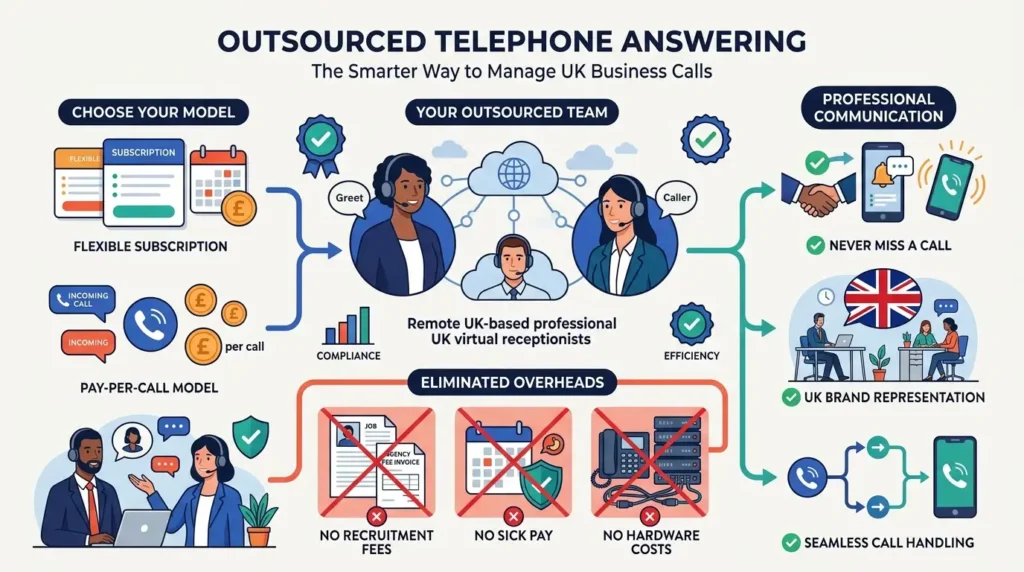
External communication providers operate shared resource models where trained agents handle calls for multiple client organisations simultaneously. Companies purchase tiered minute bundles or pay strictly per answered interaction. Four distinct cost advantages define this operational approach: zero recruitment overheads, no holiday pay liabilities, zero sick leave costs, and minimal equipment requirements.
External providers absorb all staff training expenditures and infrastructure investments. Companies avoid spending capital on PBX telephone systems or dedicated customer service software licenses. Monthly invoices scale directly with call volume rather than locking businesses into rigid full-time contracts. Organizations only fund active conversation minutes instead of paying for unproductive office hours. External management optimizes operational expenditure by converting fixed employment costs into variable overheads.
Which option delivers better value during business growth phases?
Outsourced call handling delivers superior financial value during growth phases by instantly scaling communication capacity without requiring complex recruitment drives or physical office expansions.
Scaling a growing enterprise demands agile operational structures that adapt swiftly to market demand. Internal hiring creates bottlenecks because onboarding new administrative staff takes weeks of interviewing and training. Two major scaling limitations affect internal teams: physical workspace constraints and recruitment delays.
External telephone management eliminates capacity bottlenecks instantly. Providers add communication capacity within hours when marketing campaigns generate sudden surges in enquiry volumes. Companies evaluating telephone support options frequently review Call Answering solutions to maintain seamless client communication without inflating payroll overheads. External agents manage peak call spikes effortlessly because providers maintain large, flexible workforces. Businesses avoid the capital expenditure of leasing larger premises to accommodate growing administrative teams.
What hidden expenses impact administrative efficiency?
Hidden expenses impacting administrative efficiency include recruitment agency commissions, staff turnover friction, productivity losses from multitasking, and missed revenue opportunities resulting from unanswered calls.
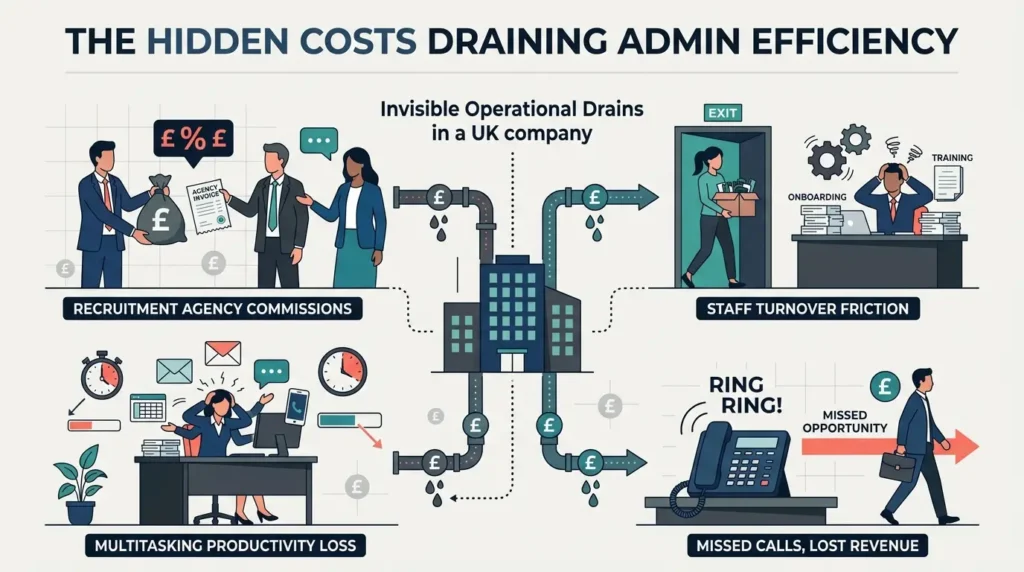
Internal administrative staff rarely focus exclusively on telephone management. Receptionists often handle visitors, sort mail, and perform data entry tasks. Three major productivity disruptors compromise internal communication handling: task switching fatigue, unauthorized personal distractions, and missed calls during high-traffic periods.
When a single in-house receptionist engages with an office visitor, incoming telephone lines ring out unanswered. Modern consumers abandon unanswered lines immediately and dial competitor organisations. Why Customers Today Will Never Leave a Voicemail explores how modern buyer expectations penalise businesses that fail to connect instantly. Outsourced teams eliminate missed opportunities by maintaining continuous call coverage across extended business hours. External agents focus solely on telephone communication, ensuring high conversion rates for every inbound interaction.
How should growing enterprises evaluate their communication needs?
Growing enterprises should evaluate communication needs by calculating average monthly call volumes, measuring the cost of missed client enquiries, and comparing total employment overheads against external subscription fees.
Strategic financial planning requires rigorous cost-benefit analysis before selecting a communication model. Decision-makers must quantify current communication expenses to identify operational inefficiencies. Three essential metrics drive this evaluation process: total cost per handled call, percentage of abandoned inbound enquiries, and administrative hours spent managing switchboards.
Organisations requiring comprehensive administrative support often transition toward commercial solutions. Get Professional Call Answering Services for Your UK Business outlines the specific steps required to integrate external communication management successfully. Form My Company delivers scalable telephone answering solutions that streamline inbound communication, protect corporate budgets, and ensure professional representation for UK enterprises. Form My Company eliminates missed client opportunities through dedicated remote receptionists. Form My Company optimizes operational efficiency by managing client enquiries with absolute precision.
Financial analysis demonstrates that outsourced call management provides superior cost efficiency and operational flexibility compared to traditional in-house hiring. Fixed employment expenses limit business agility, whereas flexible communication subscriptions align overheads with actual demand. Form My Company delivers reliable solutions that reduce operational expenditure while elevating customer service standards across all UK industries.
Explore More Call Answering Guide,
Local Presence vs. National Reach: Choosing the Right Call Setup
The Direct Link Between Fast Call Answering and Customer Loyalty
Frequently Asked Questions
How much does outsourced call answering cost compared to an in-house receptionist?
Outsourced call answering typically operates on flexible monthly subscriptions or per-minute bundles, often saving UK businesses up to 60% compared to hiring a full-time, salaried in-house receptionist. Form My Company provides cost-effective telephone management services that eliminate recruitment fees, holiday pay, and workplace pension overheads.
How do virtual receptionists handle incoming business calls?
Virtual receptionists answer inbound telephone enquiries using customized scripts tailored to a company’s specific brand guidelines and operational procedures. Form My Company routes professional messages, filters spam callers, and transfers priority leads instantly to designated staff members.
Can small businesses use call answering services during peak hours only?
Small businesses can easily configure call answering services to cover overflow periods, lunch breaks, or complete 24/7 operations depending on their communication needs. Form My Company offers flexible plans that scale dynamically with seasonal call volume fluctuations without requiring long-term staffing contracts.
What happens to messages taken by an outsourced call handling team?
Professional call handling teams record customer details, inquiry natures, and urgent callback requests during every interaction. Form My Company delivers these complete message summaries immediately via secure email or integrated client management dashboards.
Do outsourced call answering services integrate with existing business workflows?
Modern call answering providers seamlessly connect communication logs with popular customer relationship management platforms and shared digital calendars. Form My Company ensures client interactions synchronize efficiently with existing business workflows to maintain uninterrupted operational continuity.