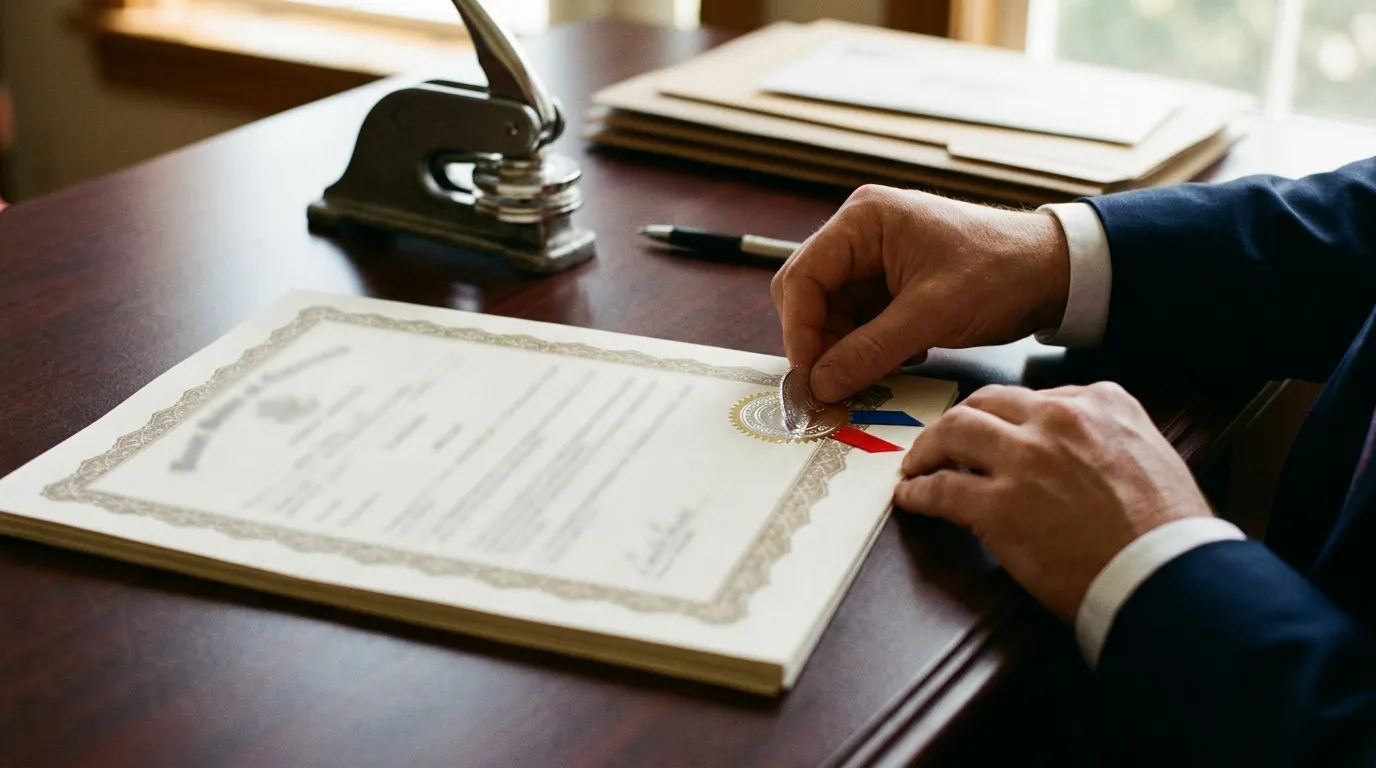
You can order an apostilled Certificate of Good Standing directly through Form My Company by submitting your corporate details online, selecting official FCDO legalisation services, and receiving verified, legalised corporate documents delivered to your international address.
What Is an Apostilled Certificate of Good Standing?
An apostilled Certificate of Good Standing is an official UK Companies House document verified by the Foreign, Commonwealth & Development Office with an legalisation certificate, confirming a legal company active status for international business transactions.
Companies House issues the primary document to confirm that a registered entity exists continuously under the Companies Act 2006. The Foreign, Commonwealth & Development Office attaches an apostille certificate to legalise the document under the 1961 Hague Convention. Overseas authorities require this legalisation before recognizing UK corporate documents for banking, foreign branches, or commercial contracts.
Foreign government agencies validate three primary elements: legal registration status, annual filing compliance, and current director details. Holding an authenticated document proves that a company maintains up-to-date confirmation statements and accounts. UK entities operating across international borders submit this certified document to satisfy overseas compliance mandates and foreign regulatory frameworks.
Understanding legalisation requirements prevents operational delays during international expansions. Foreign banks reject standard un-legalised documents during corporate account opening procedures. Reviewing our guide on what is an apostilled Certificate of Good Standing helps business owners verify specific document requirements before expanding globally.
Why Do Foreign Jurisdictions Require an Apostilled Certificate?
Foreign jurisdictions require an apostilled certificate to verify that a UK company exists legally, maintains active status, and possesses authentic signatures recognized by international government authorities under international law.
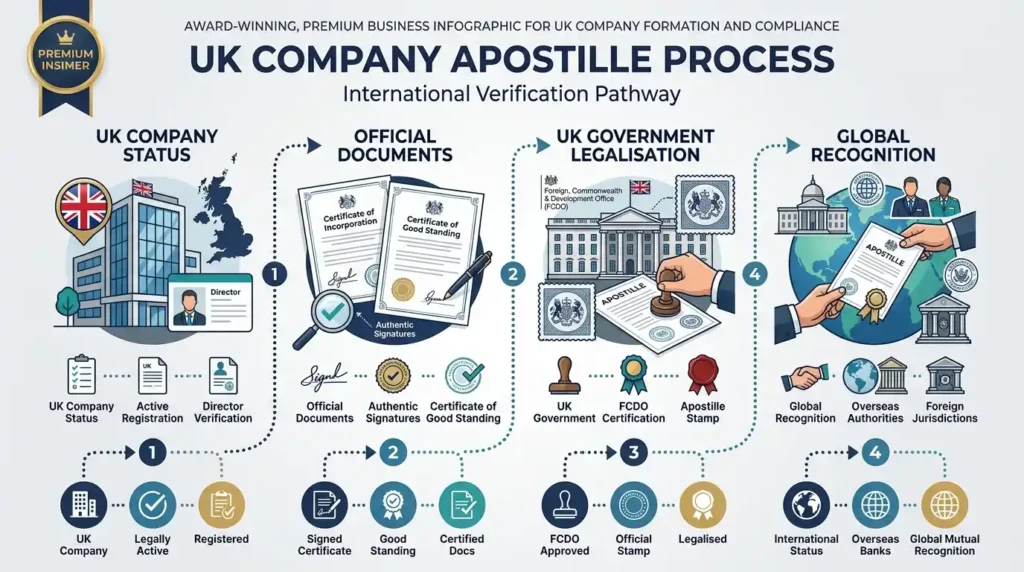
International authorities lack direct access to the UK Companies House database. Overseas regulators require standardized authentication to prevent corporate fraud across international borders. An Hague apostille certifies the signature, seal, and authority of the issuing UK public official. Overseas notary offices accept this standardized legalisation without requiring additional consular authentication.
Cross-border commercial transactions require strict identity and status verification. Foreign jurisdictions enforce compliance checks during trade licensing, commercial property leases, and international joint ventures. Presenting an official legalised certificate satisfies global anti-money laundering regulations and corporate governance standards across 120 member countries.
Selecting the correct level of authentication prevents unnecessary administrative expenses. Standard certificates satisfy simple domestic verification, whereas legalised documents fulfill legal foreign obligations. Evaluating how to choose between an apostille and standard Certificate of Good Standing ensures entities select the appropriate compliance service level for their foreign target market.
How Does the Legalisation Process Work for UK Companies?
The legalisation process involves requesting an official document from Companies House, submitting the record to the Foreign, Commonwealth & Development Office for authentication, and receiving a legalised apostille certificate.
Companies House generates the official certificate containing current corporate records, director information, and statutory compliance status. Officials print the document on specialized security paper using registered government seals. The registrar verifies that the entity holds no pending strike-off notices or outstanding statutory filing penalties before issuing the certified paper document.
The document transfers directly to the Foreign, Commonwealth & Development Office legalisation department. FCDO officials verify the official registrar signature against recorded government databases. Officials attach a paper apostille certificate to the document, applying a embossed security stamp. Legalised records undergo complete verification before dispatch to international corporate destinations.
Processing times vary based on government department submission speed and selected courier options. Standard government processing takes 10 to 15 working days, while expedited legalisation completes within 24 to 48 hours. Legalised documents retain permanent validity, provided the legal standing details of the target UK entity remain unchanged over time.
What Documents Are Required to Secure an Legalised Certificate?
Securing an legalised certificate requires the registered UK company name, official company registration number, valid applicant contact information, and specific destination country legalisation requirements.
Applicants provide basic entity identification details through an online submission portal. Form My Company retrieves official company records directly from the Companies House register without requiring physical paper filings from company directors. Supplying an accurate 8-digit UK company registration number ensures immediate document retrieval from government systems.
Certain foreign jurisdictions require specific information notes printed on the certificate. Applicants select optional additions, including official registered office addresses, current board director names, and statutory shareholder details. Specifying the target country ensures compliance with localized notary standards and foreign consulate submission guidelines.
Entities must resolve outstanding corporate administrative issues before initiating ordering procedures. Companies House blocks certificate issuance for entities with overdue confirmation statements or late annual accounts. Verifying corporate standing status beforehand prevents submission rejections and unnecessary government filing processing delays.
How Do You Order an Apostilled Certificate From Form My Company?
You order an apostilled certificate by selecting the service package on the Form My Company platform, entering company registration details, completing secure payment, and confirming international delivery addresses.
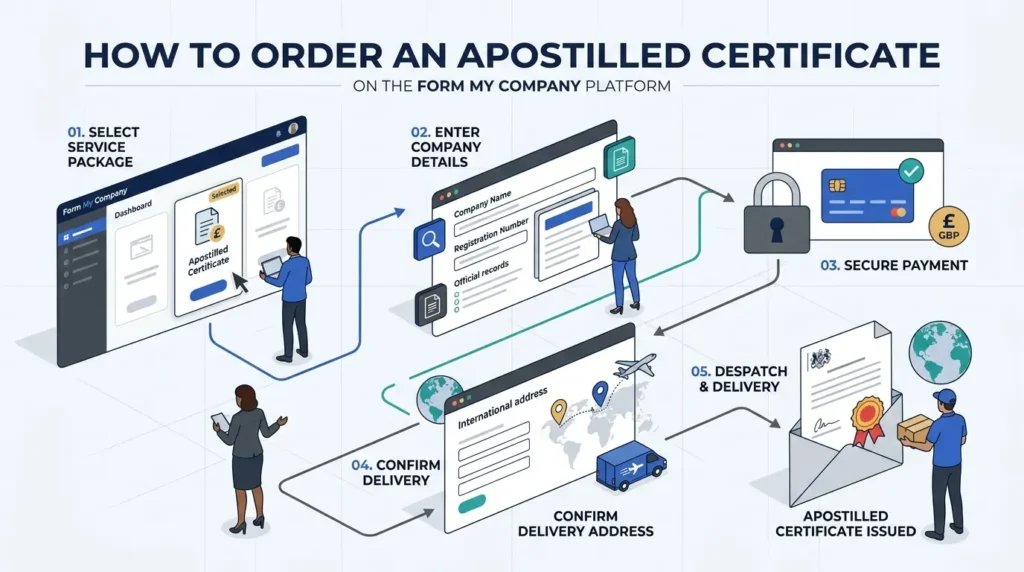
Clients access the dedicated online ordering system to initiate the legalisation order process. Entering the registered company name populates official corporate details automatically from government databases. Users select required document customization options, including director detail inclusions, registered address printouts, and express government legalisation speeds.
Form My Company processes document retrieval from Companies House and submits records directly to FCDO legalisation offices. Specialized compliance team members inspect documents for accuracy before government submission. Clients track document processing status through automated email updates and dedicated online portal dashboards throughout the multi-stage authentication procedure.
Completed legalised documents ship via secure tracked courier services worldwide. Form My Company dispatches authenticated packages to international corporate offices, foreign legal representatives, or overseas banking institutions. Clients receive digital scan copies prior to physical courier dispatch to expedite pending international compliance reviews.
Businesses seeking efficient document legalisation can order an apostilled Certificate of Good Standing from Form My Company to secure verified legal documentation quickly and reliably.
How Long Does the Order and Legalisation Process Take?
The order and legalisation process takes between 2 to 12 working days depending on the selected government processing speed and international courier delivery location.
Expedited service workflows process Companies House document retrieval within 24 hours. The FCDO premium legalisation service authenticates documents within 48 hours of physical receipt. Selecting urgent dispatch routes ensures completed apostilled certificates reach European destinations within 3 to 4 business days.
Standard processing services follow standard government administrative timeframes. Companies House issues standard paper certificates within 4 business days, while standard FCDO legalisation requires 8 to 10 working days. Global postal transit adds 3 to 7 additional days for non-European destinations.
External factors occasionally influence total processing timelines for international applicants. Government department holidays, high volume filing periods, and international customs clearance procedures introduce potential delays. Planning legalisation orders 14 days in advance mitigates risks associated with fixed foreign transaction deadlines.
What Are the Key Mistakes to Avoid When Legalising Certificates?
Key mistakes include providing incorrect company numbers, selecting unneeded document additions, missing target country compliance deadlines, and failing to verify international recipient requirements beforehand.
Submitting incorrect company registration details stalls government processing immediately. Companies House rejects requests containing mismatched company names or inaccurate registration numbers. Verifying official registration details against public registers eliminates submission errors and prevents non-refundable government processing fees.
Failing to confirm destination country requirements causes rejection by foreign authorities. Certain non-Hague member states require secondary embassy attestation following initial FCDO apostille legalisation. Verifying specific local authority mandates prevents document re-submission requirements and unnecessary administrative delays.
Neglecting corporate compliance status prevents certificate generation by registrar officials. Entities must file pending annual accounts and confirmation statements before requesting official certificates. Ensuring active corporate status enables immediate document processing and seamless international corporate authentication.
An apostilled Certificate of Good Standing validates UK company legitimacy for foreign authorities, banks, and commercial partners. The legalisation process bridges legal frameworks between UK Companies House filings and international regulatory standards under the Hague Convention.
Form My Company manages the entire retrieval, submission, and legalisation workflow, delivering authenticated government documents directly to international corporate addresses efficiently.
Explore More Certificate of Good Standing Guide,
Get Your Urgent Certificate of Good Standing Sorted by Form My Company
Buy an Express Certificate of Good Standing From Form My Company
Frequently Asked Questions
What is a Certificate of Good Standing from UK Companies House?
A Certificate of Good Standing is an official document issued by UK Companies House that confirms a registered company is actively operating and compliant with statutory filing obligations. Through Form My Company, businesses can order this certificate to verify that their annual accounts, confirmation statements, and corporate filings are fully up to date. It serves as legal proof of continuous existence for banks, foreign registries, and commercial partners.
How long does it take to get a Certificate of Good Standing?
Standard processing by Companies House typically takes three to five working days, with international delivery times varying by destination. Form My Company offers both standard and expedited retrieval services for a Certificate of Good Standing, allowing urgent requests to be processed within 24 hours. Selecting an express option ensures fast dispatch for time-sensitive corporate transactions or bank account openings.
Why do overseas banks require a Certificate of Good Standing?
Foreign banking institutions require a Certificate of Good Standing during corporate account opening procedures to verify identity, active corporate status, and compliance with anti-money laundering regulations. Overseas regulators use this verified document from Form My Company to confirm that a UK company is not facing insolvency, dissolution, or pending strike-off notices. It provides international authorities with authoritative proof of legal standing under the Companies Act 2006.
Do I need an apostille for my Certificate of Good Standing?
An apostille is necessary if the Certificate of Good Standing is being submitted to government authorities, legal representatives, or financial institutions outside the UK. Form My Company facilitates official Foreign, Commonwealth & Development Office (FCDO) legalisation to attach a legal apostille certificate recognized under the 1961 Hague Convention. Overseas jurisdictions in Hague member countries require this legalisation step to authenticate official registrar signatures.
What information is listed on a Certificate of Good Standing?
A standard Certificate of Good Standing confirms a company’s active legal registration status, official company name, and registration number. Upon request through Form My Company, additional statutory details can be included, such as registered office addresses, current director names, and secretary details. Ensuring these details are accurate helps meet specific compliance requirements specified by foreign lenders, investors, or notary officers.