
Companies House refuses a Certificate of Good Standing when annual accounts or confirmation statements remain overdue. Official compliance standards mandate that a company must maintain up-to-date public registers to demonstrate active status and lawful standing.
Companies House acts as the executive agency responsible for maintaining UK corporate records. Statutory regulations require every registered business entity to submit timely annual returns. A company must maintain active regulatory status to request official official documentation. When compliance deadlines pass without submission, the registry flags the record as delinquent. This administrative status automatically halts document processing. The registry cannot certify financial or structural integrity for non-compliant companies. Official certification confirms full statutory alignment with legal requirements. Any missing return destroys this regulatory baseline immediately.
Corporate governance frameworks rely on transparent public filings. Third-party institutions view late submissions as operational risks. Overdue accounts signal potential insolvency or legal negligence. Lenders, investors, and foreign registries check legal status before executing contracts. A missing confirmation statement conceals ownership details and registered office changes. Registries protect public interest by withholding formal certification. Businesses must resolve regulatory arrears before requesting official certificates. Clear filings validate legal existence and operational transparency.
How Does Companies House Define Overdue Filings?
Companies House defines overdue filings as statutory documents missed past their legal deadline. This regulatory status applies primarily to confirmation statements submitted past 14 days after the review period and annual accounts delivered past nine months from financial year-end.
Annual accounts document the financial performance and asset holdings of a business. Private limited companies submit these records nine months after their fiscal year concludes. Public limited companies observe a stricter six-month reporting window. Failure to submit financial statements triggers immediate legal penalties. Registry systems log the non-compliance marker instantly on the public index. Missing financial records prevent regulatory validation of corporate solvency.
Confirmation statements verify active officers, persons with significant control, and shareholder allocations. Companies must file this document at least once every 12 months. The statutory deadline expires 14 days after the annual review period ends. Missing this deadline conceals critical corporate ownership structures from public record. Registry systems categorize delayed submissions as severe administrative breaches. Official compliance frameworks require total operational transparency across all public filings.
Why Does Legal Compliance Block Official Document Issuance?
Official document issuance stops because Companies House cannot certify regulatory compliance for defaulting entities. Statutory parameters prohibit the registrar from issuing statements of good standing to corporate structures flagged for delinquent reporting or missing statutory records.
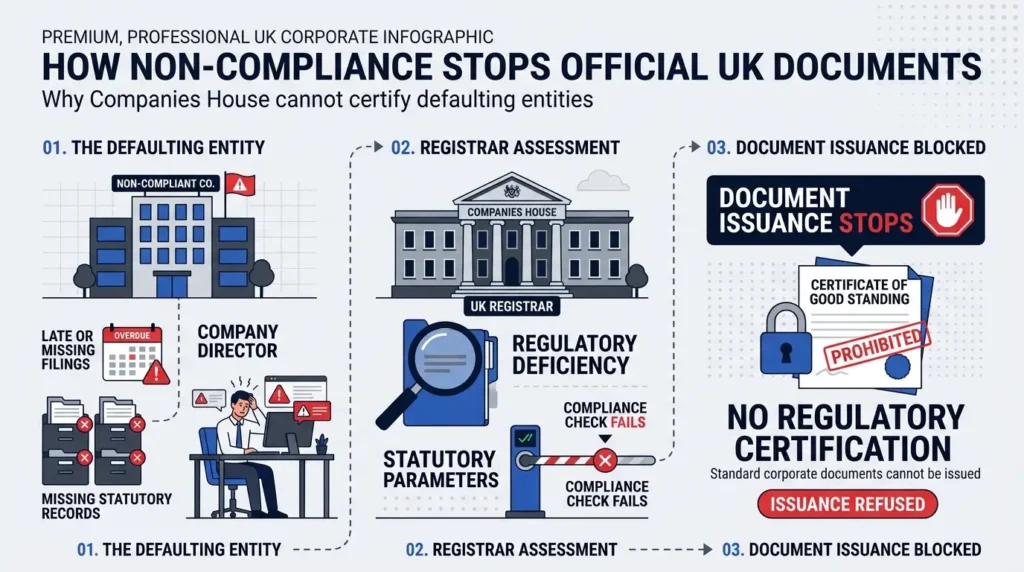
Regulatory bodies uphold strict standards regarding corporate verification. The registrar certifies specific legal facts on every official document. These details confirm active registration, continuous compliance, and correct statutory submissions. Issuing certificates to non-compliant businesses damages registry credibility. Statutory law requires absolute accuracy on official corporate certificates. Therefore, regulatory software automatically blocks document requests for flagged profiles.
Third parties depend on official documentation for corporate due diligence. Financial institutions require valid proof of compliance before opening commercial accounts. International trade partners require authenticated certificates during cross-border expansions. Obtaining an official Certificate of Good Standing proves your company maintains flawless regulatory standing. When filings remain overdue, the document system halts requests automatically. Resolving outstanding submission obligations unlocks standard registry processing routines.
What Statutory Requirements Must A Company Meet First?
A company must maintain an active corporate register, file annual accounts on time, submit confirmation statements promptly, and pay outstanding registry fees to qualify. The entity must also face zero compulsory striking-off actions or pending liquidation proceedings.
Maintaining an active corporate profile requires adherence to legal schedules. Companies House monitors submission timelines through automated tracking databases. Officers must confirm registered office addresses annually without exception. Director appointments, resignations, and residential addresses must reflect current records accurately. Any discrepancies between real-world structure and register logs suspend certification eligibility.
Financial transparency remains a core statutory obligation for directors. Companies must disclose accurate balance sheets and income summaries annually. Dormant entities must submit specific dormant accounts to retain active status. Paying all historical registry fines remains essential for clearance. Companies under compulsory strike-off warnings lose eligibility instantly. Resolving these administrative obstacles requires immediate submission of missing statutory documents. Directors must learn how to fix overdue filings before requesting a Certificate of Good Standing to restore corporate eligibility.
How Do Overdue Filings Affect International Business Operations?
Overdue filings affect international business operations by halting overseas branch registrations, delaying foreign bank account approvals, and invalidating notarized legal documents. Foreign registries mandate valid good standing certification before approving cross-border commercial activities.
International expansion strategies require extensive corporate identity verification. Foreign governments demand proof of legal existence before issuing trade licenses. Overseas banking institutions conduct strict anti-money laundering checks on foreign directors. These entities examine UK registry records directly during background checks. Overdue filings trigger high-risk flags in international compliance databases. Foreign regulators reject pending applications immediately upon detecting delinquent records.
Cross-border legal contracts often stipulate valid statutory standing. Commercial leases, joint venture agreements, and import licenses require authenticated documentation. Delaying document delivery causes severe operational disruptions and contract cancellations. Legal counsel cannot draft opinion letters for non-compliant corporate entities. Restoring good standing status requires clearing all registry backlogs immediately.
What Are The Risks Of Prolonged Non-Compliance?
Prolonged non-compliance risks civil financial penalties, director disqualification proceedings, and compulsory striking-off from the register. Companies House can dissolve delinquent corporate entities, causing immediate asset forfeiture to the Crown.
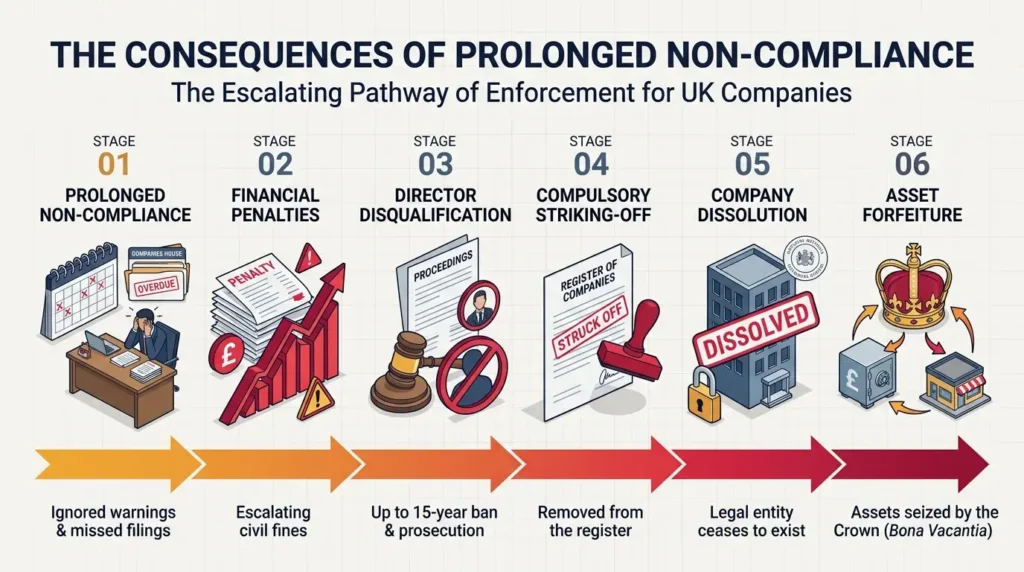
Receive statutory late filing penalties ranging from £150 to £1,500
Incur doubled financial fines for consecutive overdue reporting years
Suffer compulsory striking-off notices published in the official Gazette
Face corporate dissolution and asset forfeiture under bona vacantia
Incur criminal prosecution risks for individual company directors
Statutory financial penalties accumulate automatically when submission deadlines pass. Companies House doubles penalty rates when a company files accounts late in two consecutive financial years. Persistent non-compliance leads to formal enforcement actions against company officers. Directors hold personal legal responsibility for delivering timely statutory returns. Courts enforce disqualification orders lasting up to 15 years for severe reporting failures.
Compulsory striking-off represents the most severe regulatory penalty. The registrar publishes formal warnings in the London Gazette before dissolving non-compliant firms. Upon dissolution, the business entity loses its legal status completely. All corporate bank accounts freeze immediately upon statutory notice publication. Any remaining corporate assets transfer to the state as ownerless property. Restoring a dissolved company requires costly court intervention procedures.
How Can Directors Resolve Overdue Filings Efficiently?
Directors can resolve overdue filings efficiently by auditing public registers, preparing missing accounts, submitting confirmation statements electronically, and settling outstanding penalties. Prompt submission clears administrative holds and restores eligibility for official registry certificates.
Remediating delinquent corporate status demands systematic execution. Directors must inspect the public register to identify specific overdue items. Certified accountants draft financial statements in compliance with UK GAAP standards. Officers compile updated shareholder registers and controller information. Using direct electronic filing channels accelerates processing times significantly compared to paper submissions.
Clearing registry holds requires official processing of all backlog documents. Companies House updates the public record within 24 hours of digital approval. Financial penalties must be settled or payment structures formally arranged. Once the registry confirms compliance, the company regains document eligibility. Engaging professional corporate services speeds up remediation and ensures error-free filing executions. Smart business owners get filings sorted and certificate issued by Form My Company to guarantee seamless compliance management.
Explore More Certificate of Good Standing Guide,
What Is the Difference Between a Notarised and Apostilled Certificate of Good Standing?
How Does Apostille Legalisation Work for a Certificate of Good Standing?
Frequently Asked Questions
What is a Certificate of Good Standing in the UK?
A Certificate of Good Standing is an official Companies House document that confirms a UK company is properly registered, actively operating, and fully compliant with statutory filing requirements. Third parties, such as banks and international registries, frequently require this legal proof before entering into commercial agreements. Businesses can obtain an official copy through Form My Company to verify corporate compliance and identity.
How long does it take to get a Certificate of Good Standing?
Standard processing by Companies House typically takes four to five working days, while express same-day services issue certificates within 24 hours. Delivery timelines depend on whether digital copies or physical hard copies with apostille certification are required. Form My Company expedites the request process to ensure swift delivery of certified corporate documents.
Who can request a Certificate of Good Standing for a UK company?
Anyone can request a Certificate of Good Standing for a registered UK company because public registry records are open to inspection. However, the registrar will only issue the document if the entity’s annual accounts and confirmation statements are completely up to date. Using Form My Company allows business directors and authorized representatives to quickly order verified certificates online.
Why would a company need a Certificate of Good Standing?
Companies need a Certificate of Good Standing to open business bank accounts, apply for foreign trading licenses, secure loans, or establish overseas branches. International authorities and financial institutions request this document to ensure the corporate entity is not facing compulsory strike-off or liquidation. Form My Company assists businesses in securing these documents to fulfill regulatory and commercial due diligence requirements.
What happens if a company has overdue filings when requesting a Certificate of Good Standing?
Companies House automatically rejects requests for a Certificate of Good Standing if a company has overdue annual accounts or late confirmation statements. The business must resolve all outstanding filings and bring its public register record into full compliance before the registrar will issue certification. Form My Company helps business owners rectify overdue filings so they can successfully obtain their certificate.