
Apostille legalisation authenticates a UK Certificate of Good Standing for international acceptance. The UK Foreign, Commonwealth & Development Office verifies the registrar signature, applies an official apostille certificate, and confirms legal authenticity for overseas government agencies, banks, and corporate registries.
What Is a Certificate of Good Standing?
A Certificate of Good Standing is an official Companies House document that confirms a UK company exists legally. It verifies that the business maintains active registration, files annual returns punctually, and faces no pending dissolution or liquidation proceedings.
Companies House issues this official record to verify corporate status. The document lists core company details, including incorporation date, registered office address, and active director names. International authorities require this certificate before permitting UK companies to conduct foreign business operations.
Overseas banks request this official document during corporate account opening procedures. Foreign trade registries examine the certificate before issuing local operating licences. The document proves that a company complies fully with UK corporate governance legislation under the Companies Act 2006.
Foreign officials cannot independently verify public UK corporate registers. Therefore, foreign authorities demand officially certified documentation to establish legal entity existence. An authentic certificate provides legal certainty to overseas counterparts, investors, and regulatory bodies.
Why Do Foreign Authorities Require Apostille Legalisation?
Foreign authorities require apostille legalisation because overseas officials cannot directly verify UK corporate documents. The apostille certificate provides standardized international validation under the 1961 Hague Convention rules, eliminating complex embassy attestation procedures across member countries.
International legal jurisdictions operate under distinct administrative framework rules. A document issued by Companies House carries no automatic legal authority inside foreign territories. The 1961 Hague Apostille Convention establishes a streamlined international authentication process between participating member nations.
The apostille certificate attaches directly to the original UK document. Overseas authorities inspect the certificate to verify official signatures, stamps, and legal capacity. The process prevents cross-border fraud by establishing a clear chain of legal verification.
Foreign registries decline non-legalised corporate filings automatically. International banks freeze corporate application processes without proper apostille authentication. Obtaining an apostille ensures international bodies recognise your UK business credentials without legal delay.
When expanding operations across borders, directors must prepare a Certificate of Good Standing for legalisation abroad to satisfy overseas regulatory requirements efficiently.
Who Issues an Apostille for UK Documents?
The UK Foreign, Commonwealth & Development Office issues official apostilles for UK corporate documents. The Legalisation Office operating within the department verifies official signatures, seals, and solicitor certifications against national reference databases before issuing apostille certificates.
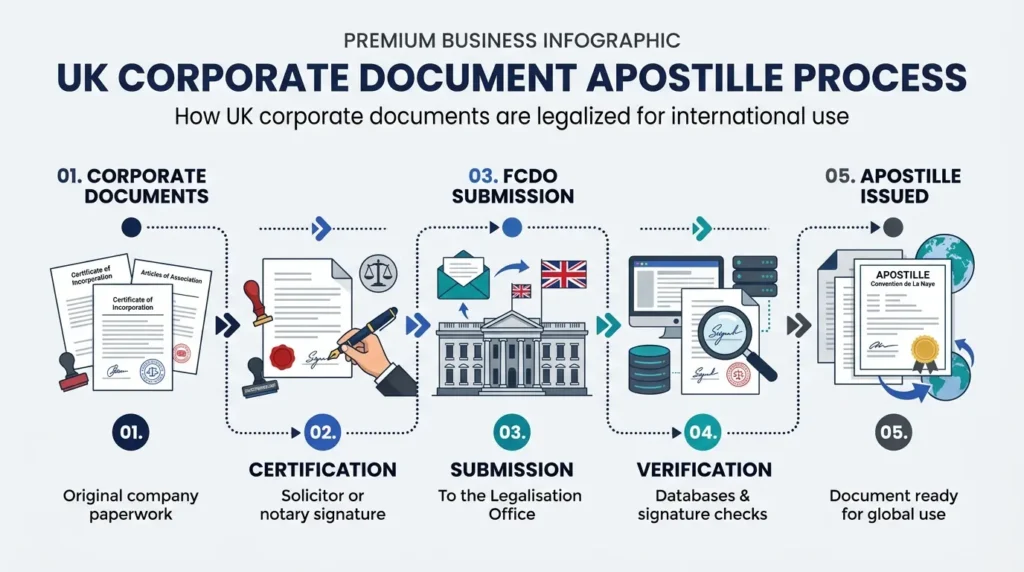
The Foreign, Commonwealth & Development Office serves as the sole competent national authority for UK apostille issuance. The department maintains a secure database containing verified signatures of UK public officials, notary public officers, and qualified solicitors.
Legalisation officers inspect each incoming Certificate of Good Standing meticulously. Officers match the registrar signature against official government records. Once verified, officers permanently attach a paper apostille certificate featuring an official embossed government seal.
The UK authority issues both physical paper apostilles and digital e-Apostilles. Paper apostilles remain the required standard for physical corporate filings abroad. Digital e-Apostilles serve jurisdictions that accept electronically signed PDF legal documents.
Submitting documents directly to government authorities requires strict adherence to submission standards. Proper preparation prevents formal rejection, administrative delays, and extra processing fees during international expansion projects.
What Steps Are Required in the Legalisation Process?
The legalisation process requires four distinct administrative steps: ordering an official certificate, conducting solicitor verification, submitting documents to the government authority, and receiving the final apostilled corporate document for international dispatch.
The legalisation workflow follows a precise regulatory sequence:
Order an official paper certificate directly from Companies House registers
Validate signatures using a registered UK solicitor or notary public
Submit verified documentation to the Foreign, Commonwealth & Development Office
Secure the physical apostille certificate stamped with an official government seal
First, a company obtains an original Certificate of Good Standing printed on official Companies House paper. Digital printouts lack official hand signatures and require preliminary solicitor certification before government processing.
Second, a qualified UK solicitor or notary public reviews the document. The legal professional attests to document authenticity, applies an official seal, and signs the record using verified credentials.
Third, the legalised package transfers to the government Legalisation Office. Officials verify the solicitor credentials, issue the numbered apostille, and log the transaction inside the national registry database.
Finally, the completed apostille document undergoes physical dispatch. Overseas authorities receive the legalised document, verify the online apostille reference number, and process the international business filing.
To streamline international corporate workflows, businesses can request a certified Certificate of Good Standing for abroad with Form My Company to ensure full regulatory compliance.
How Long Does the Apostille Legalisation Process Take?
Standard UK apostille legalisation takes 5 to 10 working days through standard postal channels. Urgent business submissions processed through registered commercial service providers complete legalisation within 24 to 48 hours.
Processing timelines depend on chosen government submission routes. Standard postal submissions face handling backlogs during peak international business cycles. Direct commercial submissions receive priority queuing at government processing centres.
Solicitor verification adds 1 business day to the total timeline. Document transport via international courier services adds 2 to 4 days depending on destination locations. Planning corporate filings in advance prevents critical transaction delays.
Government authorities offer emergency processing for time-sensitive corporate transactions. Urgent filings require verified commercial accounts to access fast-track submission portals. Commercial services expedite validation for cross-border mergers, banking setups, and tender submissions.
Unexpected errors in document formatting extend processing times significantly. Rejections occur when signatures lack official registration or background checks fail. Working with established specialists ensures rapid completion within designated target schedules.
What Is the Difference Between Legalisation and Embassy Attestation?
Legalisation via apostille validates documents between Hague Convention member nations using a single government certificate. Embassy attestation requires additional validation by the destination country’s embassy for non-Hague Convention nations.
The Hague Convention simplifies cross-border document authentication across 125 member countries. An apostille issued in the UK receives immediate legal recognition inside member jurisdictions without secondary approvals.
Non-member nations do not recognise standard apostilles alone. Countries such as the United Arab Emirates, Qatar, and Kuwait enforce multi-tier legalization workflows. These jurisdictions mandate full embassy attestation following initial government legalisation.
The embassy attestation workflow requires three separate operational phases:
Obtain UK government apostille validation from the central authority
Submit apostilled records to the destination nation’s London embassy
Secure final verification stamps from the foreign ministry overseas
Embassy attestation incurs additional consular fees and extends completion schedules by weeks. Identifying target country regulatory requirements early prevents legal compliance failures abroad.
Can Electronic Certificates of Good Standing Be Apostilled?
Electronic Certificates of Good Standing can receive an e-Apostille or physical apostille after solicitor certification. A qualified UK solicitor must verify the electronic PDF document, print a physical copy, and apply a formal certification statement.
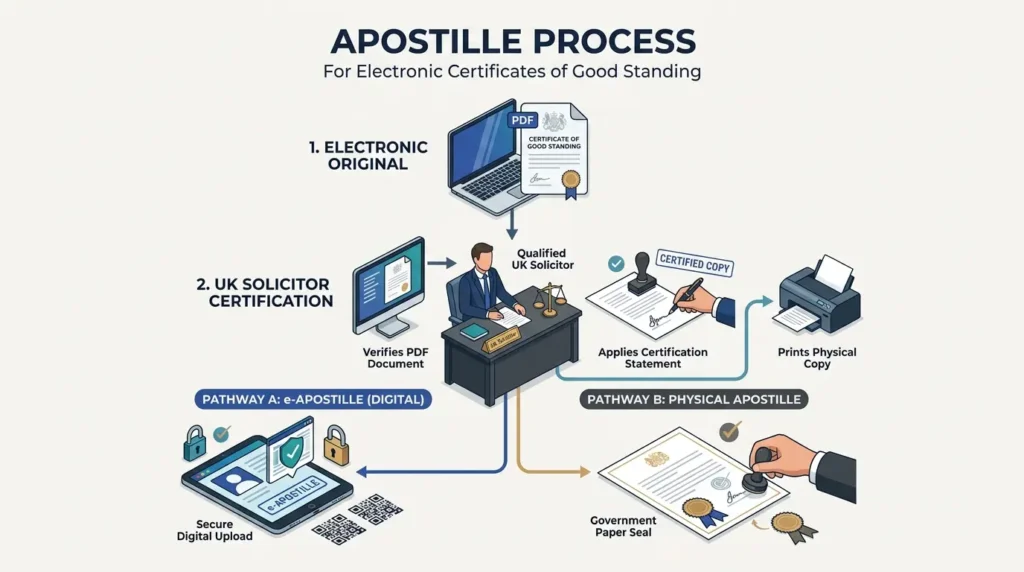
Companies House issues digital certificates in PDF format. The government Legalisation Office cannot apply physical apostilles directly to uncertified electronic documents. Physical apostilles require physical paper documents bearing original ink signatures or official solicitor seals.
A UK solicitor converts digital certificates into legally acceptable physical formats. The solicitor verifies the electronic record against public Companies House databases. After confirming document integrity, the solicitor writes a formal certification statement directly onto the printed page.
The certification statement confirms that the document represents a true and accurate copy of the official electronic record. The solicitor signs, dates, and stamps the page using registered credentials.
Once certified, the document proceeds to the Legalisation Office for standard apostille attachment. Overseas recipients verify the document signature online to confirm international validity.
Selecting a comprehensive Certificate of Good Standing package simplifies document procurement, professional solicitor certification, and government apostille handling under one managed corporate workflow.
How Do Overseas Entities Verify an Issued Apostille?
Overseas entities verify an issued apostille using the UK government online verification service. Authorities input the apostille date and unique certificate number into the official system to confirm issuing details instantly.
The UK government maintains a public online register for apostille verification. Foreign banks, courts, and government officials access the system to validate presented documents. Online verification eliminates cross-border fraud risks completely.
Verifying entities enter the unique apostille number printed on the physical certificate. The system displays matching issuing records, including document creation dates and verifying officer details. Discrepancies signal fraudulent alterations or invalid credentials immediately.
Physical apostilles feature security elements to deter counterfeiting. Papers include watermarks, embossed seals, and tamper-evident adhesives. Removing or transferring an apostille certificate renders the underlying document legally void.
Digital e-Apostilles contain cryptographically secure digital signatures. Recipient institutions verify digital signatures using standard PDF reader validation tools. Instant electronic verification accelerates international commercial transactions.
Proper legalisation ensures smooth cross-border expansion for UK businesses. Form My Company assists corporate clients by coordinating complete document legalisation workflows efficiently. Form My Company manages solicitor certifications and government submissions to guarantee international compliance.
Explore More Certificate of Good Standing Guide,
Why Do Foreign Authorities Require a Legalised Certificate of Good Standing?
How Can You Get a Certificate of Good Standing on the Same Day?
Frequently Asked Questions
How do I get a UK Certificate of Good Standing?
You can order an official UK Certificate of Good Standing directly from Companies House or through a corporate service provider like Form My Company. The document is issued on official paper or as an electronic PDF and requires active company status, compliant annual filings, and no pending dissolution proceedings.
Why do banks require a Certificate of Good Standing?
Overseas banks and financial institutions request a Certificate of Good Standing to verify that a UK company exists legally and operates in full compliance with corporate filing regulations. Form My Company assists businesses in securing this official record to establish legal proof of existence for international corporate bank account applications.
How long is a Certificate of Good Standing valid for?
A Certificate of Good Standing does not have a strict statutory expiration date, but most international banks, courts, and government registries require it to be issued within the last 3 to 6 months. Obtaining an updated certificate through Form My Company ensures foreign authorities receive current, legally compliant proof of active corporate status.
Can an electronic Certificate of Good Standing be apostilled?
Yes, an electronic Certificate of Good Standing can receive an apostille or e-Apostille after a qualified UK solicitor or notary verifies and certifies the document. Form My Company coordinates solicitor verification and Foreign, Commonwealth & Development Office (FCDO) legalisation so electronic certificates are recognized by international bodies.
What is the difference between a Certificate of Good Standing and a Certificate of Incorporation?
A Certificate of Incorporation proves that a company was formed on a specific date, whereas a Certificate of Good Standing confirms that the business currently remains active, solvent, and up to date with Companies House filing obligations. Form My Company provides both certified company documents for businesses expanding into international markets or undergoing overseas compliance checks.