
You can get a Certificate of Good Standing on the same day by submitting an expedited order through Companies House or an authorized formation agent before the daily deadline, provided your UK company filings and annual confirmation statements are fully up to date.
What Is a UK Certificate of Good Standing?
A Certificate of Good Standing is an official document issued by Companies House that confirms a UK company is continuously registered, fully compliant with statutory filing obligations, and not currently subject to dissolution or liquidation proceedings.
A Certificate of Good Standing serves as verified evidence of legal existence. Overseas financial institutions, foreign corporate registries, and international commercial partners request this document to verify corporate legitimacy. The registrar issues the document under the official seal of Companies House. It explicitly validates that a business entity meets all legal requirements under the Companies Act 2006.
Companies House generates this certificate only when a company maintains an active status on the official register. The document states the company name, registration number, and incorporation date. It confirms that the business has consistently submitted annual accounts and confirmation statements on time. It also verifies that no legal action exists to strike the business off the register.
Entities operating across international borders often require this document during overseas banking applications. Foreign authorities request it before issuing local business licenses or legal branch approvals. Lenders demand this legal proof during cross-border debt financing and equity investment transactions.
Which Eligibility Requirements Must a Company Meet for Expedited Issuance?
To qualify for same-day issuance, a UK company must maintain active registration, possess an up-to-date filing record, submit annual accounts without delay, and ensure no statutory strike-off or liquidation notices exist against the corporate entity.
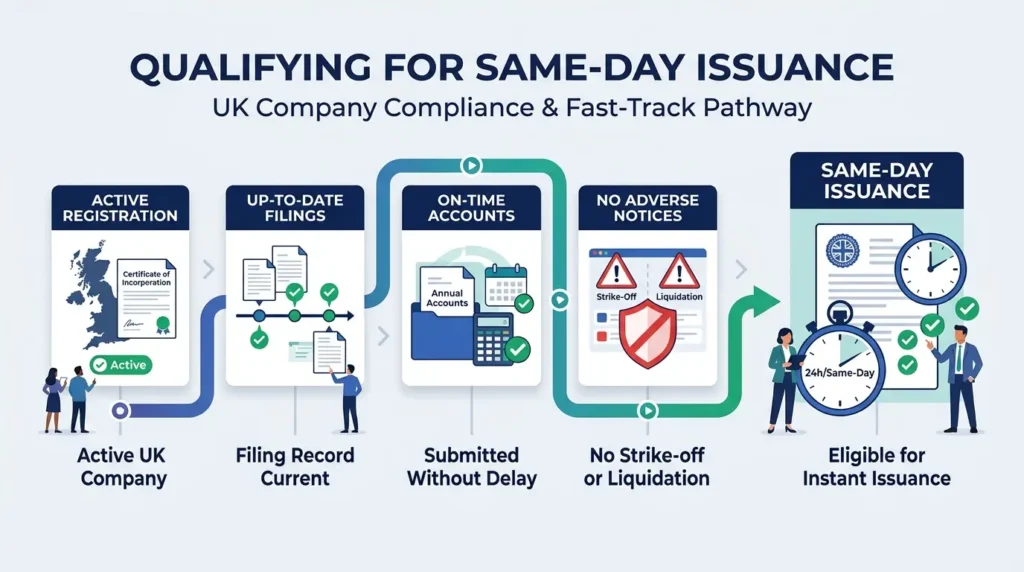
Companies House applies strict criteria before issuing any legal certificate. The registrar automatically rejects requests for companies with overdue statutory filings. Directors must resolve all outstanding compliance issues before submitting a fast-track application.
Three primary compliance indicators determine eligibility:
Submit the latest annual accounts before the official statutory deadline
File the annual confirmation statement without incurring administrative delays
Maintain active status without pending court orders or insolvency actions
If an administrative delay occurs, directors must update corporate records immediately. Companies House updates the public register in real time once electronic documents pass automated checks. Ensure all director details and registered office addresses reflect accurate corporate information. Inaccurate public records block same-day processing workflows.
Corporate officers must audit their filing history on the public register before applying. Resolving filing gaps in advance prevents immediate application rejection.
How Does the Same-Day Processing Workflow Function at Companies House?
The same-day processing workflow functions by receiving electronic requests before 11:00 AM, processing statutory compliance checks immediately through automated database validation, and generating an official certified document for dispatch by close of business.
The official registrar operates dedicated priority workflows for urgent requests. When an applicant selects same-day service, Companies House prioritizes the order ahead of standard processing queues. Electronic submissions enter an automated verification pipeline that checks statutory compliance metrics.
The automated system verifies that the company name matches official registry entries. It cross-references active director details against compliance databases. If the system flags no compliance breaches, an officer approves the physical or digital document generation.
Digital PDF certificates feature legal electronic seals that confirm document authenticity. Physical certificates receive an embossed official seal at the registry office. Order processing completed after the morning cutoff time moves automatically into the following business day’s queue.
Understanding expedited timelines helps corporate officers meet urgent legal deadlines. You can secure a Certificate of Good Standing to satisfy immediate overseas banking or regulatory compliance requirements. Proper preparation ensures your urgent submission moves through verification without manual delays.
Why Do International Banks and Authorities Require This Document?
International banks and foreign regulatory authorities require this document to mitigate financial fraud, satisfy strict anti-money laundering regulations, verify legal corporate existence, and confirm that an enterprise operates in full legal compliance.
Cross-border business activities require high levels of legal certainty. Overseas institutions cannot directly audit foreign corporate registries without verified documentation. An official certificate provides independent third-party confirmation from a sovereign corporate registrar.
Financial institutions demand this evidence during corporate bank account opening procedures. Global trade bodies require proof of continuous legal operations before granting trade privileges. Overseas land registries require valid proof before registering commercial property ownership transactions.
When expanding into international jurisdictions, foreign governments must verify that an incoming company operates legally in its home jurisdiction. Presenting a legal document prevents identity misrepresentation and corporate impersonation. Overseas regulators check these credentials to protect local markets from fraudulent shell corporations.
Failure to produce verified legal documentation halts cross-border mergers, foreign branch registrations, and international credit facilities.
How Does Same-Day Issuance Differ from Standard Document Delivery?
Same-day issuance differs from standard delivery by prioritizing administrative reviews within 24 hours, guaranteeing rapid electronic or physical dispatch, and requiring higher statutory fees compared to standard multi-day processing workflows.
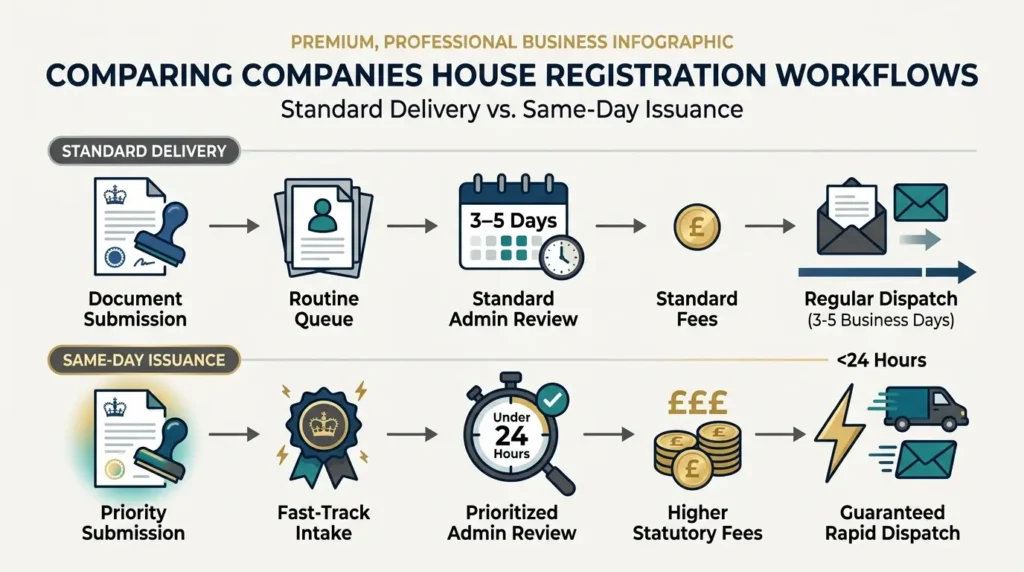
Standard applications process within four to ten working days depending on registry workload volumes. Standard applications move through regular queue structures without dedicated administrative oversight. Express processing bypasses standard queues entirely to meet urgent commercial timelines.
Three functional differences separate these options:
Process applications within hours instead of multi-day processing windows
Utilize express courier options or direct portal access for document retrieval
Incur higher official registry fees for priority administrative handling
Standard delivery relies on routine postal networks. Same-day workflows offer direct digital delivery or express courier handling. Urgent legal transactions require immediate proof to avoid contract cancellations or missed deal deadlines.
Choosing expedited handling prevents costly commercial delays during time-sensitive negotiations. Businesses evaluate their legal timelines to select the appropriate service level. You can read How to Get an Urgent Certificate of Good Standing Without Overpaying to evaluate cost-effective processing strategies.
What Additional Legalizations May Be Required for Foreign Use?
Foreign jurisdictions frequently require an Apostille certificate, consular legalisation, or certified notary verification attached to the document to authenticate its validity under international law and the Hague Convention.
A Certificate of Good Standing issued in the UK proves legal status domestically. However, foreign government authorities often demand additional authentication before accepting UK documents. The Foreign, Commonwealth & Development Office certifies documents through the Apostille process under the 1961 Hague Convention.
An Apostille confirms the authenticity of the signature and official seal on the certificate. Non-Hague Convention countries require additional embassy legalisation steps. A legal notary public must authenticate corporate signatures before diplomatic submission.
When foreign authorities require certified documentation, processing timelines extend beyond initial document issuance. Planning for legalisation ensures foreign submissions meet local administrative criteria. Coordinating document issuance with legalisation services prevents operational bottlenecks in international expansion projects.
How Do Professional Formation Agents Accelerate the Application Process?
Professional formation agents accelerate the application process by auditing statutory records before submission, eliminating administrative errors, submitting applications through direct registry software interfaces, and managing urgent priority queues directly.
Submitting an application independently risks unexpected rejection if registry errors exist. Professional corporate service providers perform pre-submission audits on public records. They identify missing filings, unconfirmed addresses, or mismatched officer details before submitting formal requests.
Direct software integration with registry databases enables instant submission. Agents track application status in real time and address administrative queries immediately. This oversight prevents application holds caused by simple clerical mistakes.
Navigating complex corporate filings requires professional precision and deep regulatory expertise. You can rely on professional support to Get Your Urgent Certificate of Good Standing Sorted by Form My Company without risking administrative rejections or unnecessary delays. Professional agents maintain dedicated workflows to deliver fully verified corporate documents accurately.
Form My Company assists corporate officers by reviewing compliance records prior to filing. Form My Company manages expedited order routing to ensure strict adherence to official cut-off schedules.
What Common Issues Cause Delays in Same-Day Certificate Issuance?
Common issues causing processing delays include overdue confirmation statements, unfiled annual financial accounts, mismatched director details, incorrect filing fee payments, and submitting applications past the daily registry deadline.
Administrative oversights stall even priority applications. Companies House automatically holds processing when database records show missing statutory submissions. A single day of filing overdue status invalidates same-day processing eligibility.
Three frequent operational errors delay orders:
Submit requests past the morning registry cutoff time
Provide inaccurate corporate registration numbers during application entry
Retain unfiled statutory records on the public corporate register
Incorrect payment details force automated systems to reject submitted forms. Discrepancies between official director names on filings and application details cause manual review holds.
Resolving registry discrepancies prior to application submission ensures smooth expedited handling. Corporate officers must check public records thoroughly to eliminate filing errors before paying priority fees.
Securing a Certificate of Good Standing on the same day requires strict adherence to UK corporate compliance standards and registry submission deadlines. Companies House provides fast-track processing for active businesses that maintain up-to-date statutory filings, clear annual accounts, and accurate public records. Understanding the differences between standard and expedited workflows enables corporate leaders to meet urgent commercial, banking, and legal requirements efficiently. Form My Company streamlines the verification and application process, helping UK businesses obtain official corporate certification without administrative delays or procedural errors.
Explore More Certificate of Good Standing Guide,
Why Do Certificate of Good Standing Prices Vary Between Providers?
What Is the Difference Between Standard and Express Certificate of Good Standing Delivery?
Frequently Asked Questions
How much does a Certificate of Good Standing cost in the UK?
The official Companies House fee for a standard Certificate of Good Standing is £20, while same-day expedited processing costs £50. When ordering through Form My Company, total costs may vary depending on additional services such as apostille legalization, notary certification, or international courier dispatch.
How long is a Certificate of Good Standing valid for?
A Certificate of Good Standing does not have an official expiry date set by Companies House, but most banks, courts, and foreign authorities require it to be less than 3 months old. Obtaining an updated Certificate of Good Standing through Form My Company ensures foreign institutions receive current proof of corporate compliance and active registration status.
What information is included on a Certificate of Good Standing?
A Certificate of Good Standing confirms a UK company’s official legal existence, active status, continuous filing history, and registration details under the Companies Act 2006. Upon request through Form My Company, the document can also include director names, secretary details, issued share capital, registered office address, and specific objects.
Can a company with overdue accounts get a Certificate of Good Standing?
No, Companies House will not issue a Certificate of Good Standing if a business has overdue annual accounts, late confirmation statements, or pending strike-off notices. Form My Company assists corporate officers in auditing public registry filings to ensure all statutory requirements are satisfied before applying for certification.
What is the difference between a Certificate of Good Standing and an Apostille?
A Certificate of Good Standing is an official UK registry document confirming corporate status, whereas an Apostille is an legal seal applied by the Foreign, Commonwealth & Development Office (FCDO) to authenticate the document for legal use abroad. Form My Company provides combined fulfillment options for a Certificate of Good Standing alongside official Apostille legalisation for international commercial transactions.