
What if the UTR number you’re searching for belongs to your company, not you? It’s an easy mix-up: individuals and limited companies can have separate UTRs, and neither is the same as a company registration number or VAT number.
The right UTR depends on who is filing. Your personal UTR is used for Self Assessment, while a company UTR relates to Corporation Tax. If you’re a director, you may need to keep track of both.
This guide explains which type of UTR applies to you, where to look for one you already have, and what to do if it’s missing. It also explains how a company UTR fits into the steps after incorporation, without confusing it with the documents that establish your company.
Key Takeaways
- Identify whether you need a personal UTR for Self Assessment or a company UTR for Corporation Tax.
- Distinguish a UTR from a Companies House registration number and a VAT registration number.
- Find out where to look for your utr number, including relevant HMRC correspondence and online accounts.
- Follow a practical recovery sequence if your UTR is missing, starting by confirming whose reference you need.
- Understand how a company UTR fits into the administrative steps after incorporation.
What is a UTR number, and why might you need one?
A UTR is a tax identifier, not a general company number. HMRC uses it to match tax returns, payments and correspondence to the right taxpayer, whether that taxpayer is an individual or a limited company.
A Unique Taxpayer Reference (UTR) is a 10-digit number HMRC uses to identify a taxpayer’s record for tax administration. The reference may belong to you personally or to your company. It identifies a tax record, but it does not prove that a company has been incorporated or that tax obligations have been met.
You may be asked for a UTR when dealing with a tax return or HMRC communication. Before providing one, check who the request concerns and which tax matter it relates to. A personal UTR is not a substitute for a company UTR, or the other way round.
What does UTR stand for in the UK?
UTR stands for Unique Taxpayer Reference. HMRC uses it to distinguish one taxpayer’s record from another and administer matters such as Self Assessment or Corporation Tax. “Unique” refers to the record it identifies; a UTR is not a general-purpose identity document. A company’s incorporation details and its tax reference serve different administrative purposes.
Keep the number with your tax records and use it when HMRC requests it for the relevant tax matter. If a message or form asks for a reference, check which person or organisation it concerns before entering your details. Clear labels on personal and company records make it easier to use the right number.
Who may need a personal or company UTR?
Individuals who deal with Self Assessment may need their personal UTR for tax returns and related HMRC administration. This can include people who are self-employed or have other income to report through Self Assessment. The reference belongs to the individual’s tax record.
Limited companies have a separate company UTR for Corporation Tax matters. A director who also files a personal Self Assessment return may therefore need to keep track of two distinct references. Which one applies depends on the taxpayer and the tax matter being handled.
For example, use the UTR associated with your individual tax record for a personal Self Assessment return. For a limited company’s Corporation Tax, use the company’s reference. A UTR number identifies a specific tax record, so don’t substitute one identifier for another simply because you’re connected to both.
Personal UTR vs company UTR: which number applies to you?
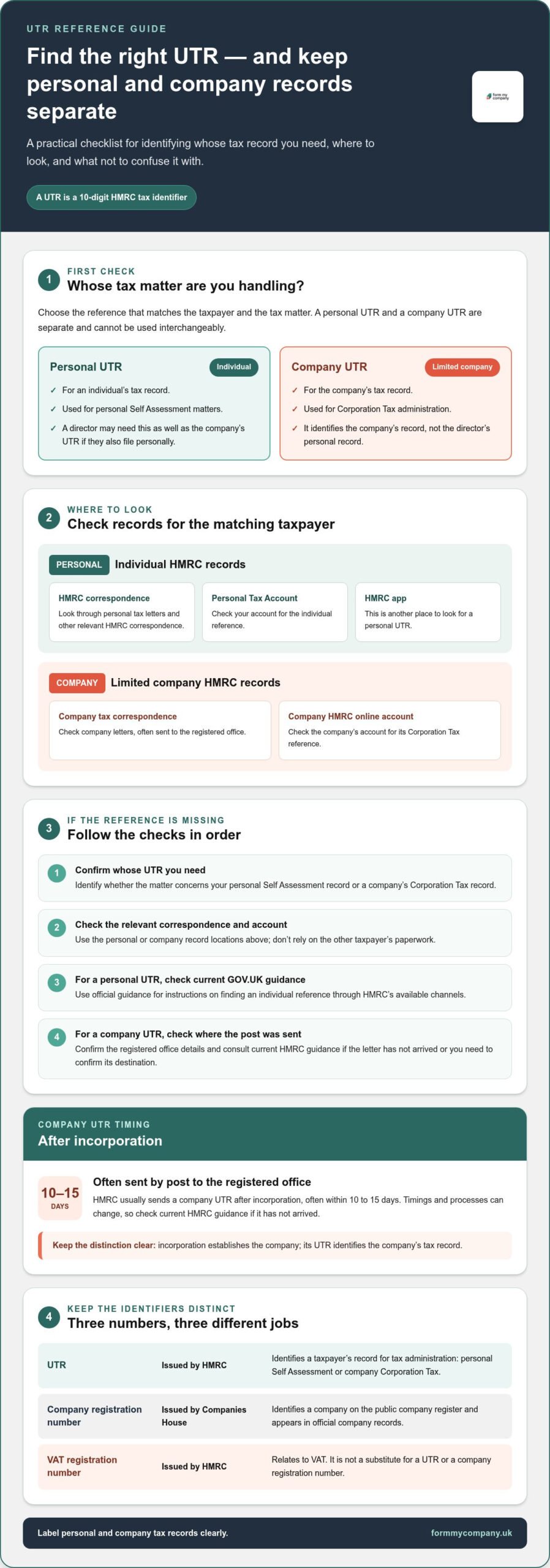
The key distinction is whose tax record HMRC is dealing with. An individual’s personal UTR is used for their Self Assessment tax affairs; a limited company’s UTR relates to its Corporation Tax administration. If you’re a director who also files a personal return, you may need both. These are separate references and are not interchangeable.
| Comparison | Personal UTR | Company UTR |
|---|---|---|
| Relates to | An individual taxpayer | A limited company |
| Used for | Self Assessment tax matters | Corporation Tax administration |
| Where to look | Personal HMRC correspondence, your Personal Tax Account or the HMRC app | Company tax correspondence, often sent to the registered office, or the company’s HMRC online account |
When is a personal UTR relevant?
A personal UTR is relevant when you deal with HMRC about your individual Self Assessment record, for example when submitting a return. Not everyone has to file a Self Assessment return, and owning or directing a company doesn’t automatically mean you need to file one personally. Your company’s tax affairs remain separate from your own. Check the current official GOV.UK guidance on UTR numbers for instructions on finding an individual reference through HMRC’s available channels.
When is a company UTR relevant?
A company UTR is used for a limited company’s Corporation Tax matters. It identifies the company’s tax record, not the director’s personal record. HMRC usually sends a company UTR by post to its registered office after incorporation, often within 10 to 15 days. If it hasn’t arrived or you need to confirm where it was sent, check current HMRC guidance, as timings and processes can change.
Company formation and tax administration are connected, but they’re distinct steps. Incorporation establishes the company; its UTR is used for the company’s tax record. If you’re preparing to set up a UK company, explore the available company formation packages as part of planning the administrative steps that follow.
UTR vs company registration number vs VAT number
A UK business may have several reference numbers, each used for a different part of its administration. A UTR relates to tax records, a company registration number identifies a company on the Companies House register, and a VAT registration number relates to VAT. They are not substitutes for one another.
| Identifier | Issued by | Purpose | Typical context |
|---|---|---|---|
| UTR | HMRC | Identifies a taxpayer’s record for tax administration | Individual Self Assessment or a company’s Corporation Tax |
| Company registration number | Companies House | Identifies a company on the public company register | Company incorporation and official company records |
| VAT registration number | HMRC | Identifies a business registered for VAT | VAT returns and other VAT-related administration |
How is a UTR different from a company registration number?
HMRC administers tax records, while Companies House maintains the company register. A UTR is used for a taxpayer’s tax matters; a company registration number identifies the incorporated company. The numbers have different roles, even when both relate to the same limited company.
For example, a supplier’s form might request a company registration number to identify the legal entity, while an HMRC Corporation Tax matter requires the company’s UTR. Use the reference that matches the organisation and purpose stated on the form. One cannot stand in for the other.
How is a UTR different from a VAT number?
A VAT registration number identifies a business for VAT administration. A UTR identifies a taxpayer’s HMRC tax record, which may relate to Self Assessment or Corporation Tax. A business may hold both, but having one doesn’t make it interchangeable with the other. VAT registration and Corporation Tax are distinct administrative matters.
Keep the identifiers clearly labelled in your company records. If you’re asked for a VAT number, provide the VAT reference rather than a UTR or Companies House number. Form My Company offers VAT registration assistance to support this separate administrative process.
Use the context of the request as your guide: Companies House matters generally concern the company registration number, tax matters may require a personal or company UTR, and VAT-related tasks call for the VAT registration number. Checking the purpose before sharing a reference helps prevent mix-ups and keeps each administrative record connected to the right identifier.
How to find or recover a UTR number
Start by confirming whose tax record you need. A personal UTR belongs to an individual’s Self Assessment record; a company UTR relates to a limited company’s Corporation Tax. The recovery route depends on which reference is missing.
- Identify the taxpayer. Decide whether the reference is for you personally or for a company. If you’re a director who handles both personal and company tax, keep the searches separate.
- Check previous HMRC correspondence. Look through letters and notices about the relevant tax matter. For an individual, check Self Assessment correspondence and previous tax returns. For a company, look for Corporation Tax letters sent to its registered office.
- Check the appropriate online account. Individuals can look in their Personal Tax Account or the HMRC app. For a company, check its HMRC online tax services and Corporation Tax records, if available. Account screens and features can change, so follow the current instructions rather than assuming every account displays the number in the same place.
- Follow HMRC’s recovery guidance if it’s still missing. Use the route for the individual or company concerned, and provide information through the official process to help HMRC identify the correct tax record. The GOV.UK guidance on finding a UTR sets out current instructions. Follow the latest guidance rather than relying on old advice or saved contact details.
Where to look for an existing UTR
For a personal reference, search your HMRC letters, notices and Self Assessment paperwork, then check your Personal Tax Account or the HMRC app. For a company reference, review its Corporation Tax correspondence and relevant company tax account records. Don’t assume the reference will appear on incorporation documents or that every letter about a company includes it.
What to do if the UTR is still missing
Use HMRC’s current instructions for the correct taxpayer. Have relevant details to hand, such as information about the individual or company connected to the tax record, and enter them only through an official HMRC channel. HMRC no longer provides UTRs over the phone. Individuals should use their online Personal Tax Account or the HMRC app, or follow the postal option in HMRC’s guidance if they can’t use digital services. Postal requests may involve security checks and take time.
If you can’t find a UTR, first identify whether it belongs to you or your company, then follow HMRC’s official recovery guidance for that tax record. Never send the number in response to an unexpected email, text or call, or enter it on a site unless you’ve verified that the channel is genuine. Treat requests for tax identifiers with care.
If you’re setting up a company and organising the administration that follows incorporation, explore Form My Company’s company formation packages.
Starting a UK company: where its UTR fits into the next steps
Incorporation is the starting point, not the end of a company’s administration. Once Companies House registers the company, keep its incorporation records together and follow the HMRC steps relevant to its tax affairs. The company UTR belongs to those tax records, but it isn’t an incorporation document, and formation doesn’t by itself complete every tax registration or filing requirement.
What company formation does and does not establish
Companies House incorporation creates the registered company and provides its company registration details. HMRC tax records serve a different purpose: a company UTR identifies the company for tax administration. In short, incorporation establishes the legal company, while HMRC’s tax processes establish and administer its tax record.
Keep those documents distinct. If a form asks for the company registration number, use the Companies House identifier; if it concerns Corporation Tax, follow the request for the company’s HMRC tax details. A director’s personal tax information also remains separate from the company’s records.
Keep company tax administration organised
Set up a secure place for company records from the outset. Keep Companies House documents, HMRC letters and tax account details together, with clear labels so you can find the right reference for each matter. Make sure the people responsible for company administration know where official correspondence is received and how it is stored.
After incorporation, read HMRC’s instructions and act on the steps that apply to the company’s circumstances. Don’t assume the company UTR arrives with the incorporation documents, or that receiving a UTR means every tax obligation has been completed. If a letter or reference hasn’t arrived, use current HMRC guidance to work out what to do next rather than relying on an assumed timetable.
VAT is a separate area of administration. A company’s UTR doesn’t register it for VAT, and VAT records shouldn’t be confused with Corporation Tax records. Where VAT registration is relevant, treat it as its own process and keep the resulting information with the company’s other tax documents. Deadlines and requirements can depend on the specific tax matter, so use up-to-date official guidance for process-specific decisions.
A clear sequence helps: incorporate with Companies House, organise the company’s records, then follow the relevant HMRC tax steps and store the correspondence safely. As you prepare to establish a business, explore UK company formation packages and plan how you’ll manage the administrative tasks that follow. Keep each identifier matched to the organisation and tax matter it belongs to.
Set up your company with the next steps in mind
Starting a company is easier to manage when you build good admin habits from day one. Set aside a secure place for official correspondence, keep personal and company records separate, and note the HMRC tasks you need to review as your business develops. That way, a missing UTR number or a new tax notice becomes a task you can handle methodically, rather than a disruption to your plans.
Choose a formation route that suits how you want to get started. Form My Company supports UK company formation and related administration, with options including a Digital Package. Good preparation gives you a clearer path from incorporation to the practical work of running your company, without treating formation as the finish line.
Explore Form My Company’s UK company formation packages and take a confident first step towards getting your business established.
Frequently Asked Questions
Is a UTR number the same as a company registration number?
No. A UTR number is used for HMRC tax administration, whereas a company registration number identifies a limited company on the Companies House register. A bank or supplier may request the company registration number to identify the business, while a Corporation Tax form may ask for its UTR. Check what the form is for before entering a number, especially if it accepts more than one type of reference.
Can a company director use their personal UTR for the company?
No. A director’s personal UTR relates to their own tax affairs and isn’t a substitute for the company’s UTR on Corporation Tax matters. If a director also completes a personal Self Assessment return, they may need their personal reference for that separate task. Keep both records clearly labelled, and check whether HMRC’s request concerns you as an individual or the company.
How many digits are in a UK UTR?
A UK UTR has 10 digits. If you’re checking a letter or tax record, count the digits and make sure you’re looking at the right taxpayer’s reference. Don’t confuse it with a National Insurance number, which has a different format, or with a company registration number or VAT registration number. Avoid posting a UTR publicly, even when asking whether a document looks genuine.
What happens if I have lost my UTR number?
If you’ve lost your UTR, look for it in earlier HMRC correspondence, relevant tax paperwork or the appropriate HMRC online account. First establish whether you need your personal reference or one belonging to a company, then follow the current HMRC recovery instructions for that record. HMRC no longer gives UTRs over the phone; use its official online or postal guidance instead.
Do I get a UTR when I register a limited company?
Companies House incorporation and HMRC’s tax administration are connected, but they’re separate processes. HMRC usually sends a company UTR to the registered office after incorporation, rather than including it as a Companies House registration detail. Watch for HMRC correspondence and keep it with the company’s records. If it hasn’t arrived, use current HMRC guidance to work out what action is appropriate; don’t assume a delivery date.
Is a UTR the same as a VAT number?
No. A UTR identifies a taxpayer’s record for HMRC tax administration, while a VAT registration number is used for VAT-related matters. A company may have both references, but one doesn’t replace the other. For instance, a VAT return concerns the VAT registration, while a Corporation Tax matter relates to the company’s tax record. Match the number you provide to the specific form or request.
Can I find my UTR online?
Yes, individuals can check their Personal Tax Account or the HMRC app for their personal UTR. If you’re looking for a company’s reference, check its Corporation Tax correspondence and relevant HMRC online tax records. Account features and recovery instructions can change, so use HMRC’s current guidance if the number isn’t visible. Sign in only through an official HMRC service, not a link in an unexpected message.