
To prepare a Certificate of Good Standing for legalisation abroad, request an official document from Companies House, verify director details, obtain an apostille from the UK Foreign, Commonwealth & Development Office, and complete embassy attestation when required by target jurisdictions.
What Is a Certificate of Good Standing in the UK?
A Certificate of Good Standing is an official state document issued by Companies House confirming that a UK registered company exists continuously and has met all statutory filing requirements under the Companies Act 2006 without facing dissolution.
Companies House acts as the central executive agency regulating corporate entities across England, Wales, Scotland, and Northern Ireland. The registrar issues this formal legal document to verify administrative compliance. Foreign authorities require this certificate before approving international expansion, foreign bank account opening, or joint venture registrations. Overseas regulatory bodies inspect the document to ensure the UK entity maintains active registration and updated statutory registers.
The certificate incorporates official company details extracted directly from the public register. These details include the registered legal name, official incorporation date, and full company registration number. The document confirms that the business files annual confirmation statements promptly. It also validates that all required financial accounts are submitted according to statutory deadlines.
Administrative standing depends entirely on continuous regulatory compliance. A company maintaining good standing has no pending striking-off actions or insolvency proceedings initiated by external creditors. Overseas financial institutions demand this proof to manage cross-border compliance risks. Incorporating accurate details prevents regulatory delays when submitting corporate filings to foreign registries.
Why Do Foreign Authorities Require Corporate Document Legalisation?
Foreign authorities require corporate document legalisation to verify the authenticity of UK signatures, official stamps, and registrar seals before granting local legal validity to foreign corporate entities operating within their legal jurisdictions.
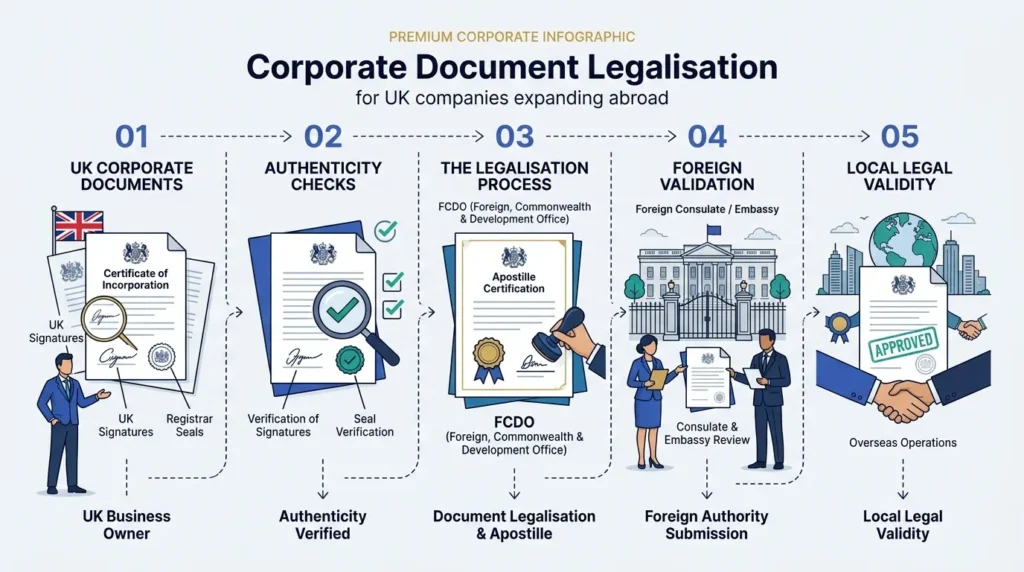
International legal cross-border transactions require official validation under international law standards. Public officials in overseas jurisdictions cannot directly verify UK legal signatures or administrative seals. Legalisation bridges this jurisdictional gap by establishing formal document authenticity through recognized diplomatic channels.
When expanding operations across borders, overseas registries require verified documentation. Local authorities evaluate company legitimacy before issuing commercial trading licenses. Foreign commercial banks mandate legalised corporate documents during mandatory customer due diligence procedures. International courts demand authenticated corporate credentials when accepting legal representation filings.
The Hague Apostille Convention streamlines cross-border authentication processes among participating member nations. Non-signatory nations require full diplomatic legalisation through embassy protocols. Failing to complete legalisation prevents UK entities from conducting valid transactions abroad. Proper authentication ensures international administrative filings remain legally enforceable across sovereign boundaries.
Which Initial Verification Steps Precede Official Document Ordering?
Initial verification steps require auditing current Companies House records, settling outstanding compliance penalties, confirming active director appointments, and verifying that the target jurisdiction accepts standard digital certificate formats prior to formal ordering.
Before requesting documentation, corporate officers must perform a comprehensive audit of current filings. The company register must accurately reflect active director names and secretary details. Registered office addresses must match current operational locations. Any discrepancies in statutory registers halt document generation or invalidate overseas legalisation attempts.
Companies House refuses certificate issuance when statutory filings are overdue. Directors must submit pending annual confirmation statements immediately. Outstanding financial statements or unpaid administrative penalties cause automatic request rejections. Correcting public records ensures the registrar generates a clean certificate showing uninterrupted compliance history.
Overseas destination requirements dictate specific document ordering criteria. Certain foreign jurisdictions require physical paper certificates bearing wet-ink signatures from official registrars. Other authorities accept digital certificates bearing certified electronic signatures. Verifying recipient requirements prevents costly reissuance procedures during diplomatic authentication.
How Do You Obtain an Official Certificate of Good Standing from Companies House?
You obtain an official Certificate of Good Standing by submitting a formal request through Companies House online services or utilizing professional company formation agents to secure certified paper copies bearing official registrar seals.
Companies House provides online portal services for ordering standard corporate certificates. Applicants select specific information inclusions required by foreign authorities. These inclusions often encompass active director lists, secretary details, objects clauses, and registered office addresses. Selecting specific inclusions aligns the certificate with foreign administrative mandates.
Standard processing times range between three to five working days. Express service options expedite document generation for time-sensitive commercial transactions. When ordering through standard portals, officers receive digital PDF copies or standard paper documents dispatched via mail. Express dispatches ensure rapid delivery to legal representatives handling downstream authentication steps.
Businesses requiring rapid international document preparation rely on specialized corporate service providers. Organizations utilize a dedicated Certificate of Good Standing service to manage official procurement, ensure correct information inclusions, and expedite physical handling for legalisation. Professional management eliminates administrative errors during initial document procurement.
What Role Does a UK Public Notary Play in Document Authentication?
A UK public notary verifies document authenticity, administers official declarations, certifies copies of original certificates, and attaches a formal notarial certificate required before applying for an apostille from the FCDO.
Public notaries function as independent legal officers recognized internationally under common law principles. Notaries verify the legal status of signatures appearing on legal paperwork. When handling corporate certificates, the notary confirms that the document originates directly from the official registrar.
The notary executes a formal notarial certificate bound securely to the corporate document. This certificate contains the notary’s official seal, signature, and formal registration details. Overseas authorities require this primary verification step to validate legal signatures before state department certification.
Certain jurisdictions permit certified notarised copies, while others mandate original notarised filings. Notaries confirm that corporate representatives executing foreign contracts possess valid power of attorney authorization. Completing precise notarial certification prevents immediate rejection at subsequent foreign ministry processing offices.
How Does the Foreign, Commonwealth & Development Office Issue an Apostille?
The Foreign, Commonwealth & Development Office issues an apostille by verifying notary signatures or official registrar seals, affixing an official paper certificate, and registering the legalisation within the UK central verification database.
The Legalisation Office within the FCDO operates as the sole competent authority for issuing apostilles in the United Kingdom. Applicants submit physical corporate documents accompanied by formal legalisation applications. Staff members verify the official seal against central signature databases.
When evaluating document legalisation requirements, corporate managers review How Does Apostille Legalisation Work for a Certificate of Good Standing? to understand the precise administrative progression, FCDO verification criteria, and expected turnaround schedules. The apostille confirms signature authenticity without certifying the underlying content of the corporate document.
Upon successful verification, the FCDO affixes a physical apostille certificate directly to the rear of the notarised document. This certificate bears a unique identification number, government impression seal, and official state signature. Foreign authorities verify this unique serial number online to confirm document legitimacy.
When Is Foreign Embassy Attestation Mandatory for International Use?
Foreign embassy attestation is mandatory when the target country is not a signatory to the Hague Apostille Convention, requiring secondary authentication from the recipient nation’s diplomatic mission within the UK.
Non-Hague Convention jurisdictions do not accept an apostille as final legalisation. These nations enforce additional consular authentication steps before recognizing foreign public documents. The target country’s UK embassy or consulate performs this secondary validation layer.
Consular officials review the FCDO apostille and verifying signatures. Embassy staff affix official diplomatic stamps, consular seals, and fee vouchers onto the document. Certain embassies require certified Arabic or regional language translations prior to completing consular attestation.
Embassy fees, processing times, and submission protocols vary significantly between diplomatic missions. Consulates require supporting corporate documents, including director passports and commercial power of attorney forms. Completing embassy attestation provides full legal validity for corporate operations within non-Hague nations.
What Are the Most Common Pitfalls During International Document Legalisation?
The most common pitfalls include submitting expired certificates, omitting required administrative clauses, using unverified translation services, and failing to confirm target country legalisation protocols prior to document submission.
Foreign authorities reject corporate documentation that exceeds strict age limitations. Most foreign commercial banks require certificates issued within 30 to 90 days of presentation. Submitting older certificates results in immediate transaction halts and requires complete re-procurement.
Omitting specific administrative clauses causes frequent regulatory rejections abroad. Foreign registries demand explicit statements confirming operational objects clauses or director details. Ordering basic certificates without verifying recipient criteria forces business owners to re-order modified documents from Companies House.
Using uncertified translators invalidates legalised documents in foreign jurisdictions. Official language translations must be executed by certified legal translators and verified by public notaries. Failing to align translation steps with embassy guidelines creates expensive administrative delays.
How Can Form My Company Streamline Your Corporate Legalisation Process?
Form My Company streamlines corporate legalisation by handling official procurement, notary certification, FCDO apostille processing, and embassy attestation through a single managed service.
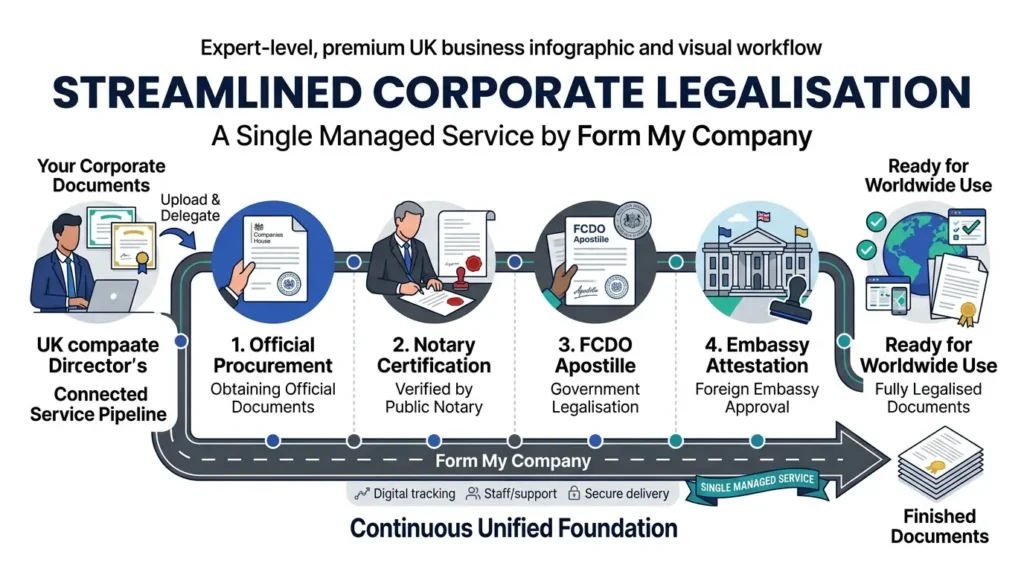
Navigating multi-tiered legalisation procedures requires precise coordination across government agencies, notaries, and foreign embassies. Administrative errors at any stage delay international expansion plans and increase legal expenses. Professional corporate service management ensures full compliance with international standards.
Businesses seeking seamless international document preparation can Request a Certified Certificate of Good Standing for Abroad With Form My Company to eliminate administrative complexity, secure rapid FCDO processing, and ensure full compliance across global jurisdictions. Expert oversight guarantees document acceptance by foreign registries and financial institutions.
Form My Company coordinates every stage of the legalisation workflow directly with official authorities. Managed processing reduces total turn-around times from weeks to days. Dedicated support ensures corporate documents comply fully with destination country rules.
What Final Verification Steps Ensure Acceptance in the Target Jurisdiction?
Final verification steps require checking document validity dates, confirming complete translation attachments, verifying embassy stamp integrity, and submitting certified physical copies to local foreign legal counsel.
Before dispatching legalised paperwork abroad, compliance teams must inspect physical document assemblies. Legalisation seals, notary ribbons, and apostille pages must remain permanently attached without damage. Removing staples or separating attached pages immediately invalidates official legalisation status.
Local foreign legal counsel should review digital scans prior to physical submission. Foreign attorneys verify that notary declarations match local court presentation standards. Confirming structural integrity prevents document rejections during formal foreign registry submissions.
Maintaining digital backup archives ensures rapid tracking of cross-border legalisation records. Corporate entities maintain permanent records of all historical apostille numbers and consular reference receipts. Structured record-keeping simplifies future corporate governance audits across international subsidiaries.
Explore More Certificate of Good Standing Guide,
How to Choose Between an Apostille and Standard Certificate of Good Standing
Apostille vs Notarisation for a Certificate of Good Standing: Which Do You Need?
Frequently Asked Questions
What is a UK Certificate of Good Standing?
A UK Certificate of Good Standing is an official state document issued by Companies House confirming a company’s active legal existence and continuous compliance with filing obligations under the Companies Act 2006. Overseas registries, foreign commercial banks, and investors require this certified document to verify that a business is not facing administrative striking-off or insolvency proceedings. Businesses can obtain official procurement and certified copies through Form My Company to ensure statutory requirements are met.
How long is a Certificate of Good Standing valid for legalisation abroad?
While Companies House certificates do not carry an official expiration date, foreign authorities and international financial institutions typically require a Certificate of Good Standing issued within the last 3 to 6 months. Overseas registries mandate recent legalisation to ensure the company’s compliance history remains accurate and up to date. Using Form My Company’s Certificate of Good Standing service ensures rapid document procurement and legalisation before presentation deadlines expire.
Can a Certificate of Good Standing be legalised with an apostille?
Yes, a UK Certificate of Good Standing can be legalised with an apostille issued by the Foreign, Commonwealth & Development Office (FCDO) for use in Hague Convention countries. The legalisation process verifies the authenticity of the official Companies House seal or notary signature attached to the corporate document. Form My Company manages the entire apostille legalisation workflow to guarantee acceptance by foreign legal and regulatory authorities.
Why would a business need a legalised Certificate of Good Standing?
A company requires a legalised Certificate of Good Standing when conducting cross-border operations, such as setting up a foreign branch, opening an overseas corporate bank account, or entering into international contracts. Foreign authorities mandate diplomatic legalisation or apostille attestation to authenticate foreign corporate entities within their jurisdiction. Obtaining this document through Form My Company allows UK businesses to validate their administrative standing to global regulatory bodies smoothly.
How do I get a Certificate of Good Standing for a UK company?
To get a Certificate of Good Standing, a business must have all statutory filings—including annual confirmation statements and accounts—up to date with Companies House. The document can be requested directly from the registrar or through a professional corporate service provider. Form My Company streamlines procurement by ordering official physical copies, handling necessary notarisation, and completing apostille legalisation for international use.