
Foreign authorities require a legalised Certificate of Good Standing to verify that a UK company exists legally, operates in full compliance with Companies House, and possesses valid corporate standing. Legalisation confirms official UK government seals so foreign legal systems accept the document without further verification.
Overseas government agencies enforce strict corporate compliance checks. Domestic laws in host countries prohibit unregistered or dissolved foreign companies from conducting official commercial transactions. Public registries, courts, financial institutions, and tax authorities need official proof that a UK business entity operates legally before issuing local licences, opening accounts, or signing contracts.
Official documents issued in the UK lack automatic legal validity in foreign jurisdictions. International law requires official authentication to validate sovereignty and document authenticity across borders. The legalisation process transforms a domestic corporate document into an internationally recognised legal instrument through certified legal verification channels.
What Is a Legalised Certificate of Good Standing?
A legalised Certificate of Good Standing is an official UK Companies House document that has been authenticated by a registered notary public or solicitor and certified with an official Foreign, Commonwealth & Development Office apostille for international legal recognition.
UK Companies House generates the original document to confirm corporate existence. The registry verifies that the company files annual confirmation statements, submits up-to-date financial accounts, and maintains a valid registered office address. The initial document validates standing strictly inside domestic UK borders under the Companies Act 2006.
International verification requires secondary validation layers. A qualified solicitor checks the registry details and signs the document. The UK Foreign, Commonwealth & Development Office verifies the signature of the notary or solicitor. The department attaches an apostille certificate that validates the document under the 1961 Hague Apostille Convention.
Why Is Document Legalisation Essential for Overseas Operations?
Document legalisation is essential for overseas operations because foreign governments cannot independently verify UK public records. Legalisation validates official signatures and seals, preventing fraud and enabling local regulatory bodies to approve cross-border business activities legally.
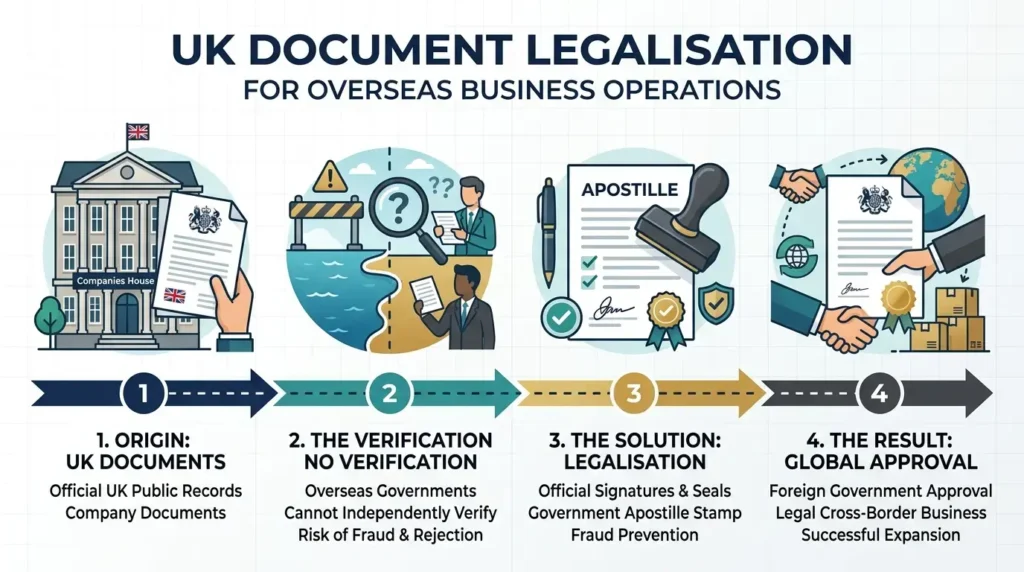
Foreign government departments enforce mandatory document authentication statutes. When UK directors open subsidiary offices in Europe, the Middle East, or Asia, local trade registries require official corporate proof. Unlegalised private documents face immediate rejection by foreign civil servants who lack access to UK Companies House registers.
Commercial banks in foreign jurisdictions enforce strict anti-money laundering regulations. International banking standards demand validated corporate standing before opening corporate bank accounts for overseas entities. Legalisation provides cross-border legal certainty, reducing corporate liability for foreign financial regulators and local operating partners.
How Do Foreign Courts and Registries Verify UK Corporate Documents?
Foreign courts and registries verify UK corporate documents by examining official apostille certificates, validating notary signatures against international registries, and checking embassy legalisation stamps issued by foreign diplomatic missions located within the United Kingdom.
The verification process follows a standardized legal chain. Foreign officials first examine the apostille attached to the document. The apostille contains a unique registration number, official seal, and signature recorded in the FCDO central database. Foreign authorities confirm these details using online verification systems.
Certain non-Hague Convention countries enforce embassy legalisation requirements. Officials from the target nation’s UK embassy physically inspect the FCDO seal, add an official consular stamp, and record the transaction in diplomatic registers. This dual-layer authentication enables full legal recognition inside non-Hague member states.
When Must UK Companies Legalise Their Certificate of Good Standing?
UK companies must legalise their Certificate of Good Standing when expanding overseas, opening foreign bank accounts, registering local tax identifiers, securing international contracts, appointing overseas corporate directors, or defending legal claims inside foreign courts.
Expanding corporate operations into international territories triggers strict statutory filing deadlines. When board members establish a foreign branch, local commercial registries require legalised corporate documents within 30 to 90 days. Failure to provide legalised documentation delays corporate registration and prevents legal commercial trading.
International financial transactions require valid legal proof. Global banks require legalised corporate certificates during annual compliance reviews and initial account setups. Foreign tax authorities also demand legalised documents when UK companies register for foreign value-added tax or apply for double taxation treaty relief.
What Legal Frameworks Govern International Document Authentication?
International document authentication is governed primarily by the 1961 Hague Apostille Convention and bilateral consular legalization treaties. These legal frameworks establish standardized verification rules that cross-border government authorities and courts accept universally.
The 1961 Hague Convention simplified cross-border document authentication across 125 member nations. The treaty abolished traditional, multi-tiered embassy legalisation requirements between member states. Participating countries agree to accept a standardized FCDO apostille certificate as definitive legal proof of document authenticity.
Non-member nations operate under traditional international law principles. Transactions involving non-Hague jurisdictions require full consular legalisation. UK companies must obtain solicitor certification, FCDO apostille endorsement, and final diplomatic validation from the destination country’s embassy to achieve complete legal compliance.
How Does Document Legalisation Protect Foreign Stakeholders?
Document legalisation protects foreign stakeholders by eliminating corporate identity fraud, confirming active company registration, validating current management credentials, and ensuring foreign courts possess legal jurisdiction over cross-border commercial transactions.
International business transactions expose foreign investors, vendors, and clients to financial risks. Fraudulent actors sometimes present forged corporate papers or operate through dissolved corporate entities. Legalisation forces domestic legal professionals to verify active Companies House records, ensuring foreign partners contract with legitimate corporate entities.
Regulatory compliance shields international counterparties from regulatory penalties. Foreign municipal authorities require validated corporate paperwork before granting operational licences or approving commercial property leases. Legalised documentation establishes clear evidentiary records that protect foreign stakeholders during cross-border litigation or regulatory audits.
What Is the Process for Obtaining a Legalised Certificate?
The process involves ordering an official Certificate of Good Standing from Companies House, completing solicitor or notary authentication, obtaining an FCDO apostille stamp, and securing embassy legalisation when targeting non-Hague Convention nations.
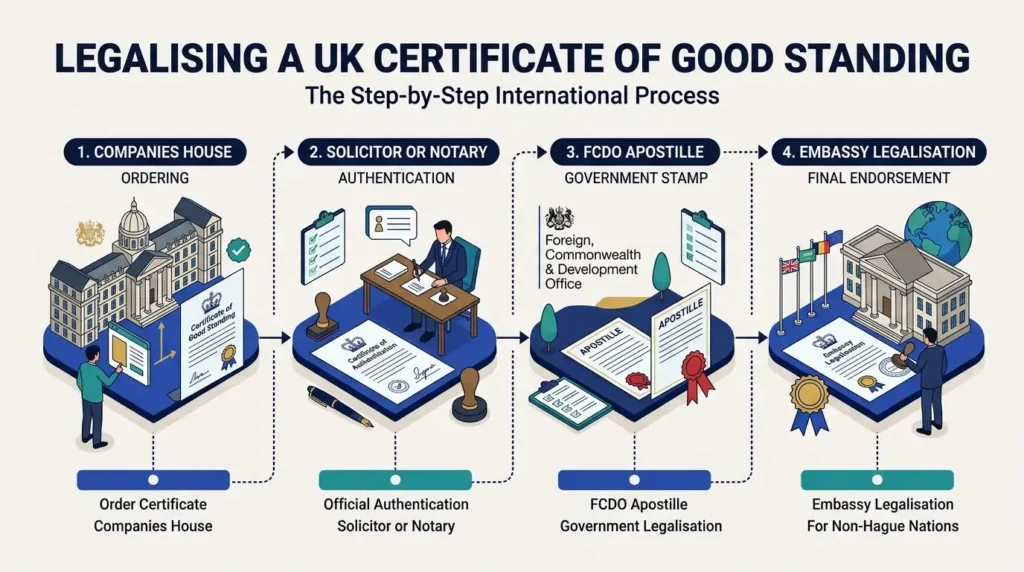
First, Companies House issues the original certificate containing official officer details and corporate standing statements. Second, a registered UK solicitor or notary public verifies the document against public registry records and applies an official legal seal. Third, the FCDO attaches the official physical or electronic apostille certificate.
For non-Hague destinations, the document moves to the relevant foreign embassy in London. Embassy officials review prior signatures, collect legalisation fees, and affix diplomatic stamps. Directors can streamline cross-border compliance by hiring specialist [Certificate of Good Standing] services to handle corporate registry orders and legalisation workflows simultaneously.
Understanding document authentication workflows helps directors select correct processing channels. For detailed comparisons of authentication methods, read our guide on [Apostille vs Notarisation for a Certificate of Good Standing: Which Do You Need?]. To bypass complex government submissions, companies can [Get Your Certificate of Good Standing Legalised for Overseas Use by Form My Company].
What Challenges Occur During Overseas Legalisation?
Overseas legalisation challenges include translation requirements, variable embassy processing times, strict expiration windows imposed by foreign registries, rejection due to missing officer details, and shifting international compliance standards.
Language barriers frequently delay foreign corporate registrations. Non-English jurisdictions require official certified translations alongside legalised English documents. Translators must complete certified translations after the FCDO attaches the apostille, ensuring local court officials can read both the primary corporate document and the official legalisation stamps.
Foreign registries enforce strict document validity periods. Many international trade registers reject corporate certificates issued more than 30, 60, or 90 days prior to submission. Processing delays at FCDO offices or foreign embassies can cause certificates to expire before final submission, requiring complete re-issuance and re-legalisation.
How Do Errors in Document Legalisation Impact Business Expansion?
Errors in document legalisation cause severe operational delays, contract cancellations, financial penalties from foreign regulators, rejected bank account applications, and increased legal costs during international business expansion.
Submitting unlegalised or incorrectly certified documents stalls international expansion plans. Foreign commercial registries reject incomplete filings automatically, freezing branch establishment procedures. During expansion delays, companies remain unable to execute commercial agreements, lease office spaces, or hire local staff legally.
Financial delays create significant commercial damage. Global banks deny corporate account opening requests when apostilles lack proper notary signatures. Missing legalisation stamps force UK companies to restart multi-week legalisation processes, delaying foreign revenue collection and exposing expanding enterprises to unexpected administrative costs.
Foreign authorities require a legalised Certificate of Good Standing to confirm the legal existence, active compliance, and corporate legitimacy of UK companies operating overseas. Legalisation bridges domestic UK corporate law and foreign legal frameworks through standardized apostille and diplomatic verification channels. Obtaining fully legalised documentation ensures smooth international branch registration, compliant foreign banking setup, and secure cross-border commercial growth. Form My Company manages corporate document procurement, solicitor certification, FCDO apostille endorsement, and embassy legalisation to deliver fully authenticated documents for overseas use.
Explore More Certificate of Good Standing Guide,
What Is an Apostilled Certificate of Good Standing?
How Can You Get a Certificate of Good Standing on the Same Day?
Frequently Asked Questions
How long does it take to get a legalised Certificate of Good Standing?
Standard processing by UK Companies House and the Foreign, Commonwealth & Development Office (FCDO) typically takes 5 to 10 working days for a legalised Certificate of Good Standing. Fast-track options, including same-day solicitor certification and express apostille services, reduce total turnaround time to 24 to 48 hours. Form My Company manages expedited document procurement and FCDO apostille processing for urgent overseas filing deadlines.
How much does a legalised Certificate of Good Standing cost in the UK?
The total cost for a legalised Certificate of Good Standing depends on government registry fees, solicitor verification charges, and FCDO apostille fees. Basic Companies House document orders start at standard registry rates, while legalised packages including notary certification and official apostilles range from £100 to £250. Form My Company offers transparent, fixed-fee packages covering official document issuance, legalisation, and international courier delivery.
How long is a legalised Certificate of Good Standing valid for overseas use?
A legalised Certificate of Good Standing does not contain an official statutory expiration date under UK law. However, foreign commercial registries, overseas courts, and international banks typically require the document to be issued within 30, 60, or 90 days of submission. Form My Company recommends ordering a freshly issued registry certificate before completing FCDO apostille legalisation to ensure compliance with foreign regulatory windows.
What is the difference between an apostille and embassy legalisation?
An apostille is an official FCDO certificate that authenticates a UK public document for use in countries participating in the 1961 Hague Apostille Convention. Embassy legalisation is an additional verification step required by non-Hague member states, involving physical inspection and stamping by the destination country’s UK diplomatic mission. Form My Company provides both Hague apostille certification and full consular legalisation services depending on the destination jurisdiction.
Can a foreign company request a UK Certificate of Good Standing?
Any individual, foreign entity, or overseas authority can request a Certificate of Good Standing for an active UK company registered at Companies House. The requesting party must ensure the UK business maintains up-to-date annual filings, confirmation statements, and active corporate status prior to ordering. Through Form My Company, international stakeholders can order, verify, and legalise official UK corporate standing certificates for cross-border commercial compliance.