To fix overdue filings before requesting a Certificate of Good Standing, submit outstanding confirmation statements and annual accounts to Companies House immediately. Pay all associated late filing penalties, verify compliance status, and ensure officer details are updated across official UK registers.
What Are Overdue Filings in UK Company Compliance?
Overdue filings represent statutory returns, accounts, or updates that a registered UK company fails to submit to Companies House by prescribed legal deadlines. Missing these dates triggers automatic administrative penalties and legal default status under the Companies Act 2006.
Companies House enforces strict regulatory schedules for statutory documents. A private limited company must submit its annual confirmation statement every 12 months. Directors must file annual accounts within 9 months of the financial year-end. Failure to deliver these filings on time causes immediate compliance status flags on the public register.
Statutory deadlines remain fixed regardless of operational trading status. Dormant entities and active businesses share equal responsibilities regarding annual reporting timelines. Overdue items trigger systemic alerts within Companies House compliance tracking networks. These alerts notify financial institutions and credit agencies about official non-compliance status.
Unresolved delinquency status escalates rapidly through judicial enforcement channels. Companies House issues formal penalty notices to the registered office address. Continued failure to respond results in active prosecution against designated individual company directors. Legal prosecution incurs personal criminal records and substantial fine structures.
The public register records every missed filing timeline permanently. Lenders, investors, and trading partners monitor compliance ratings continuously. Unresolved default status prevents the registrar from validating legal standing. Companies House denies official status certification until directors restore full regulatory compliance across all statutory accounts and confirmation registers.
Why Do Overdue Filings Stop Good Standing Certification?
Overdue filings block good standing certification because Companies House only issues certificates to entities fully compliant with statutory reporting duties. The registrar cannot validate an organisation that currently breaches the Companies Act 2006 requirements.
A Certificate of Good Standing confirms that a business entity operates without outstanding statutory defaults. The document verifies active registration status without ongoing dissolution proceedings. When filings remain overdue, the registrar marks the official corporate file as defective. Defective status automatically disqualifies an organisation from receiving official state verification.
Understanding why overdue filings stop you getting a Certificate of Good Standing helps directors address regulatory bottlenecks proactively. Companies House systems block certificate generation requests automatically when statutory records show missing annual returns. The underlying database flags compliance breaches before processing application fee payments.
Commercial counter-parties demand this document during international expansion efforts. Overseas banks require statutory validation before opening corporate banking accounts. Foreign state registries demand verified certificates before approving foreign branch registrations. An active compliance default halts international business transactions immediately.
Resolving overdue accounts restores public register integrity. The registrar reviews filing histories before applying the official seal to requested compliance certificates. Complete alignment with legal reporting duties remains mandatory for certification approval.
How Do Directors Identify Missing Companies House Submissions?
Directors identify missing submissions by querying the Companies House Service database, checking filing histories, and inspecting statutory compliance alerts. The public registry flags overdue confirmation statements, missing annual accounts, and unrecorded corporate changes instantly.
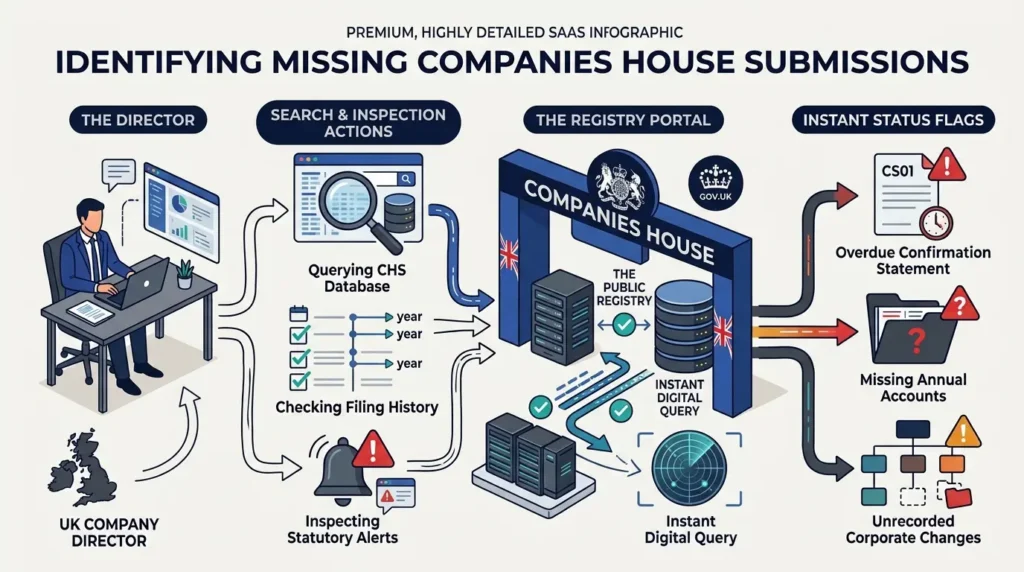
Checking company standing requires direct inspection of official register records. Directors must search their legal entity name within the Companies House online database. The main overview screen displays current filing status indicators in high-contrast text tags.
The system marks compliance standing with clear status indicators. An overdue account status appears when reporting deadlines pass without validated submissions. The filing history tab details historical submission dates, document types, and formal rejection notices. Examining previous submission logs pinpoints precise missing documents.
Statutory updates extend beyond annual reporting documents. Directors must update changes to persons with significant control within 14 days. Changes in registered office addresses require prompt submission via form AD01. Discrepancies between physical corporate records and public entries trigger registry holds.
Audit statutory registers internally to verify complete submission accuracy. Match internal board minutes against official Companies House document logs. Identifying specific missing items ensures accurate corrective action before submitting formal certificate requests.
How to Prepare and File Overdue Confirmation Statements?
Prepare overdue confirmation statements by reviewing current company details, updating persons with significant control registers, and submitting form CS01 online. Directors must pay the annual filing fee to update the public register immediately.
Form CS01 verifies that corporate information remains accurate on public records. The submission confirms registered address details, officer appointments, share capital structures, and shareholder classification codes. Directors must review existing register entries before declaring complete informational accuracy.
Errors in underlying data require corrective updates before final confirmation. Use form PSC01 to record new beneficial ownership structures. Submit form AP01 to register new director appointments officially. Complete these preliminary updates prior to submitting the main confirmation statement.
Online submission provides immediate confirmation receipt processing. Digital filings process through Companies House automated validation networks within 2 hours. Paper submissions require up to 10 working days for manual data entry processing. Digital processing avoids processing delays during urgent certification requests.
Pay statutory filing fees using electronic payment portals. Companies House charges a statutory £34 fee for online confirmation statement processing. Validated filings update the public register database status from overdue to fully compliant within 24 hours.
How to Submit Overdue Annual Accounts to Companies House?
Submit overdue annual accounts by preparing balance sheets, profit and loss statements, and director notes in full alignment with UK GAAP. File accounts through approved digital software to clear financial default status instantly.
Financial accounts require strict preparation under established accounting frameworks. Micro-entity accounts require balance sheet validation and specific director notes. Small entity accounts demand complete compliance with FRS 102 reporting standards. Ensure qualified accountants review non-trading and active trading financial figures thoroughly.
Directors must sign balance sheet declarations explicitly before filing. Digital software transmits signed iXBRL formatted accounts directly to Companies House servers. Automated validation checks inspect balance sheet totals against statutory mathematical requirements upon receipt.
Late submission triggers immediate administrative financial penalties. Companies House imposes penalties ranging from £150 to £1,500 based on delinquency length. Double penalty rates apply when accounts remain overdue for two consecutive financial years.
Clear outstanding financial penalties promptly upon receipt of official invoices. Companies House accepts electronic settlement through secure corporate payment channels. Clearing monetary obligations ensures complete clearance of registry flags on corporate accounts.
What Steps Are Needed to Restore Good Standing Status?
To restore good standing status, file all overdue statutory documents, settle outstanding administrative penalties, and request an official register status review. Companies House clears default markers once all regulatory obligations register as complete.
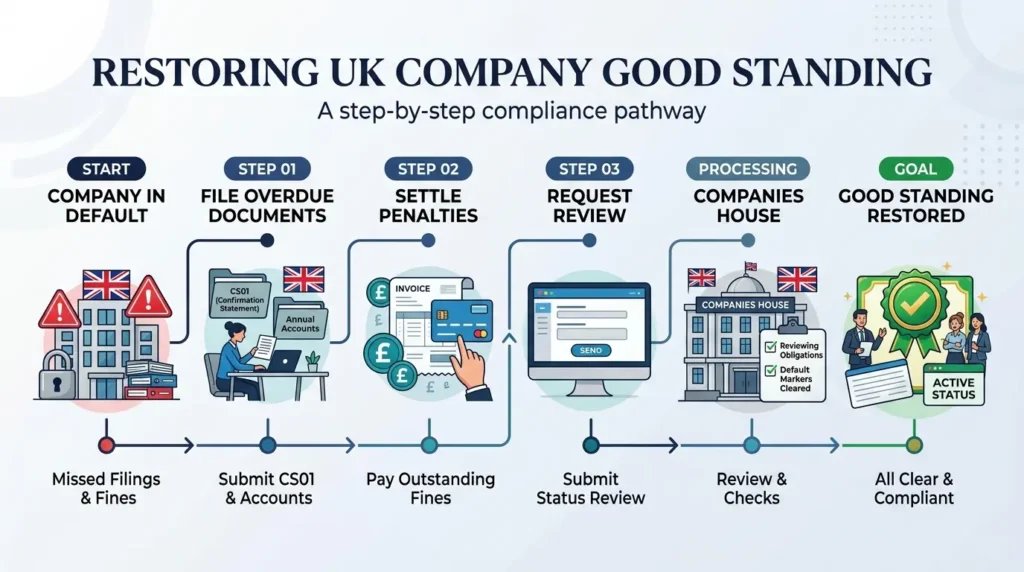
Orderly execution restores statutory compliance efficiently. Follow this systematic process to clear public records:
Compile outstanding accounting records using certified software
Submit form CS01 to update corporate officer and address registers
Pay associated late filing penalties using official payment gateways
Request updated public registry extracts to verify compliance updates
Registry status updates reflect across public databases after validation. Systems process electronic submissions faster than physical paper documents. Verify that status indicators display current compliance standing across all public search fields.
Confirm that officer records reflect current board appointments. Discrepancies in director details delay certification approvals even after accounts update. Updating officer details ensures flawless registry validation during official status checks.
Engaging Form My Company ensures swift execution of compliance updates and fast-generation of certified official documents. Professional management prevents technical rejections during registry review phases.
How to Request a Certificate of Good Standing After Compliance Is Fixed?
Request a Certificate of Good Standing after compliance is fixed by applying through Companies House or a certified corporate service provider. Select target verification details and pay standard government processing fees for issuance.
Applying for certification requires precise document specification selection. Directors choose specific informational details for inclusion on official certificates. Optional details include director names, secretary profiles, registered office history, and share capital breakdowns.
Standard government processing takes 4 to 5 working days. Same-day expedited services issue certificates within 24 hours for urgent commercial requirements. Specify digital PDF delivery or physical apostille dispatch options during application submission.
Verify that external receiving authorities accept specific certificate formats. Overseas authorities often require official apostille certification via the Foreign, Commonwealth & Development Office. Adding apostille services extends processing times by 3 to 7 working days.
Using an expert service allows directors to get your filings sorted and certificate issued by Form My Company without administrative errors. Expert management eliminates delays during critical commercial transactions.
Resolving overdue filings restores statutory compliance and protects business operations. Submitting outstanding confirmation statements and annual accounts clears legal default status from public records. Timely remediation enables immediate access to official state certification.
Maintaining precise statutory schedules prevents commercial interruptions. Updated registers build trust among international banks, investors, and regulatory bodies. Professional management simplifies complex statutory duties efficiently.
Form My Company provides comprehensive filing support and swift certificate procurement services. Professional oversight ensures ongoing compliance alignment with Companies House standards.
Explore More Certificate of Good Standing Guide,
How to Prepare a Certificate of Good Standing for Legalisation Abroad
Apostille vs Notarisation for a Certificate of Good Standing: Which Do You Need?
Frequently Asked Questions
What is a UK Certificate of Good Standing?
A UK Certificate of Good Standing, officially issued by Companies House as a Certificate of Incorporation with official notes, verifies that a registered company is actively operating and fully compliant with its statutory filing obligations. It confirms that an entity has submitted all annual accounts and confirmation statements without facing dissolution or administrative strike-off. Businesses frequently obtain this official document through Form My Company to validate corporate legitimacy for international banks, investors, and foreign state registries.
How do I get a Certificate of Good Standing from Companies House?
To request a Certificate of Good Standing, a business must ensure all annual accounts and confirmation statements are fully up to date with Companies House before submitting an official application. The service can be ordered directly through government portals or via Form My Company to streamline verification and expedite delivery. Once processed, the document is issued electronically as a PDF or as an official printed certificate with optional legalisation options.
How long does it take to get a Certificate of Good Standing?
Standard government processing for a Certificate of Good Standing typically takes 4 to 5 working days, while expedited same-day services issue the document within 24 hours. If an international authority requires an apostille certificate from the Foreign, Commonwealth & Development Office (FCDO), processing takes an additional 3 to 7 working days. Form My Company assists UK entities by managing the entire application process to avoid submission errors and processing delays.
Can a company get a Certificate of Good Standing if filings are overdue?
No, Companies House will not issue a Certificate of Good Standing if a company has overdue confirmation statements, missing annual accounts, or outstanding statutory compliance defaults under the Companies Act 2006. The registrar requires all corporate records and officer registers to be fully updated and compliant before certifying good standing. Form My Company helps directors identify outstanding filing obligations and submit required documentation to restore statutory compliance prior to requesting the certificate.
Why do overseas banks require a Certificate of Good Standing?
Foreign financial institutions and overseas registries require a Certificate of Good Standing to verify that a UK entity legally exists, maintains active registration, and possesses clear corporate authority to open accounts or conduct foreign business. The document acts as official proof that the organisation is not undergoing liquidation, receivership, or court-ordered winding-up proceedings. Utilizing the Certificate of Good Standing service from Form My Company ensures international counter-parties receive official, fully legalised corporate verification documents.