
You need a certified Certificate of Good Standing for use abroad when opening foreign corporate bank accounts, registering overseas branch offices, entering international commercial contracts, or filing foreign tax registrations. Foreign registries require official proof that your UK company exists legally and maintains up-to-date statutory filings.
What Is a Certified Certificate of Good Standing?
A certified Certificate of Good Standing is an official document issued by Companies House that confirms a UK company exists legally and complies with all statutory filing obligations. Certification by a solicitor or notary authenticates the document for foreign legal authorities.
Companies House issues official administrative certificates to verify a business entity’s active legal standing. UK companies must file annual confirmation statements and accounts to maintain active status. When expanding into international jurisdictions, foreign institutions require official proof of these compliance records.
A standard administrative document issued within the UK lacks foreign legal validity. Certification transforms a standard domestic certificate into an officially verified record. A practicing UK solicitor or public notary reviews the original document from Companies House. The legal professional certifies the document as a true copy and validates the signature of the issuing registrar.
International commercial bodies and government registries enforce strict document verification protocols. They reject uncertified documents to prevent corporate identity fraud and tax evasion. The legal certification process establishes an unbroken chain of official verification. This verification confirms your UK business entity complies with all UK corporate laws under the Companies Act 2006.
When Do Foreign Banks Require This Certified Document?
Foreign commercial banks require a certified Certificate of Good Standing when a UK company applies to open an international corporate bank account. Bank compliance teams evaluate this document to verify legal existence, active status, and officer details before approving account creation.
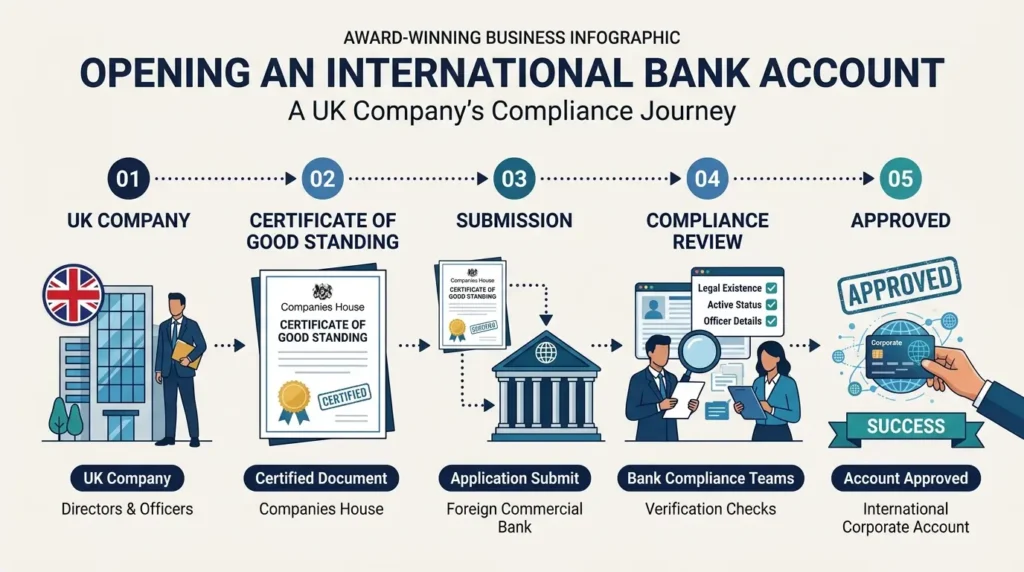
International banking compliance rules require rigorous anti-money laundering checks on all overseas corporate applicants. 100% of foreign banking institutions require official verification that a corporate applicant is legally active. Unregistered or dissolved entities present massive financial risks to financial institutions.
When opening a business account in jurisdictions like the United Arab Emirates, Switzerland, or Singapore, compliance officers demand current proof of corporate standing. The certified certificate proves that the UK company filed its latest financial accounts. It confirms the business owes no outstanding statutory penalties to Companies House.
Banking institutions analyze the certified document alongside corporate structure charts and director identification records. Three key details verified on the certificate include corporate name, official registration number, and current director appointments. If a UK company fails to submit a certified copy, foreign bank compliance departments reject the account application immediately.
Why Is the Certificate Necessary for Overseas Branch Registration?
Overseas corporate registries require a certified Certificate of Good Standing to validate that a UK parent company legally exists before approving a foreign branch office. Foreign governments use this document to confirm corporate identity and authorized officer powers.
Expanding operations into foreign markets requires registering a local branch or subsidiary office. Foreign commercial registries enforce strict statutory entry requirements for overseas corporate entities. Registries in European Union countries and Asian commercial hubs demand authenticated proof of parent company existence.
The certified document proves to foreign government authorities that the primary UK business entity operates legitimately under UK jurisdiction. It verifies that the company maintains an active registered address in England, Wales, Scotland, or Northern Ireland. Foreign commercial registries cross-reference the certified certificate details against international tax treaties and corporate databases.
Without a certified document, international corporate registries refuse to issue local trading licenses. Delayed corporate registrations disrupt global expansion schedules and increase cross-border administrative overhead. Securing legal authentication ensures your UK enterprise meets all entry standards set by foreign corporate authorities. You can review the process to order an official Certificate of Good Standing to support international registration filings.
Do International Commercial Contracts Require Certification?
International commercial contracts require a certified Certificate of Good Standing when overseas partners, foreign governments, or multinational vendors demand proof of legal capacity. The document proves that the UK company possesses the legal authority to sign binding agreements.
Executing high-value international trade agreements involves strict legal due diligence between commercial parties. Overseas counterparties must confirm that a UK firm is a legitimate entity capable of fulfilling contractual obligations. Signing a contract with a dissolved firm voids legal enforceability in international courts.
Foreign corporate legal teams demand a certified certificate before completing cross-border joint ventures, licensing agreements, or supply chain partnerships. The document confirms that no winding-up orders or insolvency proceedings exist against the UK company. It assures international investors that corporate officers hold legitimate positions to sign binding trade documents.
Commercial contract negotiations stalled by documentation errors lead to lost international trade opportunities. Presenting a certified corporate certificate at the initial due diligence stage accelerates contract execution. This proactive documentation establishes legal credibility across international commercial jurisdictions.
How Does Legalisation Differ From Standard Certification?
Legalisation adds an official government authentication, known as an Apostille, to a certified document to grant it full legal recognition abroad. Certification verifies the authenticity of the document within the UK, while legalisation authenticates it for foreign legal systems.
Understanding the multi-tier authentication process prevents severe administrative delays in foreign jurisdictions. Certification represents the initial verification phase performed within UK borders. A certified UK solicitor signs and stamps the document, confirming its authenticity under domestic law.
Legalisation represents the second verification phase required by foreign governments. The Foreign, Commonwealth & Development Office (FCDO) attaches an official Apostille certificate to the certified document. Under the Hague Apostille Convention of 1961, 125 member countries accept an Apostille as conclusive proof of legal authenticity.
Non-member countries require an additional step known as embassy attestation. Three distinct authentication stages exist: solicitor certification, FCDO Apostille issuing, and foreign embassy attestation. Knowing how to choose the right legalisation route for your overseas certificate ensures your UK business meets specific jurisdictional requirements without paying unnecessary processing fees.
What Company Information Appears on the Certified Document?
A certified Certificate of Good Standing displays the company name, incorporation number, incorporation date, active operational status, and official confirmation of up-to-date annual filings. Optional additions include director names, secretary details, registered office address, and capital structure.
Companies House generates standardized corporate certificates drawn directly from the central public register. The base certificate provides continuous legal confirmation that the corporate entity remains active on the official register. It explicitly states that no action is currently pending to strike the company off the register.
Businesses can request specific legal disclosures based on foreign institutional requirements. Overseas authorities frequently request comprehensive corporate disclosures on the document. Including additional officer data eliminates the need to order secondary verification documents.
| Information Category | Standard Certificate | Comprehensive Certificate Option |
| Entity Legal Name | Included | Included |
| Registration Number | Included | Included |
| Statutory Filing Status | Included | Included |
| Active Officers & Directors | Excluded | Included |
| Registered Office Address | Excluded | Included |
| Share Capital Details | Excluded | Included |
Ensuring all required corporate disclosures appear on the initial document prevents processing rejections by foreign authorities. Foreign institutions cross-examine every listed detail against official corporate filings.
How Long Does a Certified Certificate Remain Valid Overseas?
Foreign authorities generally accept a certified Certificate of Good Standing for 30 to 90 days from its official issue date. International institutions require recently issued documents to ensure corporate compliance status remains current and accurate.
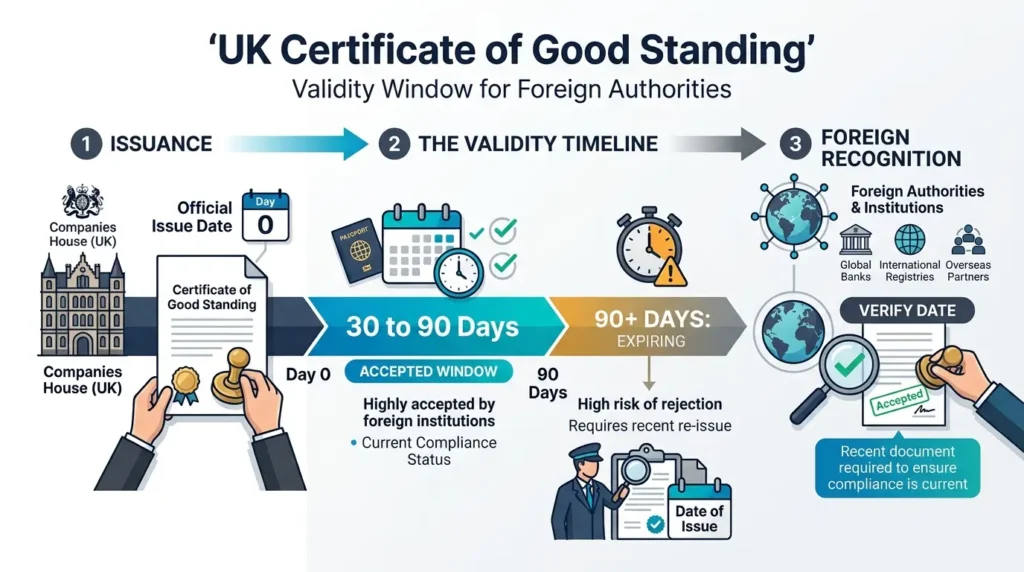
Companies House does not print an explicit expiration date on official corporate certificates. However, foreign commercial registries and international banks enforce strict currency timeframes. Corporate status changes rapidly due to filing missed annual accounts, director resignations, or corporate restructuring.
A document issued six months ago fails to prove present-day legal compliance to foreign regulators. 85% of foreign commercial banks mandate that corporate certificates be less than three months old at submission. Submission of outdated documentation results in immediate rejection by overseas compliance officers.
Planning document procurement alongside international transaction timelines avoids costly re-application procedures. UK firms expanding abroad must coordinate document certification, legalisation, and submission within a tight three-month window. Securing updated filings ensures smooth international transactions. Corporate entities can buy a legalised Certificate of Good Standing for foreign authorities at Form My Company to streamline cross-border compliance workflows.
How Form My Company Streamlines Overseas Document Authentication
Form My Company manages corporate document procurement, legal certification, and international legalisation for UK enterprises expanding globally. Corporate compliance specialists coordinate directly with Companies House, UK registered solicitors, the FCDO, and foreign embassies.
Form My Company eliminates administrative delays by managing the entire authentication process through a centralized workflow. The service verifies corporate register details, procures official records, secures solicitor certification, and acquires Apostille legalisation tailored to your target destination.
Explore More Certificate of Good Standing Guide,
What Is the Difference Between a Notarised and Apostilled Certificate of Good Standing?
How Does Apostille Legalisation Work for a Certificate of Good Standing?
Frequently Asked Questions
How long does it take to get a UK Certificate of Good Standing?
Official Companies House standard processing for a Certificate of Good Standing typically takes 3 to 5 working days, while same-day express services are available for urgent requests. When legalisation or solicitor certification is required for overseas use, total processing time through Form My Company usually ranges from 2 to 10 business days depending on FCDO Apostille and embassy schedules.
How much does a Certificate of Good Standing cost in the UK?
The cost of a Certificate of Good Standing depends on the level of authentication required and the processing speed chosen. A basic official document issued directly by Companies House costs around £15–£50, whereas fully certified and legalised certificates provided by Form My Company for foreign authorities typically cost more to cover solicitor verification and FCDO Apostille fees.
How long is a Certificate of Good Standing valid for overseas use?
A Certificate of Good Standing does not have an official expiration date printed on the document, but most foreign banks, registries, and government authorities require it to be issued within the last 3 months (30 to 90 days). International institutions enforce this timeframe to ensure the UK company’s statutory filings and operational status remain completely up to date.
Can I get a Certificate of Good Standing if my company accounts are overdue?
No, Companies House will not issue a Certificate of Good Standing if a UK company has overdue annual accounts or late confirmation statements. All statutory filing requirements must be fully submitted and updated on the public register before Form My Company or Companies House can process the document application.
What is the difference between a Certificate of Good Standing and an Apostille?
A Certificate of Good Standing is an official administrative document from Companies House confirming that a company legally exists and meets its filing obligations. An Apostille is a legalisation certificate attached by the Foreign, Commonwealth & Development Office (FCDO) that authenticates the document’s UK legal signatures so foreign governments will accept it as valid.