
To choose the right legalisation route, check whether the destination country belongs to the 1961 Hague Apostille Convention. Hague member nations require an Apostille certificate, whereas non-Hague member nations mandate full consular legalisation through embassy channels.
Choosing the correct authentication method ensures overseas authorities accept your UK corporate documents. Foreign governments, registries, and banks mandate legalised corporate paperwork to prevent fraud and confirm legal corporate status. Selecting the wrong pathway leads to rejected applications, wasted administrative fees, and costly commercial delays.
International document authentication follows strict legal frameworks governed by global treaties and diplomatic protocols. The destination country’s legal jurisdiction dictates every step of the compliance pathway. Understanding these legal pathways guarantees seamless cross-border transactions and maintains business continuity across foreign jurisdictions.
What Is the Hague Apostille Legalisation Route?
The Hague Apostille route is a simplified document authentication process for countries participating in the 1961 Hague Convention. The UK Foreign, Commonwealth & Development Office issues a standardized Apostille certificate that validates official signatures and seals without requiring consular intervention.
The Hague Convention Abolishing the Requirement of Legalisation for Foreign Public Documents established this streamlined procedure in 1961. Over 120 member states participate in this international treaty framework. The agreement replaces complex multi-tiered authentication steps with a single standardized certificate known as an Apostille.
The Foreign, Commonwealth & Development Office serves as the designated competent authority within the UK. Officials verify the signature, stamp, or seal on the official corporate document against registered government records. Once verified, the authority attaches an official paper or electronic Apostille directly to the document.
This single certification renders the corporate record legally valid across all 120 participating member countries. Foreign authorities in Hague member states accept the Apostilled document without requiring additional diplomatic or consular verification.
When Is Consular Legalisation Required for Overseas Certificates?
Consular legalisation is required when presenting official corporate documents in countries that do not participate in the 1961 Hague Convention. This multi-step process requires initial Foreign, Commonwealth & Development Office certification followed by final validation from the destination country’s embassy.
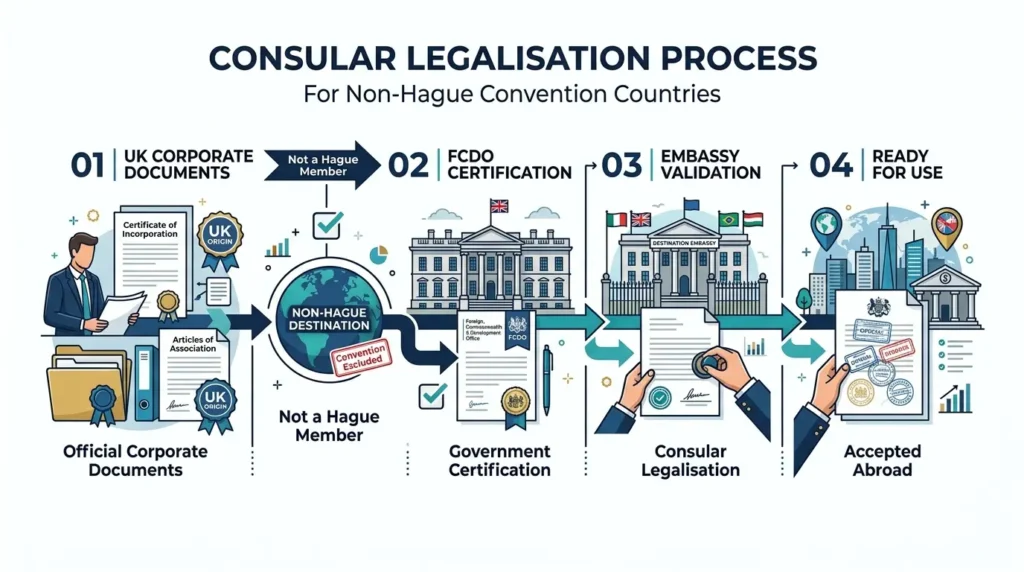
Non-Hague jurisdictions do not recognize a standalone Apostille certificate as sufficient proof of document authenticity. These nations maintain independent bilateral verification requirements to validate foreign corporate credentials. Overseas commercial activities in regions like the Middle East or parts of Asia frequently require this extended pathway.
The process begins with legal verification at the government level within the issuing country. The Foreign, Commonwealth & Development Office authenticates the document credentials first. Subsequently, official staff present the certified paperwork to the embassy or consulate of the destination country.
Diplomatic officials inspect the document and apply their official consular stamp or seal. This final consular layer confirms that the issuing government authority holds valid jurisdiction. Only after achieving consular validation do foreign commercial registries accept the document.
How Do Legalisation Requirements Differ by Destination Country?
Destination countries set legalisation requirements based on treaty membership, local commercial laws, and bilateral agreements. Hague members demand a single Apostille, non-Hague members mandate consular stamps, and specific jurisdictions require additional localized translations or notarizations.
International document acceptance rules vary significantly depending on global geographic regions and local statutory demands. Evaluating the specific legal framework of your target country prevents submission failures and administrative delays.
| Jurisdiction Category | Primary Protocol | Processing Steps Required | Typical Target Regions |
| Hague Convention Member | Apostille Certification | FCDO Verification $\rightarrow$ Apostille Issued | European Union, Americas, Australia |
| Non-Hague Jurisdiction | Consular Legalisation | FCDO Verification $\rightarrow$ Embassy Stamping | UAE, Qatar, China, Vietnam |
| Special Commercial Zone | Dual Legalisation & Translation | FCDO $\rightarrow$ Embassy $\rightarrow$ Certified Translation | Specific Middle Eastern & Asian Markets |
Commercial registries in South America or Europe operate under standard Hague protocols. Submitting a verified corporate record with an Apostille fulfills local compliance requirements. These authorities process filings rapidly because authentication rules remain standardized across treaty nations.
Conversely, commercial registries in non-Hague nations enforce rigid multi-stage requirements. Authorities in jurisdictions like the UAE or China often require official sworn translations alongside consular stamps. Local rules may also mandate that translations occur before embassy submission or after arrival in the destination state.
What Role Does a Certificate of Good Standing Play in International Business?
A Certificate of Good Standing confirms that a UK company exists legally, maintains updated statutory filings, and pays required corporate fees. Foreign authorities require this document before approving foreign branch registrations, banking facilities, or cross-border commercial transactions.
Companies House issues this official record to verify an entity’s continuous legal existence. The document provides third-party confirmation that a company has not faced dissolution or strike-off proceedings. Overseas partners and regulatory bodies rely on this record to assess corporate risk.
International banking institutions demand verified corporate status during initial account onboarding processes. Financial officers inspect the document to verify that corporate officers hold active legal authority. Lenders refuse to execute cross-border financing agreements without official proof of continuous corporate standing.
Foreign government registries mandate this corporate record when UK entities establish overseas subsidiaries or joint ventures. Regulatory bodies examine the filing history to ensure full compliance with corporate governance standards. Obtaining a verified Certificate of Good Standing proves your company maintains active regulatory compliance before expanding into international markets.
How Do You Determine Which Authentication Path Your Business Needs?
Determine your authentication path by confirming the treaty status of the destination country, verifying foreign registry demands, and checking document freshness rules. Matching these foreign requirements dictates whether you pursue a basic Apostille or full consular legalisation.
Navigating international compliance requires systematic verification of foreign legal standards before submitting official documentation. Following a clear decision framework prevents costly administrative errors.
Identify destination treaty status by reviewing official Hague Convention member lists.
Confirm foreign registry requirements with local legal counsel or receiving authorities overseas.
Assess translation mandates to determine if sworn translations must accompany official paperwork.
Verify document validity windows to ensure certified corporate records meet local age limits.
If a corporate transaction takes place in Spain, France, or the United States, Hague rules apply. The business requires standard notary verification followed by FCDO Apostille attachment. The legalisation workflow completes as soon as FCDO officials issue the stamp.
When expanding into non-member states, project managers must allocate extra time for embassy processing. Embassy workflows require distinct fee structures, specific physical presentation methods, and varying processing schedules. Understanding these requirements early keeps cross-border corporate expansion plans on schedule.
What Are the Key Steps to Legalise Your Corporate Certificate?
Legalising a corporate certificate involves ordering an official document from Companies House, completing solicitor or notary certification, obtaining FCDO authentication, and securing optional embassy legalisation. Following these sequential steps ensures full international compliance.
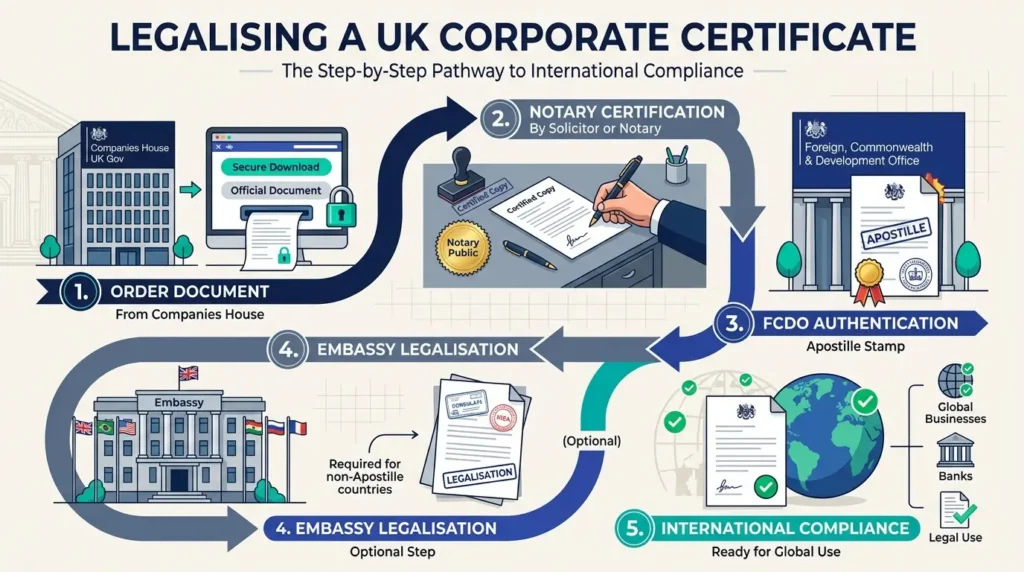
The legalisation journey follows a strict chronological structure that requires precise execution at each stage. Omitting a single legal step invalidates the entire submission package.
Document Issuance: Secure an official corporate certificate directly from Companies House.
Notarial Verification: A registered UK solicitor or notary public certifies the document copy or original signature.
FCDO Apostille: Submit the certified paper to the Foreign, Commonwealth & Development Office for official Apostille issuance.
Consular Legalisation: Present the Apostilled document to the destination country’s embassy if the target nation is a non-Hague member.
Processing timelines vary based on the chosen authentication pathway and embassy workloads. Standard FCDO processing requires roughly 5 to 10 business days. Consular legalisation adds between 3 and 15 additional working days depending on diplomatic scheduling.
Errors in solicitor certifications or missing official seals cause immediate rejections at the embassy level. Working with experienced corporate service providers eliminates procedural mistakes and accelerates processing times. Business owners learn when you need a certified Certificate of Good Standing for use abroad to avoid unnecessary administrative delays during critical commercial negotiations.
Why Do Processing Times and Costs Vary Across Legalisation Pathways?
Processing times and costs vary because Hague Apostilles involve a single UK government department, whereas consular legalisation requires multiple embassy reviews, variable diplomatic fees, and manual submission procedures.
Financial and operational investments differ significantly between the two primary authentication routes. Standard Apostille services charge fixed government fees and operate under predictable processing timelines. Most Hague applications finish within several business days under standard government handling.
Consular legalisation introduces complex cost structures dictated by individual foreign embassies. Foreign diplomatic missions set independent fee schedules that fluctuate based on commercial document classification, priority handling, and currency exchange rates. Certain embassies charge substantial commercial rates for corporate document legalisation.
Turnaround times for consular pathways depend on diplomatic schedules, public holidays, and manual submission protocols. Certain embassies require physical document walk-ins by accredited couriers on specific days of the week. These operational variables extend processing schedules, making early preparation essential for time-sensitive corporate deals.
How Can Professional Legalisation Services Streamline Overseas Authentication?
Professional legalisation services streamline overseas authentication by managing document retrieval, coordinating solicitor verification, handling FCDO submissions, and executing embassy submissions. Specialist oversight prevents document rejections and minimizes operational delays.
Navigating foreign diplomatic bureaucracies requires detailed knowledge of shifting consular regulations and legal submission formats. Inhouse administrative teams often struggle with complex embassy requirements and precise payment protocols. Outsourcing document authentication protects businesses from expensive procedural errors.
Professional providers maintain direct relationships with official agencies, registered solicitors, and diplomatic missions. Managed services handle physical document delivery directly to government offices and foreign embassies. Specialist teams review paperwork prior to submission to confirm that all signatures, seals, and notarial certificates meet strict statutory standards.
Working with corporate filing specialists allows executives to focus on international growth while experts handle complex regulatory compliance. Enterprise managers can buy a legalised Certificate of Good Standing for foreign authorities at Form My Company to secure fully verified, submission-ready corporate documentation efficiently.
Choosing the correct legalisation route depends entirely on whether your destination country belongs to the Hague Apostille Convention. Hague member states accept a streamlined FCDO Apostille, while non-Hague jurisdictions require extended consular legalisation through diplomatic embassies. Form My Company manages the entire document authentication lifecycle, ensuring your corporate certificates meet exact foreign regulatory standards without administrative delays.
Explore More Certificate of Good Standing Guide,
How to Prepare a Certificate of Good Standing for Legalisation Abroad
Apostille vs Notarisation for a Certificate of Good Standing: Which Do You Need?
Frequently Asked Questions
What is a UK Certificate of Good Standing?
A UK Certificate of Good Standing is an official record issued by Companies House confirming that a company has maintained continuous legal existence and has complied with all statutory filing requirements. It provides official verification that no administrative strike-off or winding-up proceedings are active against the corporate entity. Form My Company orders this document directly from the official registry to support corporate onboarding and compliance needs.
Why do overseas authorities require a Certificate of Good Standing?
Foreign government bodies, registries, and banking institutions demand a Certificate of Good Standing to verify a UK entity’s active status before granting trade licenses, opening foreign business accounts, or processing branch registrations. It serves as certified proof that corporate officers hold legitimate operational authority. Businesses rely on Form My Company to retrieve updated, registry-backed documents for cross-border transactions.
How long is a Certificate of Good Standing valid for international use?
Companies House certificates do not state an explicit expiry date, but foreign authorities and commercial financial institutions generally require the document to be issued within the last 3 to 6 months. Receiving organizations enforce document freshness rules to ensure corporate filing status remains compliant and up to date. Form My Company manages fresh registry orders to meet strict overseas submission deadlines.
Can a Certificate of Good Standing be legalised with an Apostille?
Yes, a Certificate of Good Standing issued by Companies House can be authenticated directly with a Hague Apostille by the Foreign, Commonwealth & Development Office (FCDO). Overseas authorities in Hague Convention member states accept this legalisation step as valid confirmation of the registry seal and signature. Form My Company coordinates both official document retrieval and complete FCDO apostille legalisation services.
How can you order a Certificate of Good Standing for your company?
A Certificate of Good Standing can be ordered through official Companies House channels or by utilizing a specialized business service provider. Form My Company handles the end-to-end extraction process, including optional solicitor verification and consular legalisation tailored to your target destination. This managed process prevents administrative rejections and ensures prompt delivery of compliance-ready documents