
VAT registration isn’t simply a box to tick when your business reaches £90,000 in sales. The UK threshold applies to taxable turnover over a rolling 12-month period, and a separate rule can apply if you expect to pass it within the next 30 days. Getting the trigger wrong could mean a missed deadline and an unexpected VAT bill, so value added tax registration deserves a closer look before you act.
It’s understandable to worry that registering will mean more paperwork or higher prices for customers. Registration can also let eligible businesses reclaim VAT on purchases. Before deciding, consider how charging VAT could affect your prices, and make sure you’re prepared for the digital record-keeping and filing requirements.
This 2026 guide explains which registration trigger may apply, what voluntary registration means and what information to prepare for an application. You’ll also learn the key deadlines to keep in mind and how VAT registration support can help make your next step more straightforward.
Key Takeaways
- Check whether your taxable turnover has crossed the £90,000 threshold in a rolling 12-month period, or whether you expect to exceed it within the next 30 days.
- Classify your supplies before calculating turnover: zero-rated sales can count towards the threshold, while exempt and out-of-scope supplies need separate treatment.
- Weigh voluntary value added tax registration against its trade-offs, including whether your customers can reclaim VAT and whether you may recover VAT on eligible purchases.
- Gather accurate business, contact, activity and turnover details before starting your application.
- Identify the relevant registration trigger and deadline, then consider Form My Company’s VAT Registration Service for administrative support.
When does value added tax registration become compulsory in the UK?
VAT registration means notifying HM Revenue & Customs (HMRC) that your business is accounting for Value Added Tax on its taxable activities. Once registered, a business generally charges VAT on taxable sales and can reclaim VAT on eligible purchases, subject to the rules. For an overview of how the tax works, see Value Added Tax (VAT) principles.
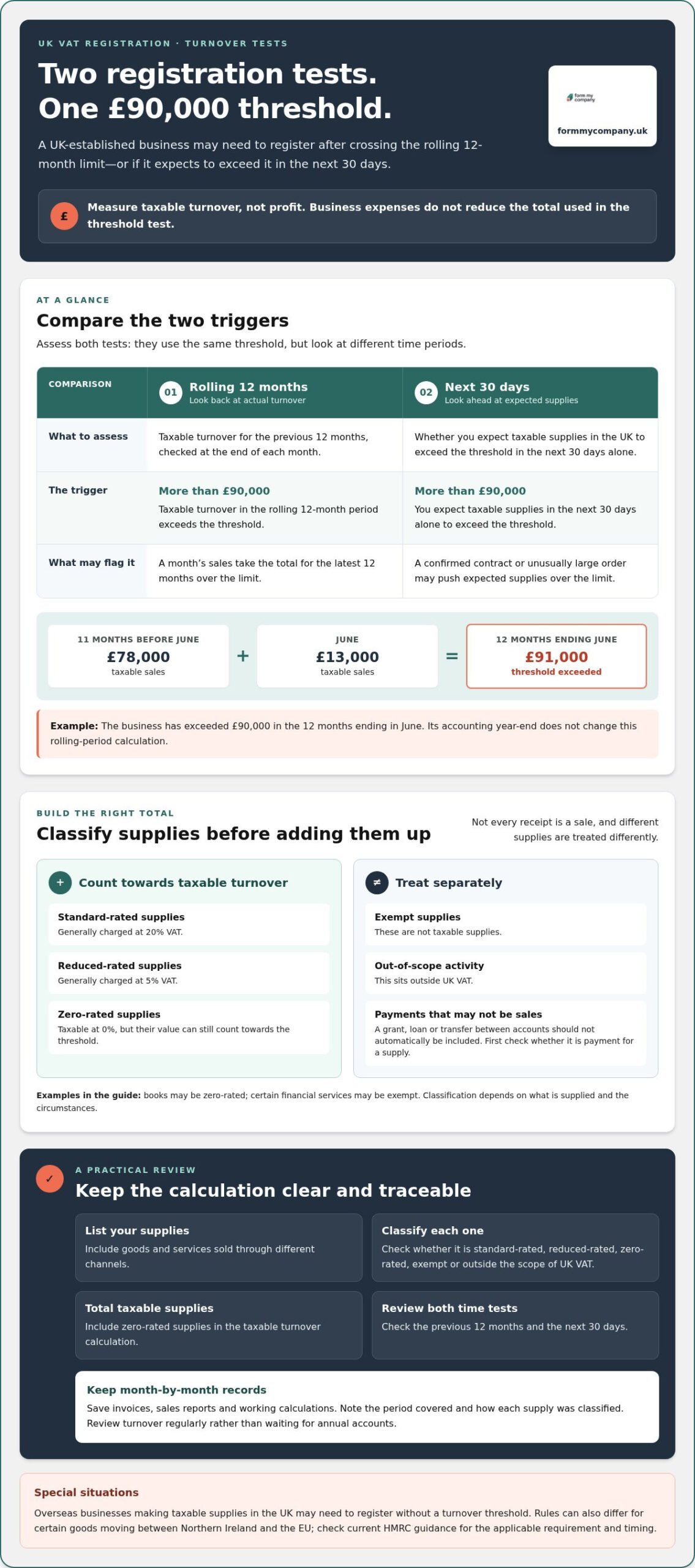
For a UK-established business, compulsory registration is generally triggered when taxable turnover exceeds £90,000. This is a turnover test, not a profit test, and it doesn’t necessarily match the total amount paid into your bank account. The value of your taxable supplies and the relevant time test determine whether the threshold has been crossed.
How does the rolling 12-month VAT threshold work?
At the end of each month, review your taxable turnover for the previous 12 months. This is a rolling period, not a fixed tax year or the period since your business started. Supplies don’t all count in the same way: standard-rated and zero-rated supplies are generally taxable, while exempt supplies and activities outside the scope of UK VAT are treated separately.
Example: A business makes £78,000 of taxable sales in the 11 months before June, then £13,000 in June. Its total for the 12 months ending in June is £91,000, so it has exceeded the threshold. It must assess its registration obligation based on that trigger, even if its accounting year ends later. These figures are turnover, not profit: business expenses don’t reduce the total used in this test.
Keep a month-by-month record of the supplies included in your calculation. Note the period covered and how you classified each supply. If the total is approaching the limit, review it regularly rather than waiting for annual accounts to show that the threshold was crossed.
When can a business need to register below the threshold?
A separate test applies if you expect the value of your taxable supplies in the UK to exceed £90,000 in the next 30 days alone. A confirmed contract or unusually large order, for example, may mean you expect to pass the threshold during that period even if your previous 12 months of turnover remain below it. The two tests are distinct, so assess both.
Overseas businesses making taxable supplies in the UK may need to register without a turnover threshold. The rules can also differ for certain goods moving between Northern Ireland and the EU. Treat these as specialist situations and use current HMRC guidance to establish the applicable requirement and timing.
When a trigger applies, act within the relevant HMRC deadline. The effective date of registration and notification deadline depend on which test you meet, so don’t assume the same timing applies to both. Form My Company’s VAT registration assistance can help with the administrative steps once you’ve identified your obligation.
How to assess taxable turnover and identify the right VAT registration trigger
Start with the nature of each supply, not the total money passing through your business. Use this review to build a clear picture of your position:
- Identify your supplies. List the goods or services your business provides, including sales made through different channels.
- Classify each supply. Decide whether it is standard-rated, reduced-rated, zero-rated, exempt or outside the scope of UK VAT. Don’t assume every receipt is a sale.
- Total taxable turnover. Add the value of taxable supplies for the relevant period, including zero-rated supplies.
- Check both time tests. Review the rolling 12-month total and whether you expect taxable supplies to exceed the threshold in the next 30 days.
Taxable turnover is the value of a business’s taxable supplies, including zero-rated supplies, measured against HMRC’s £90,000 registration threshold, in force since 1 April 2024. It’s a turnover measure, not profit, and it doesn’t automatically include every payment received.
Which sales and supplies count towards taxable turnover?
Standard-rated supplies are generally charged at 20%, while reduced-rated supplies are generally charged at 5%. Zero-rated supplies are taxable at 0%, so their value can still count towards the registration threshold. Exempt supplies aren’t taxable supplies, while out-of-scope activity sits outside UK VAT. The correct classification depends on what you supply and the circumstances.
For example, a business selling books may make zero-rated sales, while certain financial services are exempt. Don’t automatically include a grant, loan or transfer between accounts as turnover. First establish whether the payment is consideration for a supply, then determine how that supply is treated. Classifying receipts carefully helps avoid both overlooking taxable sales and counting unrelated payments.
How should a business monitor its registration position?
Review sales regularly, ideally as part of your normal monthly financial checks. Keep the invoices, sales reports and working calculations behind each review, noting the dates covered and the classifications used. If you cross a trigger, these records can help show when it happened and support your next steps. The Official UK VAT registration guidance explains HMRC’s rules and registration process.
Forecasts matter too. If a confirmed contract, scheduled delivery or expected order could take taxable supplies over the threshold within the next 30 days, assess that forecast separately from the previous 12-month total. Record the assumptions and update them if plans change. This makes your value added tax registration decision easier to explain and act on.
Once you’ve established your position, VAT registration assistance can support the administrative next step.
Compulsory or voluntary VAT registration: which choice fits your business?
If your business is below the compulsory threshold, you can usually choose to register voluntarily. The decision depends on who buys from you, what you purchase, how your prices work and whether the ongoing administration suits your business. Registration isn’t automatically advantageous or disadvantageous.
Use this comparison as a starting point, then review HMRC’s UK VAT registration thresholds and rules before deciding.
| Consideration | Voluntary registration may suit | Staying unregistered may suit |
|---|---|---|
| Customer base | Businesses that are VAT-registered and may be able to reclaim VAT on your eligible sales. | Consumers or other customers who can’t reclaim VAT, particularly if a price increase could affect demand. |
| Business purchases | Businesses with eligible purchases that include VAT they may be able to recover under the rules. | Businesses with limited VAT-bearing costs or purchases where recovery isn’t permitted. |
| Administration and pricing | Businesses prepared to manage VAT charges, records and returns. | Businesses that value simpler administration and want to avoid changing customer-facing prices. |
When might voluntary registration suit a business?
Start by looking at your customer mix. A VAT-registered business customer may be able to reclaim VAT charged on a purchase if it meets the relevant rules. A private consumer generally can’t reclaim it, so VAT added to a price may feel like a direct increase. Whether you can absorb that amount, change your prices or risk making your offer less competitive depends on your market.
Then assess your costs. Registration may allow recovery of input VAT on eligible business purchases, but it isn’t an automatic refund of all VAT paid. The purchase, its business use and the supporting records matter. Compare the VAT that may apply to your sales with potential recovery on costs, and weigh both against the work of keeping records and submitting returns.
What changes after a business registers for VAT?
Registration brings ongoing responsibilities. You’ll need to charge VAT on relevant taxable sales, follow applicable invoicing rules, keep the required records and submit VAT returns. For most businesses, returns and payments are generally due one calendar month and seven days after the accounting period ends. A quarterly period is common, but check your assigned periods and deadlines.
Making Tax Digital applies to VAT-registered businesses: digital records must be kept and VAT returns filed using compatible software. Include this in your decision rather than treating registration as a one-off form. Registering doesn’t change your company structure or guarantee a commercial advantage. It changes how you account for VAT, so base your choice on realistic sales, purchases, customers and administrative capacity.
If you decide to proceed, VAT registration assistance can support the administrative next step.
What to prepare before applying for UK VAT registration
Once you’ve established that registration is required, or decided that voluntary registration suits your business, organise your details before you begin. Accurate information helps you complete the current HMRC application consistently and identify gaps early. The information requested can vary according to your business circumstances and the application route, so use this as a preparation checklist rather than a fixed list of documents.
Gather information in four areas:
- Business identity: your business name, structure and relevant identification details.
- Contact details: a suitable business contact and the contact information requested in the application.
- Business activity: a clear description of what you sell or supply, and when you began or expect to begin trading.
- Turnover and banking: records supporting your taxable turnover calculation, the date a registration trigger applied, and relevant bank details if requested.
Check names, dates and figures against your business records before submitting anything. Reconcile the turnover figures in your application with the sales information used to assess your registration position. If your trading arrangements are unusual, describe them clearly rather than forcing them into a generic description. This preparation can help you complete the application accurately, but it doesn’t determine HMRC’s decision or processing time.
What information should applicants organise in advance?
Keep the source of each figure clear. Your turnover working should show the period covered, the supplies included and the calculation behind the amount reported. Prepare a plain-language description of your business activity as well. The current HMRC application will guide you on which details or supporting information apply to your circumstances. Avoid relying on an old checklist, as requirements and routes can change.
For the application sequence itself, use a dedicated How to Register for VAT in the UK guide alongside the current HMRC instructions. Keep this preparation step focused: confirm that your information is accurate, complete the application using the relevant route and retain a copy of the details you provide.
What should a business understand about its effective date?
The effective date of registration is the date from which your business is treated as VAT-registered. It isn’t necessarily the day you submit the application. From that date, VAT responsibilities apply to relevant supplies, so the date can affect how you handle sales, invoices and records. The correct effective date depends on the registration trigger and your circumstances. Use current HMRC guidance rather than assuming it matches your application date.
Before applying, note the date you believe the trigger occurred, or the date relevant to your expected-turnover test, and keep the records supporting your assessment. Don’t delay action while trying to predict the outcome of an application. Form My Company can provide administrative support with preparing for VAT registration.
Get help with value added tax registration for your business
Once you know which registration trigger applies, organise your information and act within the relevant HMRC deadline. Don’t wait for year-end accounts to confirm a position you can assess using current sales records. Keep the calculation, key dates and application details together in a clear working file.
When can VAT registration assistance be useful?
Assistance can help you move from identifying a trigger to preparing an application. Before taking that step, keep your key information to hand:
- Your business identity and contact details.
- A clear description of your business activity and supplies.
- Turnover records and the calculation supporting your registration position.
- The date you believe the relevant trigger applied, and the deadline associated with it.
These details help you approach the process in an organised way. They don’t remove your responsibility to provide accurate information or meet the requirements that apply to your business. If you’re deciding whether to register voluntarily, consider that separately from the application process and weigh the effect on customers, purchases and administration.
What is the next step after deciding to register?
Start by checking your records against the trigger you’ve identified. Confirm the relevant dates, organise the business and turnover information requested by the current application, and follow HMRC’s latest instructions for your circumstances. Registration deadlines and effective dates depend on why you need to register, so don’t rely on an assumed timeline or treat the application submission date as the date your VAT responsibilities begin.
If something in your circumstances makes the application unclear, identify the specific information you need to resolve. Keep the underlying sales records and calculations accessible, and make sure any figures you provide match them. An organised preparation file makes it easier to follow the application requirements and refer back to the details you submitted.
Work through the trigger, dates and information in order, then take the next step in line with current HMRC requirements. A short checklist and organised records can make the process more manageable. Form My Company’s VAT Registration Service can support you with the registration process.
Make your next VAT decision with confidence
Use your registration decision as a prompt to make VAT part of your business planning. Consider how it fits your pricing, customer relationships and the way you’ll manage financial records as the business grows. Planning these processes early can help you avoid treating VAT as an afterthought.
If you’re ready to move forward but would value support with the administration, Form My Company provides UK company formation and administrative services, including a dedicated VAT Registration Service. You remain responsible for your business’s VAT obligations, and the service can help you with the registration process.
Take the next step that fits your business. Explore VAT registration support for your business, and keep building your venture with clarity and confidence.
Frequently Asked Questions
Does setting up a limited company automatically register it for VAT?
No. Incorporating a limited company at Companies House and registering for VAT with HMRC are separate administrative processes. A newly formed company that starts trading should track its supplies from the outset rather than assume its incorporation filing covers VAT. Keep both tasks on your launch checklist, and assess the company’s activities and turnover against current HMRC rules to establish whether it needs to register.
Can a sole trader register for VAT in the UK?
Yes. Sole traders can complete value added tax registration, just like other eligible business types. A sole trader may need to register if a mandatory trigger applies, or may choose voluntary registration if eligible. Use the details and records for the sole trader’s business when assessing turnover and completing the application. If the business makes both taxable and exempt supplies, check how each is treated before calculating its registration position.
How long does VAT registration take in the UK?
Processing times can vary, so avoid planning around a fixed estimate. Check HMRC’s current service information and keep a record of the application and any reference provided. If you have a time-sensitive contract or launch, identify the relevant effective date separately from the date you applied. Don’t assume an approval message sets when VAT responsibilities begin. For a deadline-sensitive situation, seek suitable tax advice promptly.
What happens if a business registers for VAT late?
A business that misses a required deadline may have to account for VAT from its applicable effective date, even if it didn’t charge customers at the time. This can leave the business needing to fund VAT due from its own resources, and HMRC may charge penalties or interest depending on the circumstances and current rules. Review when the trigger arose, act promptly and get appropriate tax guidance rather than waiting for further sales.
Can an overseas business register for UK VAT?
Yes. An overseas business can register, and a business based outside the UK may have to do so when it makes taxable supplies here, even if its turnover is below the threshold that applies to a UK-established business. The correct treatment depends on what is supplied, where customers are based and how goods or services are delivered. Check current HMRC guidance and seek suitable tax advice for cross-border arrangements.
Do I need to charge VAT as soon as I submit an application?
Not necessarily. Submitting an application doesn’t by itself establish the date from which your business must account for VAT. That depends on the applicable rules and the effective date relevant to your circumstances. Follow HMRC’s instructions, keep records of sales and application communications, and clarify how to handle invoices issued around that date. If the timing could affect customer invoices, get appropriate tax advice before making adjustments.