
To check your articles of association before issuing new shares, review the document for pre-emption rights, share class restrictions, authority limits, and director approval processes to ensure statutory compliance under the Companies Act 2006.
What Are the Key Provisions to Review in Your Articles of Association?
Reviewing your articles of association requires examining statutory pre-emption rights, director allotment authority, share class authorizations, and transfer restrictions to prevent unauthorized equity distribution and legal disputes.
Articles of association serve as the primary constitutional document for UK limited companies. The Companies Act 2006 dictates that corporate powers originate directly from this constitutional framework. Directors must examine specific clauses before approving any equity allocation. You must evaluate whether current provisions restrict the creation of new share classes or limit total share issuance volume.
Pre-emption rights represent the most critical clause during equity reviews. Section 561 of the Companies Act 2006 gives existing shareholders statutory rights of first refusal over new share issues. You must verify whether your specific articles waive these statutory pre-emption rights or enforce custom allotment rules. Issuing shares without addressing pre-emption rights breaches corporate duty and invalidates equity transactions.
Director authority to allot shares requires detailed verification. Section 550 of the Companies Act 2006 grants directors of private companies with a single share class automatic authority to issue shares. However, companies with multiple share classes require explicit authorization under Section 551. You must confirm whether the articles impose monetary caps or time limits on director powers. When reviewing complex constitutional structures, directors frequently analyze what the Memorandum and Articles say about your company’s powers to verify legal authority limits.
Class rights and constitutional restrictions dictate how equity creation impacts existing ownership structures. Articles specify voting rights, dividend entitlements, and capital distribution rules for each share class. You must identify whether creating new shares dilutes existing class rights or requires formal shareholder consent. Reviewing these internal rules prevents corporate deadlock and ensures full statutory compliance during share issues.
How Do Pre-emption Rights Affect the Share Issuance Process?
Pre-emption rights require directors to offer newly created shares to existing shareholders on a pro-rata basis before allocating equity to external investors.
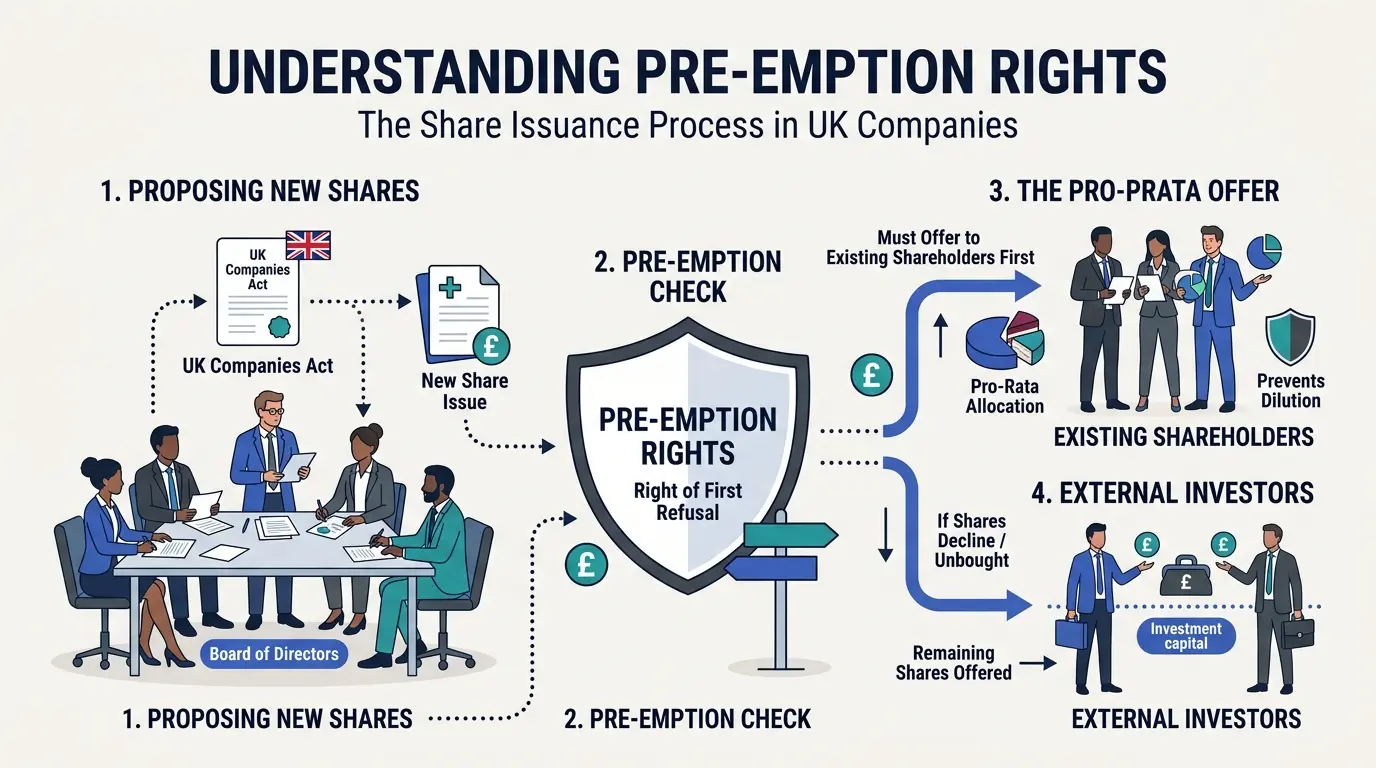
Pre-emption rights protect existing shareholders from unintended equity dilution. When a company issues new equity, statutory provisions require directors to make a formal offer to current members first. The offer must remain open for a minimum statutory period of 14 days. Existing shareholders possess the right to purchase new shares proportional to their current percentage ownership in the business.
Waiving statutory pre-emption rights demands strict adherence to formal corporate procedure. If a company plans to issue shares directly to third-party investors, shareholders must pass a special resolution under Section 570 or Section 571 of the Companies Act 2006. A special resolution requires a 75% majority vote to disapply pre-emption rights. You must cross-reference your articles to confirm whether higher voting thresholds or custom notice periods apply.
Disregarding pre-emption clauses creates severe legal consequences for company directors. Unauthorized equity allocations grant existing shareholders grounds to apply for court orders to reverse illegal allotments. Furthermore, directors face personal liability for breach of fiduciary duties under corporate law. Validating pre-emption provisions protects the business from costly shareholder disputes and ensures valid share allocations.
What Director Approvals Are Required Before Issuing Shares?
Directors must obtain explicit board resolution approval and verify statutory authorization limits under Section 551 of the Companies Act 2006 before issuing new shares.
Board meetings constitute the formal legal venue for approving share issuances. Directors must convene a board meeting to propose equity allotments, evaluate pre-emption compliance, and vote on allotment resolutions. Minute books must record board decisions, including share pricing, subscriber identities, and total equity volume. Directors must maintain precise corporate documentation to satisfy statutory audit standards.
Shareholder approval becomes mandatory when director authority limits expire or do not exist within the articles. If a private company operates with multiple share classes, directors must pass an ordinary resolution under Section 551. An ordinary resolution requires a simple majority above 50% to grant directors authority to issue shares. The resolution must specify the maximum nominal value of shares authorized and state an expiration date not exceeding 5 years.
Corporate governance protocols require formal documentation for every stage of the allotment process. Directors must execute share application forms, issue share certificates, and update the register of members within 2 months of allotment. Managing corporate governance records becomes simpler when utilizing professional supplementary company documents to maintain statutory registers, board minutes, and official share certificates. Accurately documented board approvals ensure complete transparency for regulatory authorities.
How Do You Amend Articles If They Restrict Share Issuance?
Amending articles of association requires passing a special resolution passed by a 75% shareholder majority and filing the updated articles with Companies House within 15 days.
Constitutional restrictions often hinder business growth by limiting equity creation or restricting investor entry. When existing articles contain restrictive clauses, shareholders must formally modify the constitutional framework. The board of directors drafts the proposed alterations to remove cap limits or adjust pre-emption rules. Directors then circulate a formal notice of a general meeting or present a written resolution to all voting members.
Passing a special resolution represents the statutory requirement for amending company articles under Section 21 of the Companies Act 2006. Shareholders holding at least 75% of total voting rights must vote in favor of the proposed amendments. The resolution text must state the exact wording changes made to the articles of association. Written resolutions require signature confirmation from the required majority within 28 days of circulation.
Filing requirements enforce regulatory compliance following constitutional changes. Companies must file a copy of the special resolution alongside the full amended text of the articles with Companies House within 15 days of approval. Failure to file updated articles within the statutory timeframe incurs financial penalties and invalidates public records. Companies House updates the public register to ensure corporate transparency across all operations.
What Filings and Documentation Are Required After Share Issuance?
After issuing shares, companies must submit Form SH01 to Companies House within 1 month, update the register of members, and issue share certificates to new shareholders within 2 months.
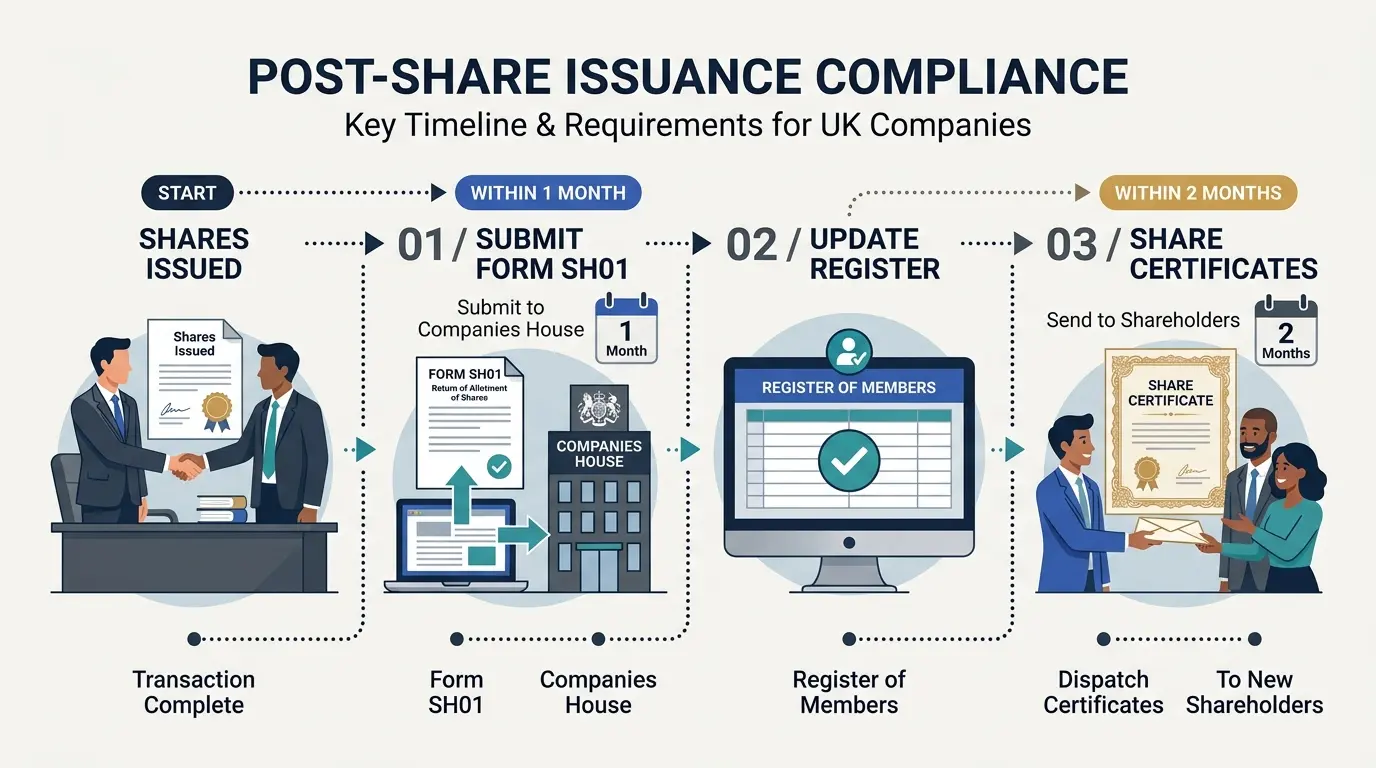
Form SH01 represents the official return of allotment required under Section 555 of the Companies Act 2006. Directors must complete Form SH01 detailing the total number of shares allotted, nominal value, currency, and total consideration paid. The form must also include a statement of capital detailing total voting rights, prescribed particulars, and aggregate paid-up value. Form SH01 must reach Companies House within 1 month of the allotment date.
Updating the company register of members serves as the legal mechanism that confirms shareholder ownership. Section 112 of the Companies Act 2006 states that a person becomes a company member only when their name enters the register of members. Directors must record shareholder full names, addresses, class of shares held, allotment date, and total capital paid. Failing to maintain accurate registers constitutes a statutory offence by company officers.
Issuing share certificates fulfills statutory obligations under Section 769 of the Companies Act 2006. Companies must prepare and deliver share certificates to subscribers within 2 months of share allocation. Share certificates must display the company seal or official director signatures, share class, certificate number, and total shares held. Companies can easily get a bound Memorandum & Articles copy from Form My Company to maintain organized physical records alongside updated share documentation. Complete legal documentation protects corporate validity during future investment rounds.
Explore More Supplementary Company Documents Guide,
What to Do if Companies House Won’t Confirm Your Good Standing Status
Get Help Qualifying for Good Standing and Order From Form My Company
Frequently Asked Questions
What supplementary company documents do UK limited companies need?
UK limited companies require statutory registers, share certificates, board minutes, and official corporate resolutions to maintain statutory compliance under the Companies Act 2006. Form My Company provides professional Supplementary Company Documents to ensure corporate governance records, registers of members, and constitutional documentation remain accurate and audit-ready.
How do I order extra share certificates or bound articles of association?
You can order printed share certificates, hard-copy registers, and bound copies of your Memorandum and Articles of Association directly through official company secretarial services. Form My Company offers Supplementary Company Documents tailored to your business, allowing directors to easily replace lost records or issue updated documentation following corporate restructuring.
Why are statutory company registers required for a business?
Under UK law, private limited companies must maintain accurate statutory registers, including the register of members, directors, officers, and persons with significant control (PSC). Using official Supplementary Company Documents from Form My Company ensures your company registers remain legally valid, fully compliant with Companies House standards, and easily accessible during legal or financial audits.
When should a company update its official supplementary records?
A business must update its statutory documentation immediately after issuing new shares, changing directors, transferring equity, or amending the articles of association. Form My Company provides Supplementary Company Documents to simplify updating board minutes, resolutions, and share records within statutory deadlines set by corporate law.
What is included in a complete supplementary company documentation package?
A complete company document package typically includes bound Memorandum and Articles of Association, share certificates, minute books, and statutory registers for members, directors, and PSCs. Form My Company delivers comprehensive Supplementary Company Documents that provide full legal clarity, protect shareholder interests, and establish clear corporate governance.